Taking pictures of eclipses is no easy task. Chip Somedevilla, a photographer at Getty Images, spoke to FOX Weather Meteorologist Bayne Froney about the art of taking photos of one of the coolest phenomenas in space.
THE TAKEAWAY
- A partial lunar eclipse will occur from Aug. 27 to 28.
- Around 3.3 billion people will be able to experience the event.
- The moon will turn a coppery color during the earlier phase.
Yet another celestial event will dazzle the sky this week as a partial lunar eclipse becomes visible across much of North and South America.
Starting on the night of Aug. 27 and continuing into Aug. 28 for some locations, the full moon will slip through Earth’s shadow, creating a partial lunar eclipse.
NATIONAL PARK WEEK KICKS OFF AS NATIONAL PARK SERVICE PREPARES TO CELEBRATE 110 YEARS
“At maximum eclipse, about 93% of the moon’s diameter will be inside Earth’s dark central shadow, called the umbra,” NASA said. “The moon will not be completely covered, but it can look dramatically darkened, with a rusty, coppery tint along the covered edge.”
Partial Lunar Eclipse phases.
(Ernie Wright / NASA’s Scientific VIsualization Studio)
This shadow gets smaller as it goes away from the sun, and it is the dark center of the eclipse shadow.
After the eclipse begins and for less than an hour following the partial phase, the penumbra will have a subtle effect on the moon, turning it copper.
Expected cloud coverage across the U.S.
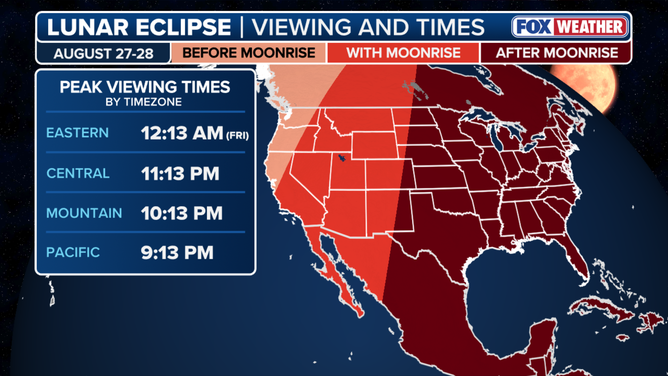
During the peak of the eclipse on Aug. 28 at 4:13 a.m. UTC, 96.3% of the moon’s disk will be within Earth’s Umbra, the central part of the shadow where our planet completely blocks the sun.
The eclipse will begin after the moon rises.
AUGUST SKYWATCHING GUIDE: FROM A PLANETARY PARADE AND ECLIPSES TO A METEOR SHOWER
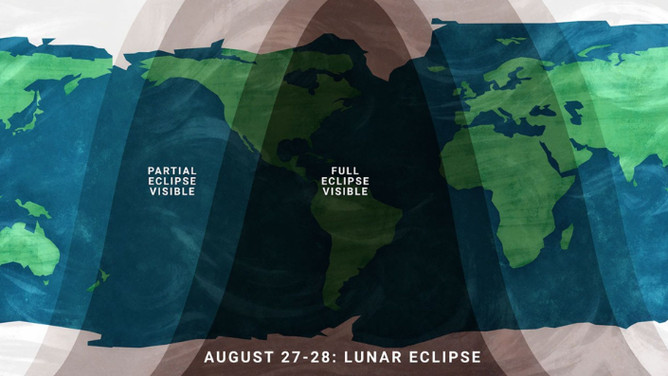
Viewing areas for the August 2026 lunar eclipse.
(NASA/JPL-Caltech)
This exciting part of the eclipse will be visible for around 3.3 billion people across North and South America (except Alaska and Northwestern Canada), western Europe and western Africa. That is about 44% of the world population.
SOLAR VS. LUNAR: WHICH ECLIPSE GIVES YOU THE BEST CHANCE OF SEEING IT?
Thankfully, a lunar eclipse is much easier to view than a solar eclipse because we are viewing reflected sunlight bouncing off the moon, so you don’t need safety glasses or viewing tools.
Use a telescope or binoculars for the best possible view of this stunning celestial event as summer comes to a close.