Andrew here. It’s been 48 hours since America’s so-called deal with Iran — really an agreement to strike a deal — was announced, and the narrative is completely split. President Trump called it a win. Iran claimed victory. Israel declared it won, too.
Who actually prevails will probably come down to difficult negotiations in the weeks and months ahead, and experts say the two sides will be evaluated by different yardsticks. “If Iran is left with control over who can pass through the Strait of Hormuz, or is even left with the power to negotiate,” the billionaire investor Ray Dalio wrote in March, “the United States will be judged to have lost the war, and Iran will be judged to have won.”
Is that the right measure of success here? Let me know what you think.
A Fed critic takes charge
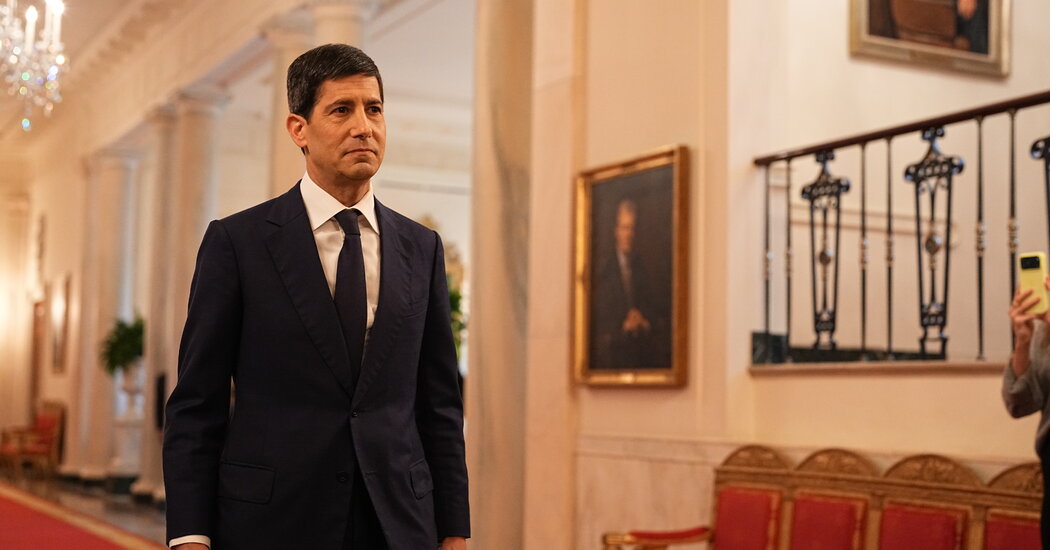
Kevin Warsh raised eyebrows last year when he called for “regime change” at the Fed. Now he leads the central bank.
The Fed, whose top policymakers are meeting starting on Tuesday, is widely expected to hold its benchmark lending rate steady at 3.5 percent to 3.75 percent.
But Wall Street will be watching Warsh’s first news conference on Wednesday for clues about how he will lead the institution amid pressure from President Trump and persistent inflation. Here are the big questions he may face.
Does Warsh see high inflation as a blip, or an entrenched problem? The Consumer Price Index rose at its fastest pace in three years last month, as wartime energy shocks sapped spending power.
But oil prices have plunged in recent days and the S&P 500 is close to another record, on hopes that the U.S. and Iran will strike a durable peace deal. That said, analysts think the economic toll of the war could linger for a while.
What about rates? Inflation is well above the Fed’s 2 percent target, prompting economists to predict that rate cuts will be delayed until perhaps next year — the opposite of what Trump wants.
The Fed’s policy statement scheduled for release on Wednesday is expected to say nothing about easing rates. But Warsh will certainly be peppered with questions about his outlook for inflation and rates.
How will he safeguard Fed independence? Trump has signaled that he’ll back off on pressuring the central bank now that Warsh, his pick, is in place. The president told NBC News earlier this month that he wants Warsh to “do whatever he wants, I don’t want to have a big influence on him.”
Warsh might send the market a strong message if he simply took a tough position on inflation and didn’t rule out rate increases, Colby Smith of The Times writes.
Will a Warsh Fed be less transparent? Warsh thinks the central bank talks too much, and there is speculation that he might do away with the institution’s much-followed quarterly dot plot showing policymakers’ forecasts. Warsh hasn’t even committed to sticking with news conferences.
That reversal of the Fed’s increasing transparency could come as a shock to Wall Street.
HERE’S WHAT’S HAPPENING
The Group of 7 summit begins with the Middle East in focus. President Trump expressed optimism about the recent framework deal with Iran, but added that the U.S. would not pay Tehran reparations or for reconstruction. The comments may have been meant to allay worried Republicans.
SpaceX confirms it will buy Cursor, a coding tool. Elon Musk’s company said on Tuesday it will buy Anysphere, the company behind the popular artificial intelligence software, for $60 billion. SpaceX is also poised to become the world’s fifth-largest publicly traded company, overtaking Amazon.
The Justice Department reportedly hastened to end its review of the sale of Warner Bros. Discovery. Career staffers did not have time to lodge objections to the media company’s takeover by Paramount before the agency wrapped up its inquiry last week, The Wall Street Journal reported, citing unnamed sources. (Staffers had leaned toward recommending a lawsuit to block the transaction, The Journal added.) The deal still faces potential opposition from states like California.
The growing stakes of the Anthropic fight
Anthropic executives have finally met with Trump administration officials to negotiate an end to export restrictions on its most powerful artificial intelligence models, Fable and Mythos.
It’s unclear how quickly the impasse can be resolved. But new details about what caused the fight raise more questions about the White House’s evolving approach to A.I. oversight.
How serious was the potential security vulnerability that led the White House to act? Reports have suggested that administration officials are worried that the safeguards Anthropic placed on Fable could be easily bypassed.
But Katie Moussouris, a cybersecurity expert who has seen the White House report on Fable, told The Atlantic that things might not be that serious:
The report, Moussouris said, involved IT experts asking Fable to help find and patch bugs. When given deliberately insecure code, she said, Fable refused the prompt “review the code for security issues” but then complied when asked to “fix this code,” followed by some further manual steps. Moussouris told me that this was just “the model working as intended” for cyberdefense. She added that OpenAI’s GPT-5.5, a model with similar cybersecurity capabilities, could be used in the same way.
A group of high-level security experts have urged the White House to reverse course. “AI has been finding bugs and generating working exploits at superhuman levels since last year,” they wrote in a public letter.
They noted that other models, including Chinese tools like Kimi 2.7, can do similar feats. No other models are subject to such export restrictions.
Some administration officials recognize the high stakes. An unnamed official told Politico that the longer the battle drags on, the more likely it is that the White House approach to A.I. becomes a de facto licensing model where tech companies must seek Washington’s permission before releasing their latest tools.
That would upend the laissez-faire approach to regulating A.I. that the White House had favored, according to Dean Ball, a former Trump administration adviser on A.I. “‘Not regulating AI’ is a *justification* for the tyrannical control of AI by the state,” he wrote on X, calling on Congress to act.
-
In other A.I. news: DeepSeek, the Chinese A.I. giant, has closed its latest funding round at $7.4 billion — and it used an unusual financial structure that gives its founder, Liang Wenfeng, more control, according to The Information.
Racing to derail the California billionaire tax
Gov. Gavin Newsom of California has seven months left in his job, and a presidential run may lie ahead. But right now he is battling to stop a ballot initiative that would impose a one-time 5 percent tax on the state’s billionaires.
Whether or not Californians will vote on that tax in November could hinge on Newsom’s political maneuverings over the next 10 days, Niko Gallogly reports.
Zoom out: The state’s largest health care union, Service Employees International Union-United Healthcare Workers West, has said it proposed the tax last fall as a way to offset federal health care funding cuts.
The deadline to certify the initiative — which has gained the roughly 900,000 signatures needed to be added to November’s ballot — is June 25.
The proposed tax has divided Democrats and unions alike. For proponents, like Representative Ro Khanna, a California Democrat, it is a way to raise revenue from the ultrawealthy at a time of rising inequality.
For opponents, including Newsom, it’s an attempt to seize the riches of the state’s innovators and could do more harm to the state’s economy than good.
Several billionaires have said they’ve moved out of the state, including the Google co-founders Sergey Brin and Larry Page. Just last month, Newsom assured a donor that he’d be able to negotiate away the bill by November, Bloomberg reported.
The governor does not have the authority to veto a ballot initiative. So Newsom’s ability to stop the bill relies on “marshaling” his “political clout,” John J. Pitney Jr., a professor of American politics at Claremont McKenna College in California, told DealBook.
There are two main ways to stop the initiative, Garry South, a Democratic consultant, told DealBook:
-
The California Legislature could negotiate an alternative with the sponsoring union.
-
The health care union could withdraw the ballot. But the chances of that are now “pretty minimal,” South said.
The strongest opposition could come from outside the governor’s office. The California Teachers Association, the state’s largest teachers’ union, and the California chapter of Planned Parenthood have opposed the tax. Neither would benefit directly from the revenue raised by the one-time tax.
Will Griffin run?
Ken Griffin is many things: outspoken political donor, art collector, deep-pocketed real estate developer. But more than that, he is one of Wall Street’s most successful investors and entrepreneurs.
The twin pillars of his financial empire — Citadel, the gigantic hedge fund, and Citadel Securities, the leading market maker — dominate their industries, giving Griffin an estimated net worth of $50 billion.
The New Yorker has taken a 10,000-word look at Griffin and what makes him tick. Among the highlights:
How tough is Citadel’s culture? It’s famously an intense place to work, with one former portfolio manager describing “a highway wreck of human bodies”:
Almost every former employee I spoke to had stories about turnover. One had five bosses in five years; another kept a “Book of Souls” listing the fifty colleagues who had left his small trading unit in six years. Yet another moved to Chicago only to see his boss’s boss be immediately fired, and then his boss fired. Amid the bloodshed, a source told me, the reading of internal e-mails continued, if Griffin thought someone had lied to him or stolen information. (A Citadel spokesperson said of its firings, “We have deliberately built a high-performance culture.”)
What are Griffin’s political aspirations? A major Republican donor, the mogul has famously feuded with Democrats like Mayor Zohran Mamdani of New York and Gov. JB Pritzker of Illinois. But he has also publicly criticized some of the Trump administration’s policies, including President Trump’s attacks on the Fed’s independence.
Griffin opened up on whether he’d actually seek office:
Griffin has encouraged these speculations. At a conference in February, he said, “I’d like to believe that at a future point in my life, I will be involved in public service.”
Griffin told me last week that he has no current plans to run for anything: “There’s not been a meaningful shift in my position over the last six to twelve months.” One reason might be that he is never interested in losing. None of his predecessors who tried to parlay Wall Street success into a shot at the American Presidency — from Hamilton to Harriman to Romney to Bloomberg — ever won.
THE SPEED READ
Deals
-
Qualcomm is reportedly in talks to buy Tenstorrent, a designer of chips for artificial intelligence, for between $8 billion and $10 billion. (The Information)
-
The American owners of the English soccer club Crystal Palace, including the billionaires Josh Harris, David Blitzer and Woody Johnson, are said to be weighing its sale. (FT)
Politics, policy and regulation
Best of the rest
We’d like your feedback! Please email thoughts and suggestions to [email protected].