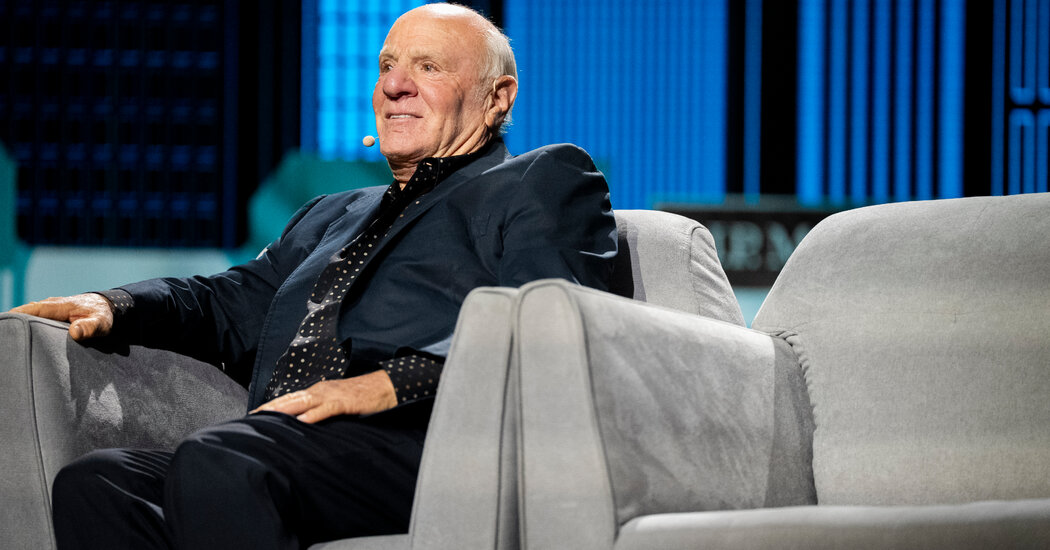
Andrew here. We’ve got a scoop: Barry Diller is working on a bid to buy MGM Resorts, the casino giant.
Also, Niko Gallogly goes behind the scenes of a law firm giant’s investment in its own A.I. systems and what it means for partners and associates. And Vivienne Walt reports for DealBook on Tehran’s threats to damage or seize control of data cables under the Strait or Hormuz.
An $18 billion takeover bid for MGM Resorts
Update: People Inc. offered on Monday to buy control of MGM Resorts at an $18 billion valuation, including the assumption of its debt.
Barry Diller’s business empire, People Inc., is preparing an offer to buy MGM Resorts, the casino giant, that values it at more than $18 billion, DealBook has learned.
The proposal is still being finalized and could be delayed or scrapped, but the move would be Diller’s latest strategic pivot after overhauling the company once known as IAC.
What Diller plans to offer: People Inc. is planning to bid $48.30 a share in cash for the 73.9 percent of MGM Resorts that it doesn’t already own.
That’s a nearly 10.6 percent premium over MGM Resorts’ closing price on Friday and 30 percent higher than its volume-weighted average price over the past 90 days.
MGM Resorts already figures large at People Inc. Beyond the existing 26.1 percent stake, Diller’s company holds two board seats, one of which Diller himself occupies.
That holding is now one of People Inc.’s major businesses, along with a big digital publishing arm anchored by the magazine the company is named after. (Over the past year, IAC shed other divisions, including the home services platform Angi and Care.com.)
It’s unclear whether a bid by People Inc. for MGM Resorts would put the casino operator in play, drawing in other suitors. But its existing stake could serve as a substantial blocking position against rivals.
Why Diller is betting on MGM Resorts: In a letter to People Inc.’s shareholders in April, Diller described the casino operator this way:
MGM Resorts is an extraordinary operation powered by a compelling mix of iconic resort destinations, scalable digital platforms, premium brands, an expanding global presence, and, under its C.E.O. Bill Hornbuckle, an outstanding management team. MGM owns 40 percent of the Las Vegas Strip — an entertainment nucleus that simply cannot be replicated anywhere in the world.
Combined with People Inc.’s digital media businesses, Diller wrote, MGM Resorts’ “very hard assets” represents a “perfect hedge in a world that is changing so unpredictively fast.”
Shares in MGM Resorts have climbed over 19 percent over the year so far as analysts have said the company could benefit from a comeback by Las Vegas.
Diller has been enamored of MGM for years, first building a stake during the pandemic lockdowns of 2020. He has long been focused on travel and leisure: The mogul famously bought Expedia just after Sept. 11 and spun it off in 2005, and the company became one of his most successful investments.
Yet MGM Resorts faces new challenges. Its BetMGM digital business is growing profitably amid competition from the online betting sites DraftKings and FanDuel. But the sector is also competing for bettors with the increasingly popular prediction market sites Kalshi and Polymarket.
HERE’S WHAT’S HAPPENING
Nvidia moves into personal computing and robots. The dominant maker of chips for artificial intelligence unveiled a new chip, called the RTX Spark, for laptop and desktop computers that run A.I. systems locally rather than via the cloud.
Berkshire Hathaway makes its first big purchase of the post-Buffett era. The conglomerate agreed to buy Taylor Morrison, an Arizona-based home builder, for $6.8 billion in cash. Shares in Berkshire have dropped about 4.5 percent this year as investors have questioned whether Greg Abel, who took over as C.E.O. this year, possessed the deal savvy of his predecessor, Warren Buffett.
SoftBank becomes Japan’s biggest company. The technology conglomerate surpassed Toyota as the country’s largest business by market capitalization amid investor enthusiasm for its A.I. bets like OpenAI. SoftBank’s latest foray into the sector: a planned €75 billion ($87.4 billion) investment in a network of artificial intelligence computing facilities in France.
The White House is said to have helped steer millions to a company tied to Donald Trump Jr. ProPublica reports, citing unnamed sources, that the presidential adviser Peter Navarro requested that the Defense Department lend $620 million to Vulcan Elements, a North Carolina rare-earth magnet start-up, about three months after 1789 Capital, a venture capital firm where the president’s son is a partner, invested in it. The Pentagon denied that the company had received preferential treatment.
Iran’s threat to undersea data cables
Peace talks with Iran have stalled as the U.S. and Iran negotiate over nuclear enrichment, frozen assets and missile supplies for Tehran. Meanwhile, American warships are quietly guiding commercial vessels through the Strait of Hormuz.
But executives are worried about a less public danger: Tehran’s threats to damage or seize control of data cables under the strait, Vivienne Walt reports.
Tech giants are conducting “intensive back-channel engagement” to protect their crucial subsea networks, according to Sean Evins, head of artificial intelligence advisory for the communications firm Kekst CNC and a former global affairs director for Meta.
The latest: In early May, an Iranian military spokesman said the country was threatening to demand license fees from Amazon, Google, Microsoft and Meta to use the cable networks they operate under the strait. There was a suggestion that the cables could be cut or tampered with, with a semiofficial news agency calling the networks a “vulnerable point in the region’s digital economy.”
It estimated that the cables carry about $10 trillion a day in financial transactions.
Underwater risk: The cables connect the Gulf region to parts of Europe, Asia and Africa, part of a vast subsea infrastructure that carries about 99 percent of global internet traffic, according to the International Telecommunication Union, a U.N. agency.
The group estimates there are about 200 cable cuts worldwide every year, mostly from seaquakes or dragging anchors.
The Iranian military is still dangerous. Despite suffering heavy damage to its navy, Iran still has the combat divers, unmanned underwater vessels, and munitions needed to shut down cable traffic, according to an April report by Al Habtoor Research Center, a research center affiliated with an Emirati billionaire.
“It wasn’t at the top of anyone’s mind,” Erin Murphy, a former C.I.A. analyst and the managing director for Asia at Redpoint Advisors, a global intelligence firm in Washington, told DealBook. “Now people are going, ‘Shoot, we’ve got to think about this.’”
It’s easier to damage cables than to fix them. A 2024 cable cut in the nearby Red Sea, during attacks on commercial vessels by Houthi rebels in Yemen, shut 25 percent of internet traffic across the region and took weeks to restore.
As for the repair work: Only four companies specialize in laying undersea cables, while there are roughly just 20 repair ships, many of which would need weeks to arrive in the Middle East — if they can go at all.
Behind Kirkland’s big A.I. bet
A plunge in enterprise software stocks this year — the so-called SaaSpocalypse — was driven by fears that companies would increasingly use artificial intelligence tools to build software instead of buying it.
The news last week that the giant law firm Kirkland & Ellis planned to spend $500 million to build its own A.I. platform underscores another concern for corporations weighing whether to build or buy software: More businesses are looking to build their own tools so they can protect their intellectual property and maintain a competitive edge, Niko Gallogly reports.
A.I. upstarts have put pressure on the legal industry, which largely charges clients on an hourly basis, including for tasks that A.I. threatens to automate. A.I.-native law firms, including Norm Law, Crosby and General Legal, charge far less for work like contract reviews and have been hiring lawyers away from traditional firms.
And start-ups like Harvey and Legora have attained multibillion-dollar valuations selling legal A.I. software.
Kirkland has high ambitions for its software. The firm is building more than a chatbot, a spokesperson told DealBook: Employees will do most of their work on the platform, rather than using it for specific tasks.
About 180 developers inside and outside the firm are creating the system, which will be built on top of existing A.I. models. An early version will be rolled out in the next few weeks.
Behind Kirkland’s bet: The law firm, the world’s highest-grossing, most likely wants to “own the technology” rather than depend on third-party providers, Zoë Egelman, a founder of the start-up law firm Elego, told DealBook.
Kirkland will probably use its decades of internal data — “every M&A deal, every capital-markets transaction, every case, every complex commercial contract,” Egelman said — to create a system fine-tuned on highly proprietary information. That could reassure clients who are anxious that their confidential data could be shared with a third party.
A downside, of course, is cost. Kirkland, which reported a record $10.6 billion in revenue last year, is one of few firms that can afford to design and operate such a system.
The big question: Will A.I. let the richest firms pull further ahead of less-profitable rivals?
How Epstein derailed the Gates P.R. machine
The Justice Department’s release of files related to Jeffrey Epstein led to the resignations of prominent names in business, entertainment and academia.
Revelations from those documents also derailed an effort by the staff of Bill Gates, the Microsoft co-founder and philanthropist, to burnish his reputation as a global philanthropist, The Wall Street Journal reports.
The release of files associated with Epstein, the convicted sex offender, revealed extramarital affairs by Gates and a much closer relationship with Epstein than Gates had admitted to.
That led to the shunning of Gates from high-profile events, The Journal reports.
In February, Gates was scheduled to speak at an artificial intelligence conference in India attended by heads of state and major tech C.E.O.s. Then this happened:
Gates was stationed at the Oberoi, a hotel in New Delhi, known for its symmetrical staircase and a “Tree of Life” sculpture in its lobby. He waited to receive word if he should attend a dinner with Indian Prime Minister Narendra Modi, French President Emmanuel Macron and business leaders, government officials said. Those who attended were part of the A.I. summit.
Gates did not end up attending the dinner. [Archna Vyas, the Gates Foundation’s India lead] later received word from the Indian government that it would be better if Gates wasn’t part of the summit since the heightened Epstein news would take away from the A.I. focus.
The Epstein files also strained Gates’s relationship with his longtime friend Warren Buffett. From The Journal:
In early May, Gates didn’t attend the annual meeting of Berkshire Hathaway, the company Buffett led for decades where Gates had been a board member until 2020. While he wasn’t barred from attending, some people advised Gates not to go. It was the first time he didn’t attend in many years.
-
In other Epstein-related news: Jes Staley, who resigned as C.E.O. of the British lender Barclays amid an investigation into his ties with Epstein, has agreed to testify before Congress about that relationship.
THE SPEED READ
Deals
-
Yum Brands is said to be in talks to sell the Pizza Hut chain to the investment firm LongRange Capital. (Bloomberg)
-
Shares in easyJet, the European airline, are up more than 9 percent after the U.S. investment firm Castlelake said it might make a takeover bid worth more than $4 billion. (WSJ)
Politics, policy and regulation
Best of the rest
We’d like your feedback! Please email thoughts and suggestions to [email protected].