Wine lovers could be forced to say goodbye to some of the world’s finest Pinot Noir as climate change brings more frequent droughts, scientists warn.
Researchers have pinpointed a potential tipping point at which the popular red wine grape begins to struggle under severe water stress.
This could spell particularly bad news for growers in some of the world’s most famous wine regions such as France, Spain and Italy, they warned.
Pinot Noir – known for its prominent notes of cherries and red berries – is notoriously sensitive to its growing conditions, which help give the wine its distinctive character.
Now, scientists have found that the grape’s delicate chemistry can begin to change dramatically when vines are pushed too far by a lack of water.
It comes as an intense drought grips large parts of the world, as prolonged periods of heat and scarce rainfall put increasing pressure on water supplies and agriculture.
Europe is currently particularly badly affected, with major rivers including the Danube, Rhine and Po at exceptionally low levels.
‘Our results suggest that above a certain severity of water deficit, ‘Pinot Noir’ wines would exhibit more contrasted or unknown properties because of a sudden switching-off of metabolic pathways during ripening,’ the team, from the University of Burgundy, said.
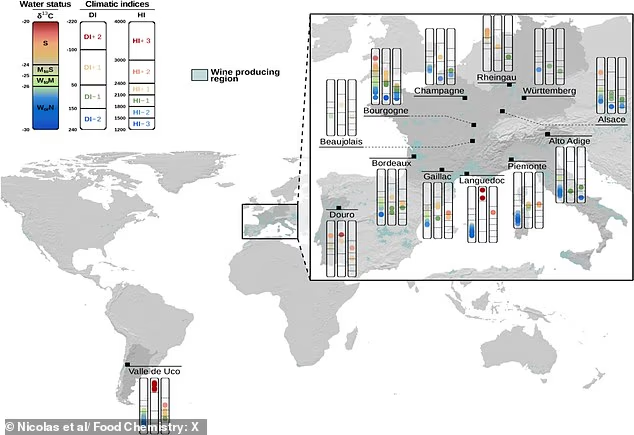
Scientists studied Pinot Noir and Chardonnay grapes grown in 80 vineyards spanning 13 wine-producing regions across France, Italy, Germany, Portugal and Argentina

The findings could spell particularly bad news for growers in some of the world’s most famous wine regions such as France, Spain and Italy. Pictured: A view of a dry vineyard in Catalonia’s famous Penedes wine region during widespread drought in 2024
For the study, published in the journal Food Chemistry: X, the team studied Pinot Noir and Chardonnay grapes grown in 80 vineyards spanning 13 wine-producing regions across France, Italy, Germany, Portugal and Argentina.
They analysed grapes harvested over three consecutive years, from 2019 to 2021, and examined hundreds of compounds that contribute to the grapes’ characteristics.
The researchers found that both varieties were capable of coping with a surprisingly wide range of water shortages.
But there was a crucial difference between the two.
Chardonnay appeared to adapt more consistently as water became scarcer, with its chemical response changing in a relatively steady way.
Pinot Noir, on the other hand, appeared to reach a tipping point when the vines were subjected to severe water stress.
Beyond this point, some of the molecules linked to the grape’s distinctive characteristics began to decline rather than continue responding to the drought.
These changes could ultimately affect the sensory qualities of wines made from the grapes, the researchers warn.

The team used ultra-high resolution mass spectrometry to closely analyse the juices produced by the grapes
The findings are particularly concerning as climate change is expected to make hotter and drier conditions increasingly common in many traditional wine-growing regions.
While a little drought can sometimes improve a red wine vintage, too much water stress can leave vines producing fewer, smaller berries and struggling to ripen their fruit properly.
For wine producers, simply swapping Pinot Noir for a more drought-tolerant grape is not necessarily an easy solution.
That is because famous wine regions such as Burgundy have built their reputations around particular grape varieties and the unique flavours they produce.
The researchers say changing varieties could therefore be a risky last resort for premium wine regions with strict rules governing which grapes can be grown.
‘While many possibilities have been explored to adapt wine production to climate change, changing cultivars is indeed a risky choice for premium wine regions whose wine characteristics and reputations strongly rely on a single or a few varieties,’ they concluded.