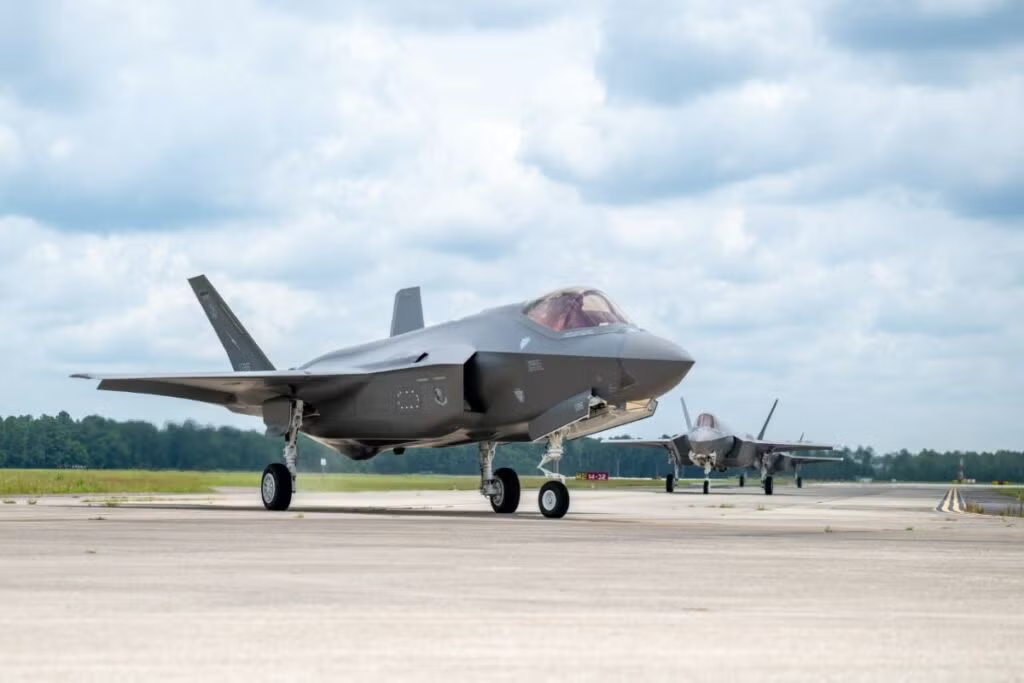
Pictured is a U.S. Air Force photo of F-35A fighters at Jacksonville Air National Guard Base, Fla. on July 9, 2025.
At least 15 F-35s built in the last year have lacked required equipment, according to a Defense Contract Management Agency (DCMA) list sent to sister publication Defense Daily after a Freedom of Information Act (FOIA) request.
On Feb. 7, Defense Daily requested from DCMA a list of all Department of Defense Form DD-250s–Material Inspection and Receiving Reports–filed with the agency since May 2025, for all Lockheed Martin F-35 fighters delivered to the U.S. Air Force, U.S. Navy, and U.S. Marine Corps between May 1, 2025, and Feb. 6, 2026.
When a military service accepts a system but does not mark it as delivered because of material shortfalls, that system is “DD-250ed” and is in a not operationally ready-supply (NORS) status until the gaps are filled. The signing of the “receipt”–the DD-250–marks a transfer in ownership from the contractor to the federal government.
Nine “DD-250ed” F-35s are on the list provided by DCMA on July 13 in response to the FOIA request–one Marine F-35B to be delivered/ferried to VMFA-533 at Marine Corps Air Station Beaufort, S.C., three Navy F-35Cs to be delivered/ferried to VFA-125, a fleet replacement squadron at Naval Air Station Lemoore, Calif., one F-35A to be delivered/ferried to the 325th Fighter Wing, a training wing at Tyndall AFB, Fla., and four F-35As to be delivered/ferried to the 125th Fighter Wing, an Air National Guard domestic air defense wing.
Asked why each of the above nine aircraft were “DD-250ed,” the F-35 Joint Program Office (JPO) wrote in a July 14 email that “we cannot detail the specific equipment shortfalls, resolution timelines, or variant mix of these aircraft.”
“Due to program security reasons, we are protecting any additional information with enhanced security measures,” according to the JPO.
In addition to the above nine aircraft, six Marine Corps F-35s are in NORS status as “DD-250ed.”
Marine Lt. Gen. Gregory Masiello, the director of the F-35 Joint Program Office (JPO), testified last month that “we have accepted six aircraft for the Marine Corps that do not have a radar installed” because the Marine Corps is awaiting the installation of the Northrop Grumman [NOC] APG-85 radar, which the Pentagon expects to field in the first half of 2028.
The APG-85 is critical to the 55 upgrades in the Block 4 program–22 of which have fielded so far, including seven last year, and six on target for this year, according to Masiello. For full functionality, the APG-85 and Block 4 require 62 kilowatts to 80 kilowatts (kW) of cooling versus the 32 kW on the plane now.
The current mission capable rate of the F-35 is 56 percent, and the full mission capable rate is 25 percent.
Radar mountings in the F-35’s nose are different for the current APG-81, also by Northrop Grumman, and the APG-85–a difference which has helped complicate fielding of the new radar that was to deliver with F-35 Lot 17.
The Air Force has been considering an APG-81/APG-85 dual-mount bulkhead, though the latter may take two years to field.
The service’s fiscal 2027 future years defense plan (FYDP) contains $133 million in fiscal 2031 for retrofitting 14 F-35As with APG-85s–a unit cost of $9.5 million per radar, and outside the FYDP the service said it plans to spend about $1.6 billion to retrofit another 167 jets with the APG-85.
The first signed DD-250 for an F-35 in Lot 17 was on July 8, 2025, for an F-35A delivered/ferried the next day to the 125th Fighter Wing in Jacksonville, according to the list provided by DCMA in response to the FOIA request.
Radar-less F-35s must fly with nose ballast to balance the fighter during flight. Temporarily radar-less fighters are not unprecedented. For example, in the late 1960s, McDonnell Douglas, now part of Boeing, put lead in the nose of the F-4J for the Navy/Marine Corps due to late deliveries of the fighter’s government furnished equipment radar by Westinghouse, now part of Northrop Grumman, and in the 1980s, the Panavia Tornado F2 interceptor had so-called “Blue Circle” concrete in the nose due to delays in the development of the fighter’s Foxhunter radar by GEC-Marconi, now part of BAE Systems.
British Aerospace, Germany’s MBB, and Aeritalia built the Panavia Tornado. Those companies are now part of BAE Systems, Airbus, and Leonardo, respectively.
A version of this story originally appeared in sister publication Defense Daily.