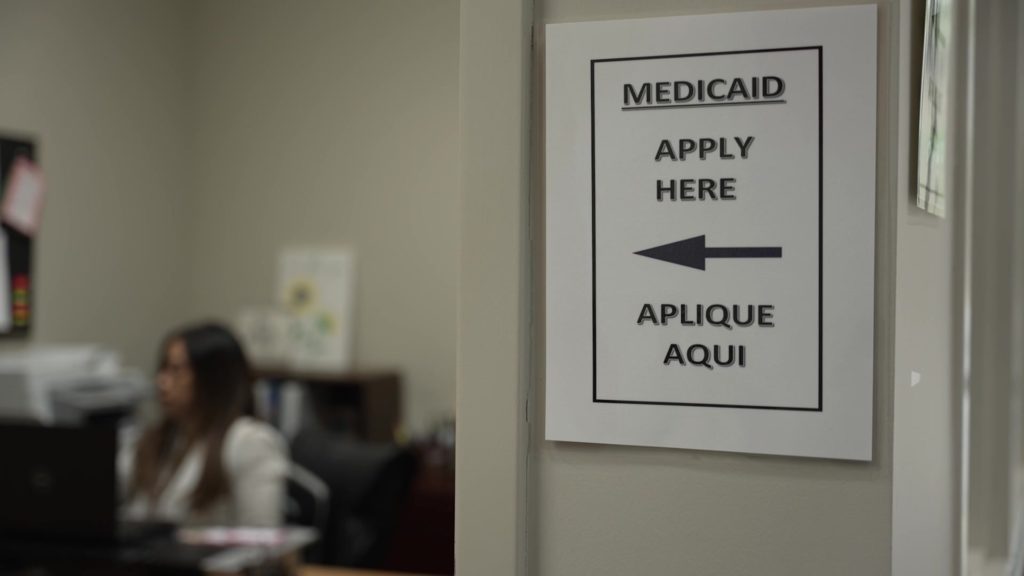
The Health Center Association of Nebraska usually enrolls about 15 people each month in Medicaid.
In May, after Nebraska became the first state to enact President Donald Trump’s stricter work requirements, the organization enrolled none.
WATCH: Who will be affected by Trump administration’s Medicaid, SNAP work requirements
That drop-off in new Medicaid enrollees is unheard of for the organization, said CEO Amy Behnke, whose nonprofit supports and advocates for the state’s community health centers. She believes people aren’t coming in because they assume, with these new work requirements, they’re not eligible for Medicaid or “they think it’s going to be too overwhelming or cumbersome to try to keep coverage.”
Trump’s big tax and funding bill, or “One Big Beautiful Bill Act,” signed into law last summer, established “community engagement requirements” for people with low incomes or disabilities who receive health insurance through Medicaid. The federally mandated requirements won’t affect all Medicaid recipients, but millions of enrollees in 43 states, including Washington, D.C., must now prove they’re working, volunteering or going to school for at least 80 hours a month or risk losing their benefits at the start of 2027. Nearly all of these states expanded Medicaid under the Affordable Care Act. Experts told PBS News they worry the new requirements could result in hundreds of thousands of otherwise eligible enrollees losing health coverage.
Nebraska enacted new requirements on May 1, eight months ahead of the Jan. 1, 2027, deadline. New applicants have to prove that they’re meeting the work requirements or qualify for an exception in the month immediately prior to enrollment, Behnke said.
The state said the change will not apply to Medicaid enrollees whose yearly renewal is in May or June of this year. The first group of re-enrollees affected will be those whose yearly renewal is set for the end of July.
The changes come as the administration says it’s targeting fraud and waste in federal health programs. After the Centers for Medicare & Medicaid Services issued new guidance in early June on how states ought to implement the work requirements, Dr. Mehmet Oz, head of CMS, said the stricter rules will restore a “perverted” Medicaid system.
“If you’re sitting at home, which is true for the millions of people who are able-bodied on Medicaid, on average you’re spending 6.1 hours watching television or just hanging around,” he said, appearing to cite an American Enterprise Institute analysis that may not accurately reflect how nonworking Medicaid recipients with disabilities spend their time, KFF found.
Watch the clip in the player above.
It’s too early to definitively say what effect the work requirements will have on Medicaid enrollment and spending, but tens of thousands lost coverage or were poised to when Arkansas and New Hampshire attempted similar requirements beginning in 2018, said Dr. Ben Sommers, a professor of healthcare economics at Harvard T. H. Chan School of Public Health who studied the work requirement programs.
Both Montana and Iowa will also implement the work requirements ahead of the federal deadline.
Ultimately, millions are likely to lose coverage as states begin complying with the new federal rules. The Congressional Budget Office estimates that the work requirements will save the federal government $326 billion over the next 10 years, while around 5 million people will lose coverage each year between 2029 and 2034.
How do the new requirements work?
Some 72,000 Nebraskans are enrolled in the state’s Medicaid expansion program.
There are a handful of ways enrollees can meet the new requirements in one month:
- Work at least 80 hours
- Complete at least 80 hours of community service
- Participate in a work program for at least 80 hours
- Enroll in school at least half-time
- Make at least $580, which is 80 hours of work at the federal minimum wage of $7.25
- For seasonal workers: have an average monthly income of at least $580 over the prior six months
Starting in 2027, Medicaid recipients will have to re-enroll every six months. States must check that enrollees are completing the work requirements at least once between re-enrolling periods, but can verify compliance more regularly.
Many people enrolled in Medicaid are exempt from the work requirements. That includes parents of children 13 and younger, veterans with disabilities, people participating in drug or alcohol use programs and pregnant people. One specific designation — “medically frail” — was further described by the federal government as having a medical condition that “significantly impairs” an applicant’s ability to meet the requirement.
If the state can’t verify that a person either meets the work requirements or qualifies for an exemption, it is required to inform the enrollee and tell them what’s needed to qualify, said Jennifer Tolbert, deputy director of KFF’s program on Medicaid and the uninsured. The enrollee then has 30 days to provide that information before they’re disenrolled.
In Nebraska, that means no one should be disenrolled for a few months, but Behnke said that’s not been the reality so far. In one case, an applicant went to renew coverage and was incorrectly disenrolled after reporting unemployment.
“That’s also a really good example when we say the rules and the processes on paper may not look overly burdensome, but when we come to the application of it, that’s where we start to really see the bumps in the road,” she said.
What challenges could states face as they implement the new rules?
States will use the resources available to them to first exclude people who won’t be subject to the work requirements, but the data sources each state can access will be highly variable, experts told PBS News. That could include accessing quarterly wage data or Social Security information to check on earnings, or using the National Student Clearinghouse to determine whether someone is in school.
The variation in how states choose to implement the new rules will likely affect how many people lose coverage, Tolbert and Sommers said.
States that are “very interested in trying to keep as many people on coverage as possible” are working to streamline and automate their processes for verifying exemption and work status, Tolbert said.
State legislatures may step in to make more — or less — restrictive decisions for state Medicaid agencies. But Tolbert cautioned against assuming that states’ efforts will fall along political lines.
“In some cases, it may also just simply have to do with systems and how far along states are,” she said.
Nebraska allows for nearly 300 reasons a Medicaid enrollee could be considered medically frail, Behnke said. But some aspects of the verification system make designating someone medically frail “more challenging,” she added.
When the state is reviewing claims data, they’ll only look at the primary diagnosis code, she said. That means if someone goes to the doctor for a cough, that visit might not include other previous diagnoses that would qualify someone for medical frailty, such as anxiety or diabetes.
Nebraska also looks back over the prior 12 months of claims, so people who haven’t seen the doctor in the past year may not have documentation of their medical frailty.
Behnke is still waiting for the state to clarify how the federal government’s new guidelines for medical frailty will work.
Lessons from previous attempts at work requirements
When Arkansas attempted in 2018 to implement work requirements, 18,000 people lost insurance between July and December due to non-compliance.
Before New Hampshire suspended its own attempt to enact work requirements a year later, the state deemed about one third of its Medicaid expansion population noncompliant, according to an Urban Institute report released in March 2025.
Sommers and his colleagues studied the fallout of Arkansas’ work requirements, which implemented new rules for Medicaid recipients aged 30 to 49. Of this group, 97% “were already meeting the community engagement requirement or should have been exempt before the policy took effect,” their study concluded.
“If you’re subjecting many people to a requirement to try to change the behavior of a very small number of people, it’s pretty easy to end up with the policy not working,” Sommers said.
Instead, there were coverage losses among people who should have maintained coverage, while employment didn’t meaningfully increase, he said.
That study, published in the New England Journal of Medicine in 2019, also found that about a third of the people who were subject to the work requirements had not heard anything about the policy. More than 44% were unsure whether the requirements applied to them.
In both Arkansas and New Hampshire, the states were able to keep about half to two thirds of their enrollees in Medicaid because the government knew they were exempt. But among the remainder — the people who actively had to provide documentation for working — between 72 to 82% were deemed “noncompliant” by the state in the first month of reporting, according to the Urban Institute report.
WATCH: How people with disabilities could bear the burden of Medicaid funding cuts
“What this tells you is there are a lot of people who are doing what they’re supposed to do under this law, but based on past experience, they’re going to have trouble navigating the system and are going to end up losing coverage,” he said.
In Nebraska, Behnke said her organization has heard that community partners are having difficulty accessing the state’s Department of Health and Human Service’s Spanish language line. Callers have either been routed to English services or been disconnected from the call, she said.
Sommers said states can inadvertently cause loss of coverage when the systems don’t communicate quickly or easily with each other. For instance, even if the state should know someone is pregnant, or is getting treatment for substance use disorder, these may not automatically appear as work requirement exemptions.
There are still “a whole host of reasons” that someone who’s meeting the requirement might not be able to navigate the system and could end up losing coverage, Sommers said.
“Imagine having to do your income taxes two to three times a year. Sure, it’s possible. But many people won’t be able to do it, or will struggle, or they won’t get the forms because they’re not sent to the right address if they moved,” he said.
In Nebraska, Behnke and her colleagues are concerned that people who are eligible for Medicaid aren’t getting the care they need or might lose existing coverage because of administrative problems, such as being asked to provide information they don’t have access to or not receiving letters because they’ve been misdelivered.
They’ve been conducting outreach and education to help get people ready for the changes, Behnke said. But it’s been a “heavy lift” for the state, healthcare providers and people on Medicaid.
After a silent May, HCAN is still waiting to help enroll its first post-work requirement Medicaid applicant.