Drone video from New Year’s Day shows lava spilling and cracking from a new fissure in Mount Etna. The volcano recently erupted over the Christmas holiday in December.
POMPEII, Italy – History lovers can rejoice over the recent announcement of the restoration of a fresco lost during the disastrous eruption of Mount Vesuvius in Pompeii, Italy.
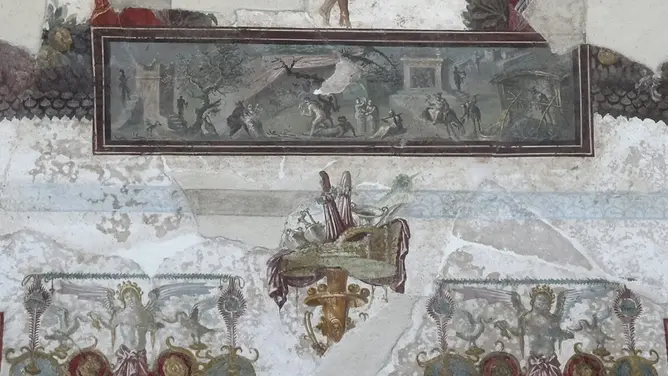
Officials at the Pompeii Archaeological Park have successfully restored the ceiling of a house in Pompeii, which features a large fresco depicting the Greek god of wine, Dionysus, and his relationship with Ariadne, a Cretan princess.
SEE IT: VILLA CONTAINING RUINS FROM ROMAN EMPIRE UNCOVERED IN EGYPT
Experts carefully restored the ceiling using fragments recovered during the archaeological investigation, allowing the restoration of over a quarter of the original, according to the Pompeii Archeological Park.
Through time, archeologists were able to piece together the fragments, noting clear connections.
Part of the restoration effort includes restoring the spatiality of the decorative apparatus, ensuring the conservation of fragments and also allowing for future additions to the masterpiece.
“The modular structure allows for the addition of new fragments without compromising the reconstruction already completed, transforming the restoration into an open and updatable process,” the Pompeii Archeological Park said.
Stunning image of the fresco on the ceiling of a home from 2,000 years ago.
( Pompeii Archaeological Park)
This is an important feature of the restoration process, as it can’t be considered complete until numerous ceiling fragments are preserved separately while searching for more.
By comparing other ancient art, experts helped the central scene survive, despite enduring unthinkable conditions during the iconic eruption of Mount Vesuvius in 79 AD.
UNDERWATER ROBOTS FIND RARE ARTIFACTS IN FRANCE’S DEEPEST SHIPWRECK, A 16TH CENTURY VESSEL
Astonishingly, something could survive amidst layers of lava, ash and rock, causing buildings to collapse and burying the dead.
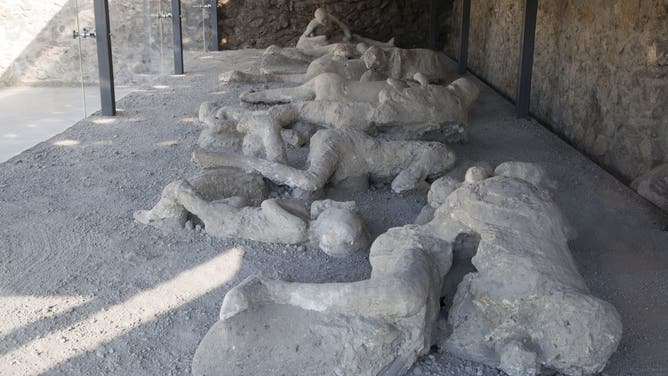
This picture taken on November 9, 2012 through the protective glass of the Orto dei fuggiaschi (The garden of the Fugitives)shows the13 bodies of victims who were buried by the ashes as they attempted to flee Pompeii during the 79 AD eruption of the Vesuvius volcano. The garden of the fugitives reoponed the same day to public after about a year of restoration works.
(CARLO HERMANN,CARLO HERMANN/AFP / Getty Images)
According to historical accounts from Roman Senator Pliny the Younger, the eruption lasted 18 hours, as Pompeii was buried under 14 to 17 feet of ash and volcanic rock. In contrast, the neighboring city of Herculaneum was buried under more than 60 feet of mud and volcanic material.
The eruption sent many fleeing from the city, as some 2,000 people stayed, hiding in cellars or stone structures in hopes the eruption would pass.
SEE IT: SCIENTISTS SAMPLE ONCE-INACCESSIBLE TEPHRA FROM WALL OF CRATER ON KILAUEA’S SUMMIT
Sadly, this was not the case. A giant cloud of hot ash and gas surged from the western side of the volcano, engulfing Pompeii in flames and causing asphyxia, suffocating men, women and children by the next morning, when toxic gas poured into the city.
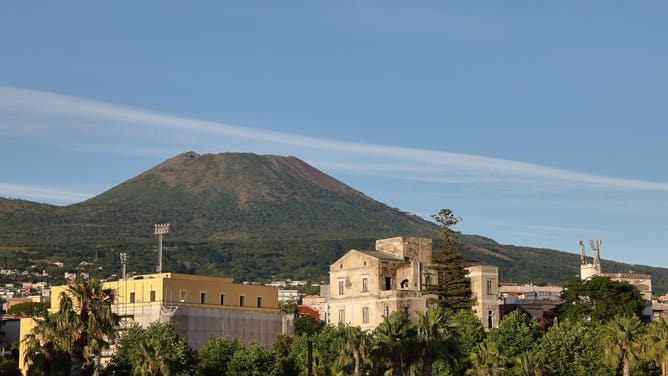
Mount Vesuvius captured from Ercolano (Italy), June 12th, 2026
( Grzegorz Galazka/Archivio Grzegorz Galazka/Mondadori Portfolio / Getty Images)
Over 2,000 people perished from the historic eruption, as the remains of the dead have been found over the years, covered with ash that hardened and preserved the bodies, leaving a haunting outline of the last moments of life before an excruciating death.
HAWAII’S KILAUEA SEES 52ND ERUPTION EPISODE, CREATES TOWERING 500-FOOT LAVA FOUNTAINS
Today, Mount Vesuvius is still an active volcano, with its last eruption in 1944, along with the last major eruption occurring in 1631, according to History.com.