The historic lunar flyby Artemis II mission is over. The crew splashed down in the Pacific Ocean on Friday night, and the crew is reportedly doing well.
It’s been almost a week since the Artemis II crew returned to Earth after a nearly 10-day mission to the moon and back, and the four astronauts are reflecting on their time in space.
NASA Astronauts Reid Wiseman, Victor Glover, Christina Koch and Canadian Space Agency Astronaut Jeremy Hansen had the chance to experience something no humans have ever experienced before — going deeper into space than anyone else and seeing the far side of the moon with their own human eyes.
On Thursday, six days after splashing down in the Pacific Ocean, the astronauts held a news conference at NASA’s Johnson Space Center in Houston, answering questions about their journey.
MEET RISE, THE BELOVED ARTEMIS II MASCOT THAT TRAVELED TO THE MOON AND BACK
Artemis II’s crew answers questions about their mission on April 16, 2026 with their ZGI mascot “Rise” at NASA’s Johnson Space Center.
(NASA)
Artemis II Commander Reid Wiseman kicked off the conference with an opening statement.
He started off thanking his fellow crew on the mission, saying without their support the mission couldn’t have happened.
IS NASA CONSIDERING RECLASSIFYING PLUTO AS A PLANET IN OUR SOLAR SYSTEM?
“We are bonded forever. I mean, that’s the closest where humans can be and not be a family,” Wiseman said of him, Victor Glover, Christina Koch and Jeremy Hansen.
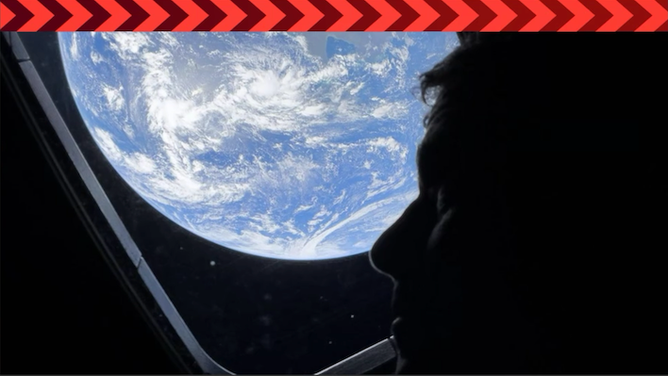
NASA astronaut and Artemis II Commander Reid Wiseman peers out of one of the Orion spacecraft’s main cabin windows, looking back at Earth, as the crew travels towards the Moon. (NASA)
(NASA)
He continued by thanking NASA and their international partners who made the mission possible, and finally, he thanked the world.
“When we came home, we were shocked at the global outpouring of support, of pride, of ownership of this mission,” Wiseman said. “We wanted to go out and try to do something that would bring the world together to unite the world.”
WHEN WILL NASA LAND ON THE MOON? TRACKING THE ARTEMIS PROGRAM’S JOURNEY BACK TO THE LUNAR SURFACE
The crew members talked about their perspective of the mission since being back on the ground.
Koch said her husband and family talked about how to tell her that their impact reached millions.
“I can tell you that the difference now is when we come before you now, we’ve done this together,” she said. “We took your hearts with us, and your hearts lifted our hearts.”
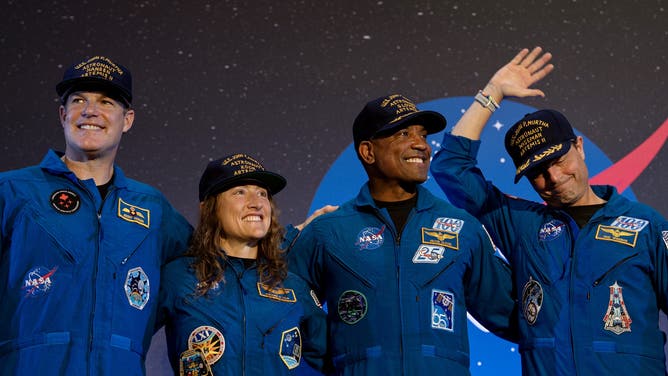
HOUSTON, TEXAS – APRIL 11: (L-R) Artemis II Mission Specialist Jeremy Hansen, Mission Specialist Christina Koch, Pilot Victor Glover, and Commander Reid Wiseman wave during a press conference on April 11, 2026 at Ellington Field Joint Reserve Base in Houston, Texas. Their historic 10-day mission around the moon concluded successfully
(Danielle Villasana / Getty Images)
They talked about how they’d been sleeping since they came back, with Koch mentioning she has had multiple mornings where she woke up feeling like she’d been floating.
The crew was asked about how safe they felt on Integrity, the name they chose for the Orion spacecraft that was their home for the mission.
Despite some of the challenges they encountered on the mission with the toilet and a smoke detector going off, Wiseman said they could launch Artemis III on Orion tomorrow and that crew would be in great shape.
PHOTOS: LARGE LUMINOUS SWIRL OF GALAXY CALLED IC 486 SEEN MILLIONS OF LIGHT-YEARS FROM EARTH
Glover described the splashdown, saying it was a “very intense” 13 minutes and 36 seconds from reentry to hitting the ocean.
-
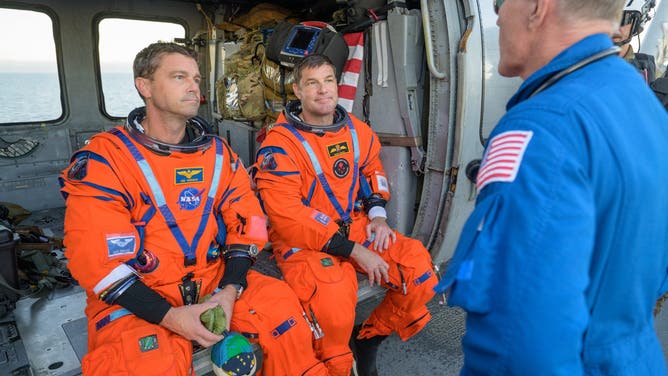
AT SEA – APRIL 10: (EDITOR’S NOTE: This Handout image was provided by a third-party organization and may not adhere to Getty Images’ editorial policy.) In this handout photo provided by NASA, NASA astronaut Victor Glover, Artemis II pilot, left, and CSA (Canadian Space Agency) astronaut Jeremy Hansen, Artemis II mission specialist, talk with NASA Flight Surgeon Richard Scheuring at their Navy MH-60 Seahawk from Helicopter Sea Combat Squadron (HSC) 23 on the flight deck of USS John P. Murtha after they and fellow crewmates NASA Astronauts Victor Glover, and Christina Koch were extracted from their Orion spacecraft after splashdown, Friday, April 10, 2026, in the Pacific Ocean off the coast of California. NASA’s Artemis II mission took the quartet on a nearly 10-day journey around the Moon and back to Earth. Following a splashdown at 5:07 p.m. PDT (8:07 p.m. EDT), NASA, U.S. Navy, and U.S. Air Force teams are working to bring the Orion spacecraft aboard the recovery ship. (Photo by Bill Ingalls/NASA via Getty Images)
( ) -
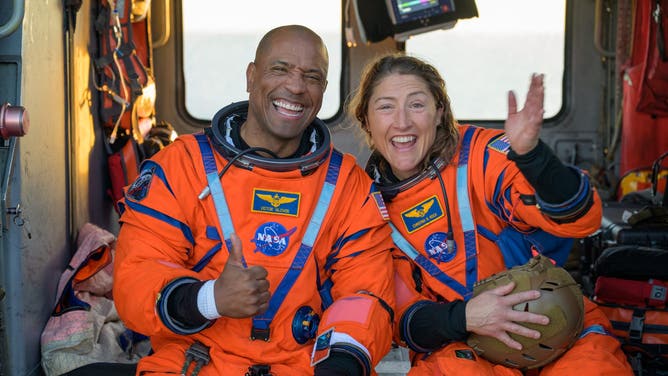
AT SEA – APRIL 10: (EDITOR’S NOTE: This Handout image was provided by a third-party organization and may not adhere to Getty Images’ editorial policy.) In this handout photo provided by NASA, NASA astronaut Victor Glover, Artemis II pilot, left, and NASA astronaut Christina Koch, Artemis II mission specialist are seen sitting on a Navy MH-60 Seahawk from Helicopter Sea Combat Squadron (HSC) 23 on the flight deck of USS John P. Murtha after they and fellow crewmates CSA (Canadian Space Agency) astronaut Jeremy Hansen, Artemis II mission specialist, and NASA astronaut Reid Wiseman, Artemis II commander, were extracted from their Orion spacecraft after splashdown, Friday, April 10, 2026, in the Pacific Ocean off the coast of California. NASA’s Artemis II mission took the quartet on a nearly 10-day journey around the Moon and back to Earth. Following a splashdown at 5:07 p.m. PDT (8:07 p.m. EDT), NASA, U.S. Navy, and U.S. Air Force teams are working to bring the Orion spacecraft aboard the recovery ship. (Photo by Bill Ingalls/NASA via Getty Images)
( ) -
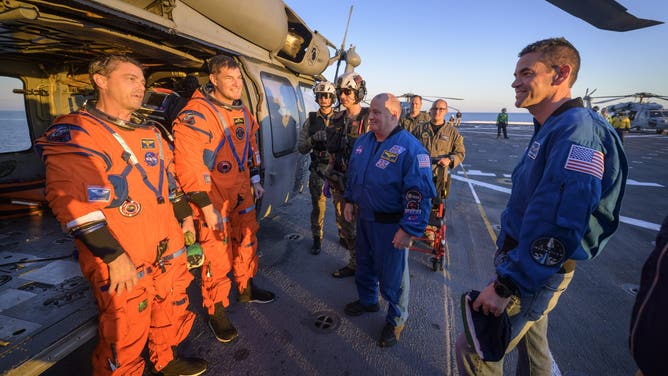
AT SEA – APRIL 10: NASA astronaut Victor Glover, Artemis II pilot, left, and CSA (Canadian Space Agency) astronaut Jeremy Hansen, Artemis II mission specialist, talk with NASA Administrator Jared Isaacman at their Navy MH-60 Seahawk from Helicopter Sea Combat Squadron (HSC) 23 on the flight deck of USS John P. Murtha after they and fellow crewmates NASA Astronauts Victor Glover, and Christina Koch were extracted from their Orion spacecraft after splashdown, Friday, April 10, 2026, in the Pacific Ocean off the coast of California. NASA’s Artemis II mission took the quartet on a nearly 10-day journey around the Moon and back to Earth. Following a splashdown at 5:07 p.m. PDT (8:07 p.m. EDT), NASA, U.S. Navy, and U.S. Air Force teams are working to bring the Orion spacecraft aboard
(Bill Ingalls/NASA) -
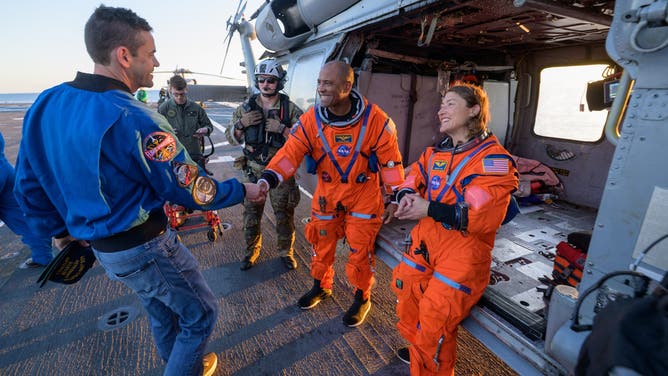
AT SEA – APRIL 10: (EDITOR’S NOTE: This Handout image was provided by a third-party organization and may not adhere to Getty Images’ editorial policy.) In this handout photo provided by NASA, NASA astronaut Victor Glover, Artemis II pilot, left, and NASA astronaut Christina Koch, Artemis II mission specialist, talk with NASA Administrator Jared Isaacman at their Navy MH-60 Seahawk from Helicopter Sea Combat Squadron (HSC) 23 on the flight deck of USS John P. Murtha after they and fellow crewmates NASA Astronauts Victor Glover, and Christina Koch were extracted from their Orion spacecraft after splashdown, Friday, April 10, 2026, in the Pacific Ocean off the coast of California. NASA’s Artemis II mission took the quartet on a nearly 10-day journey around the Moon and back to Earth. Following a splashdown at 5:07 p.m. PDT (8:07 p.m. EDT), NASA, U.S. Navy, and U.S. Air Force teams are working to bring the Orion spacecraft aboard the recovery ship. (Photo by Bill Ingalls/NASA via Getty Images)
( ) -
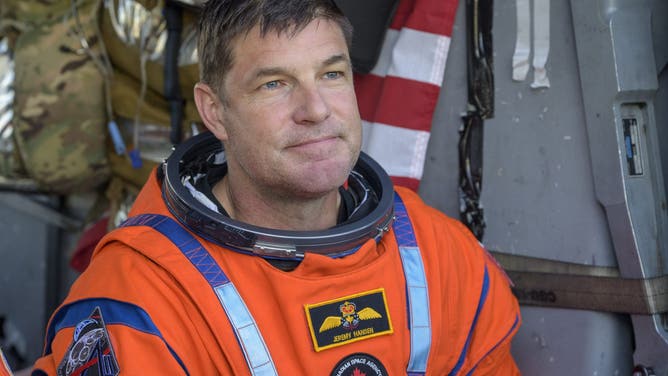
AT SEA – APRIL 10: (EDITOR’S NOTE: This Handout image was provided by a third-party organization and may not adhere to Getty Images’ editorial policy.) In this handout photo provided by NASA, CSA (Canadian Space Agency) astronaut Jeremy Hansen, Artemis II mission specialist is seen sitting in a Navy MH-60 Seahawk from Helicopter Sea Combat Squadron (HSC) 23 on the flight deck of USS John P. Murtha after he and fellow crewmates NASA Astronauts Reid Wiseman, Victor Glover, and Christina Koch, were extracted from their Orion spacecraft after splashdown, Friday, April 10, 2026, in the Pacific Ocean off the coast of California. NASA’s Artemis II mission took the quartet on a nearly 10-day journey around the Moon and back to Earth. Following a splashdown at 5:07 p.m. PDT (8:07 p.m. EDT), NASA, U.S. Navy, and U.S. Air Force teams are working to bring the Orion spacecraft aboard the recovery ship. (Photo by Bill Ingalls/NASA via Getty Images)
( ) -
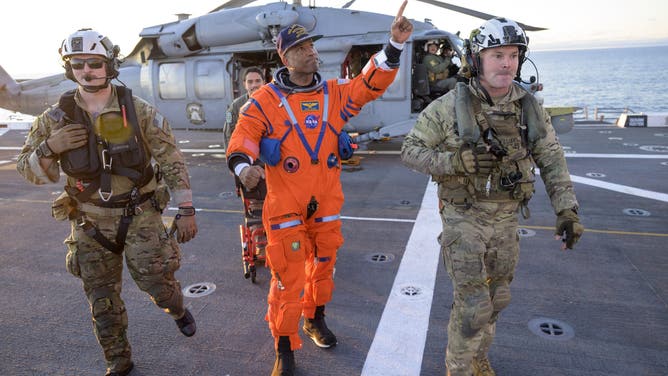
AT SEA – APRIL 10: (EDITOR’S NOTE: This Handout image was provided by a third-party organization and may not adhere to Getty Images’ editorial policy.) In this handout photo provided by NASA, NASA astronaut Victor Glover, Artemis II pilot is assisted off the flight deck after arriving aboard USS John P. Murtha after he and fellow crewmates NASA astronauts Reid Wiseman, commander; Christina Koch, mission specialist; and CSA (Canadian Space Agency) astronaut Jeremy Hansen, mission specialist were extracted from their Orion spacecraft after splashdown, Friday, April 10, 2026, in the Pacific Ocean off the coast of California. NASA’s Artemis II mission took the quartet on a 10-day journey around the Moon and back to Earth. Following a splashdown at , NASA and U.S. military teams are working to bring the crewmembers and Orion spacecraft aboard the recovery ship. (Photo by Bill Ingalls/NASA via Getty Images)
( )
He talked about the feeling of free-falling for a few moments while they awaited the pilot parachutes to deploy following the release of the drogue parachutes.
The crew was asked about Orion’s heat shield, and how they thought it held up. WIseman said they’d have to wait and see what NASA said, but it was a very smooth ride down.
FROM LIFTOFF TO SPLASHDOWN: SEE THE MOST PIVOTAL MOMENTS OF THE HISTORIC ARTEMIS II MISSION
They had fun questions about what they’d want to be included in a movie about them, what stamp they’d choose if the USPS asked, and personal effects they’d brought with them aboard the spacecraft.
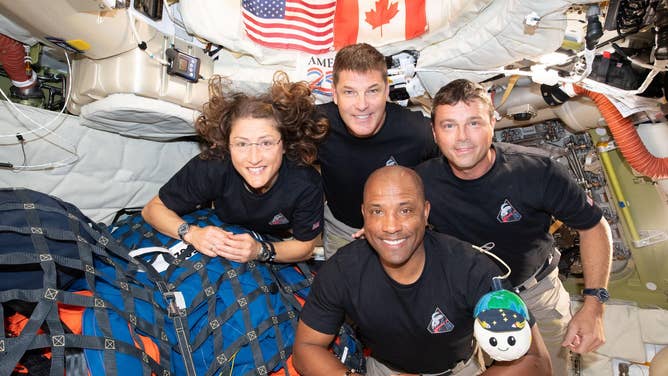
April 7, 2026) – The Artemis II crew – (clockwise from left) Mission Specialist Christina Koch, Mission Specialist Jeremy Hansen, Commander Reid Wiseman, and Pilot Victor Glover – pause for a group photo with their zero gravity indicator “Rise,” inside the Orion spacecraft on their way home.
(NASA)
Glover gave advice to young people who have hopes of becoming astronauts.
“The three things I’ve always encouraged young people to do, I think still apply to be gritty or resilient, to be a lifelong learner and to be a good teammate,” he said.
Glover, Wiseman and Hansen talked about the piloting demonstrations they were able to do aboard Orion during the mission.
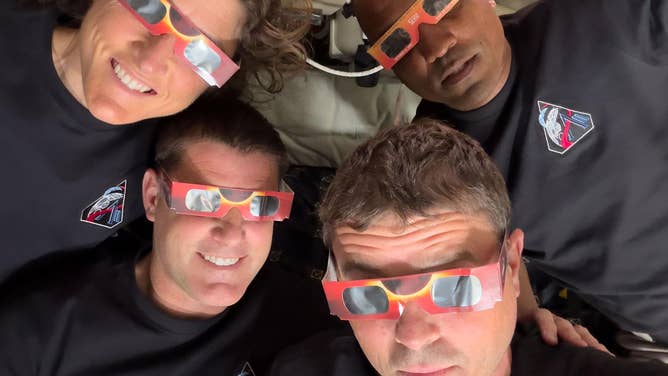
April 6, 2026) – The Artemis II crew – Mission Specialist Christina Koch (top left), Mission Specialist Jeremy Hansen (bottom left), Commander Reid Wiseman (bottom right), and Pilot Victor Glover (top right) – uses eclipse viewers, identical to what NASA produced for the 2023 annular eclipse and 2024 total solar eclipse, to protect their eyes at key moments during the solar eclipse they experienced during their lunar flyby. This was the first use of eclipse glasses at the Moon to safely view a solar eclipse.
(NASA)
“First of all, it’s an immense privilege to fly a spaceship that just at all and to fly a new spaceship is kind of an unreal privilege,” Glover said.
The crew gave their advice to the future crews of Artemis missions.
“You have got to invest in each other,” Wiseman said.
“Ask more questions,” Glover said.
“Remember you’re part of a team,” Koch said.
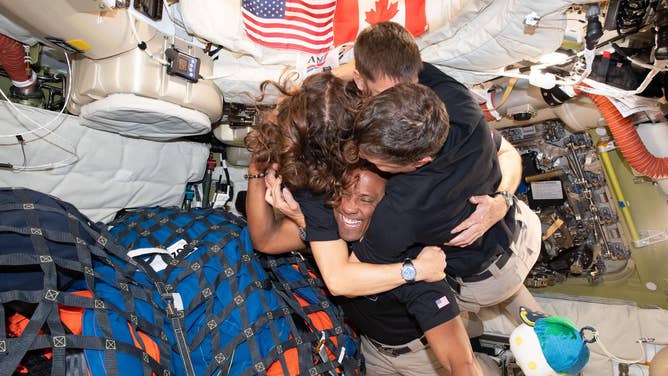
(April 7, 2026) – The Artemis II crew – (clockwise from left) Mission Specialist Christina Koch, Mission Specialist Jeremy Hansen, Commander Reid Wiseman, and Pilot Victor Glover – take time out for a group hug inside the Orion spacecraft on their way home.
(NASA)
The Artemis II crew remains in Houston for at least another week while they continue their medical evaluations and tests following their mission.