Arctic sea ice has hit a record low following unusually warm temperatures in two key areas, Japan‘s National Institute of Polar Research (NIPR) has warned.
The Arctic’s annual maximum extent – the point in winter when ice coverage should be highest – is now smaller than at any time since satellite observations began in 1979.
At its very largest point on March 13, ice covered 5.31 million square miles (13.76 million square km).
This narrowly beats the previous low in March 2025, when coverage plunged six per cent below the average for 1991 to 2010.
Compared to the previous low in 2025, the Arctic ice sheet was 11,580 square miles smaller (30,000 square km) this year.
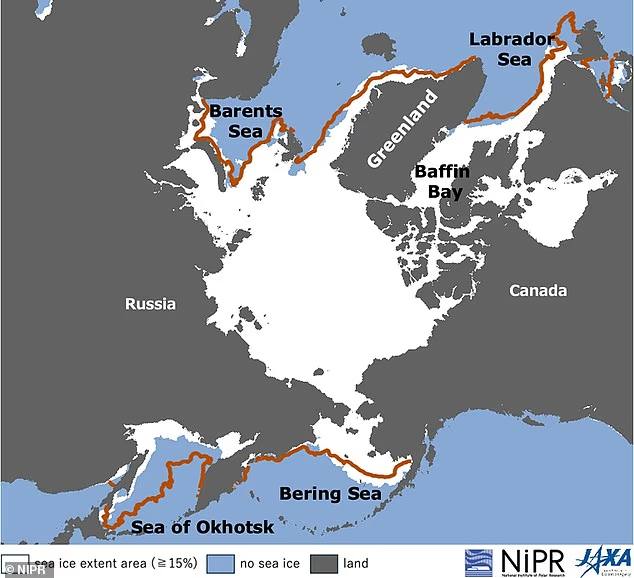
Researchers blame warm temperatures in the Sea of Okhotsk near Russia, and Baffin Bay off the northern coast of Canada, which meant ice ‘failed’ to expand.
In a statement, NIPR says: ‘There are concerns that Arctic sea ice changes may reach a point of no return amid progressing global warming.
‘Potentially triggering a chain of impacts across the global climate system.’
Arctic sea ice hit its lowest point on record this March, due to exceptionally warm conditions in Baffin Bay and the Sea of Okhotsk. Pictured: March 2026 winter maximum (white area) compared to the 2020 average (brown lines)
Arctic sea ice usually increases during the Northern Hemisphere’s winter, growing outwards between October and March.
After reaching its yearly maximum, the sea ice then naturally melts away between April and September to hit the yearly minimum.
However, in the winter of 2025 to 2026, the Arctic sea ice’s extent remained fairly low throughout the entire season.
Using data gathered by the Japanese Space Agency’s SHIZUKU satellite, researchers confirmed that this culminated in a record low maximum in March.
Comparing the sea ice extent to the yearly average for 2010 clearly reveals the issue.
The boundary of the Arctic ice was several miles further back in March 2026 than it was in 2010, particularly in the Sea of Okhotsk and in the Baffin Bay.
Detailed analysis later revealed that the temperatures in these areas remained significantly higher than normal between January and February, severely hindering ice formation.
Likewise, strong southeasterly winds combined with warm water in the Sea of Okhotsk so that the ice extent actually began to decrease as early as February 19.

At its very largest point on March 13, ice covered 5.31 million square miles (13.76 million square km), 1,580 square miles (30,000 square km) less than the previous record low in 2025

Scientists blame unusually hot conditions in parts of Baffin Bay and the Sea of Okhotsk, which prevented the ice from growing during the key winter months
This comes as scientists continue to warn that the warming climate is threatening the existence of sea ice in the Arctic ocean.
Previous studies have suggested that the first year in which the sea ice completely vanishes in summer could come as soon as next year.
Using 300 computer simulations, scientists predicted that the Arctic’s first ice–free day is guaranteed to occur within nine to 20 years, regardless of how humans alter their greenhouse gas emissions.
However, nine out of the 300 simulations suggested that an ice–free day could occur by 2027, regardless of how humans act.
Separate research conducted by the University of Exeter last year found that the Arctic has actually been melting at a slower rate for the past 20 years.
From 1979 to 2024, ice was lost from the Arctic at a rate of 2.9 million cubic kilometres of ice per decade.
But from 2010 to 2024, the rate had reduced to just 0.4 million cubic kilometres per decade – seven times smaller.
But this is not necessarily good news, as the scientists say this temporary slowdown will probably only continue for five to 10 years.

With the winter maximum at its lowest extent since records began in 1979, there are fears that the Antarctic might experience an iceless summer in the coming decade
When this period ends, it’s likely to be followed by ‘faster–than–average’ sea ice decline.
Sea ice is already floating on the ocean, so its melting doesn’t directly affect global sea levels.
However, the ice plays a key role in regulating the temperature of the atmosphere and oceans.
NIPR says: ‘Sea ice is a critical component of the climate system; its fluctuations can impact extreme weather patterns and marine environments.’
Without a cover of reflective ice, the Arctic oceans would absorb significantly more energy from the sun.
That risks destabilising the balance of global weather systems and raising sea levels as the warmer water expands.
Dr Céline Heuzé, of the University of Gothenburg, previously told the Daily Mail that this would ’cause more extreme weather, year–round.’
Dr Heuzé added: ‘Think of the cold spells with –20° (–4°F) down to Italy, or the heatwaves over northern Europe and forest fires throughout Scandinavia.’