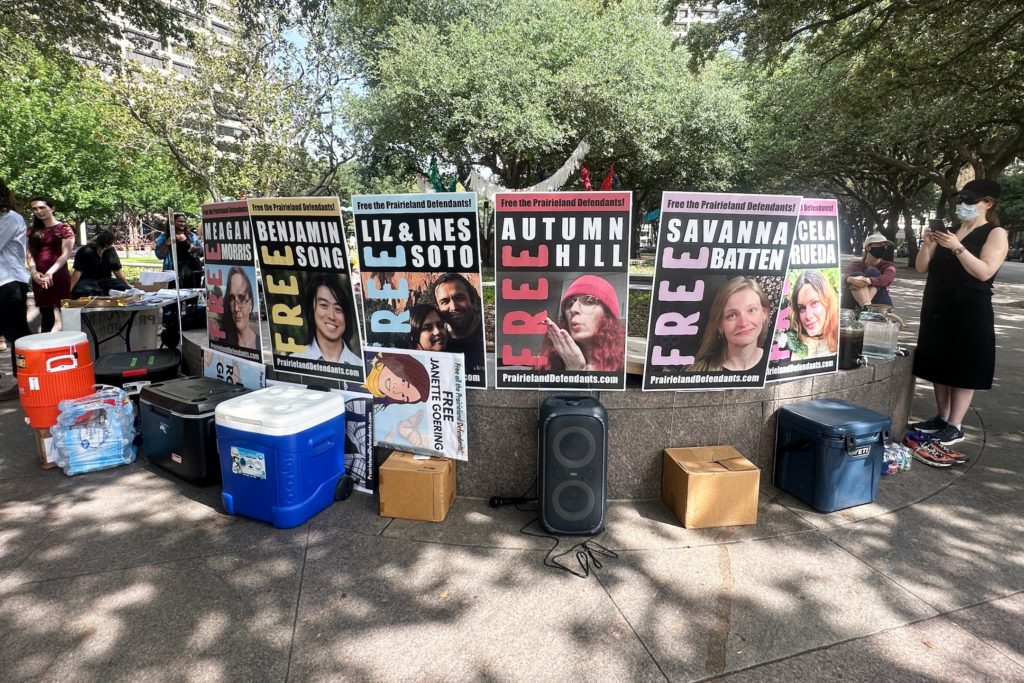
In two federal courts, a group of protesters received unusually long sentences after the Justice Department accused them of being members of Antifa. These nine protesters were arrested after they demonstrated outside a migrant detention facility in Texas. During the protest, a police officer was shot. Justice correspondent Ali Rogin discussed more with former federal prosecutor Paul Butler.
Amna Nawaz:
In two federal courts yesterday, a group of protesters received unusually long sentences after the Justice Department accused them of being members of the far left movement Antifa. The sentences range from 30 to 100 years in prison, longer than the harshest sentence handed down to any of the convicted rioters in the January 6 attack on the U.S. Capitol in 2021.
All of those people have since received pardons or commutations from President Trump.
Our justice correspondent, Ali Rogin, has more.
Ali Rogin:
These nine protesters were arrested after they demonstrated outside a migrant detention facility in Texas last year. During the protest, a police officer was shot in the neck. He survived.
Their case is the first to incorporate new guidance from a presidential declaration last year that labels Antifa as a domestic terrorist organization. That’s despite the fact that Antifa is a decentralized movement, not a single organization, and that there is no federal charge of domestic terrorism under existing U.S. law.
To discuss the implications of this sentencing, I’m joined by Georgetown law professor and former federal prosecutor Paul Butler.
Paul, good to see you. Welcome back to the “News Hour.”
Paul Butler, Professor, George University Law Center:
It’s great to be here.
Ali Rogin:
I’d like to ask first about these decades-long sentences that were passed down. The longest was 100 years in prison. Most of the others received sentences of 50 to 70 years.
You’re familiar with the allegations against these defendants. Were these sentences — are these sentences typical?
Paul Butler:
No, they’re not. The sentences are extremely harsh. They’re sentences that are more typical for people who have committed murder or stolen millions of dollars.
Compare these defendants to two other sets of defendants, one, their co-defendants who were accused of the same conduct, but pled guilty. They are going to be sentenced next month, and they’re looking at around 15 years.
We can also think of the 1,500 people who were prosecuted in connection with the attack on the Capitol on January 6, 2021. The most any of those defendants received was 22 years, compared with the 30 to 70 years that these defendants received.
Ali Rogin:
Acting Attorney General Todd Blanche released a statement, in which he said in part: “The sentences handed down today make clear that the Antifa terrorists who attack law enforcement and federal facilities will face swift and uncompromising justice,” calling them Antifa terrorists.
What do we know about Antifa and whether or not this terrorism label is really accurate?
Paul Butler:
Antifa is not a formal organization. It doesn’t have a leadership structure or a list of members. It’s more of a network of people on the far left who are opposed to fascism.
President Trump has labeled it a domestic terrorist organization. Now, there is such a thing as a foreign terrorist organization, but the law doesn’t provide any classification for domestic terrorist organizations. More significantly, five of the alleged Antifa members pled guilty, and they supported the prosecution.
But on the stand, they denied that they and any of the co-defendants were members of Antifa. They said what brought them together is that they were a member of a book group, of the Emma Goldman reading society, that read books by revolutionary authors.
Ali Rogin:
Named after a famous anti-fascist protester.
What sort of message do you think the Department of Justice was sending in pursuing these sentences? And do you think we’re going to see this in future cases against protesters, especially those who are protesting administration policies like the immigration crackdown?
Paul Butler:
Last year, after the murder of Charlie Kirk, President Trump signed the National Security Presidential Memo 7. It’s a directive that says that the government should use its law enforcement resources to focus on domestic terrorist organizations.
And he said domestic terrorist ideology could include anti-capitalist views, people who have extreme views on race and gender and immigration, and even people who are opposed to what the directive described as traditional teachings on marriage and the family.
The concern is that prosecutions based on this directive chill free speech. People who demonstrate, even people who are resisting the administration, have First Amendment rights to free speech and freedom of assembly.
Now, when they cross the line, as these defendants did with acts of vandalism, of course, they should be brought to justice. The concern is, when people are labeled terrorists based on their political views, that chills free speech.
Ali Rogin:
Professor Paul Butler, thank you so much.
Paul Butler:
Always a pleasure.