
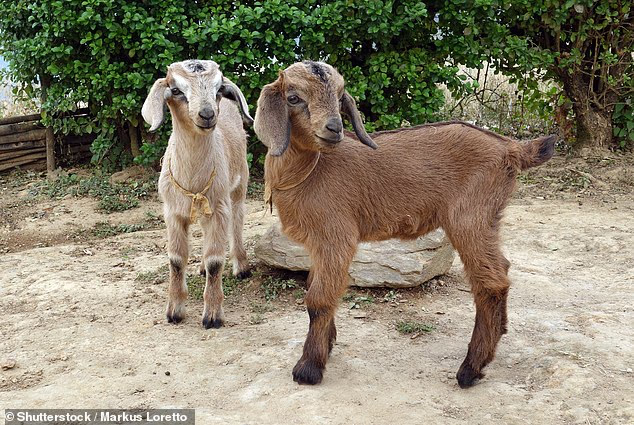
Multiple animals in a traveling petting zoo have tested positive for rabies, health officials have announced.
The North Carolina Department of Health and Human Services (NCDHHS) said Friday that three baby goats that traveled to 10 petting zoos across the state this summer tested positive for rabies, a nearly 100 percent fatal condition that spreads to humans through infected animal bites.
‘Rabies is almost always fatal in mammals, including people, unless medications to prevent infections are given before symptoms develop,’ NCDHHS said in a statement.
Authorities said they were first notified of potential rabies exposure among four baby goats at mobile petting zoo Farm Adventures on August 27.
The department believes the goats were likely exposed to rabies by a skunk that had entered the pen where they were kept in late July.
Lab tests confirmed the rabies virus in three of the four goats on August 28. The fourth goat was not tested but assumed to have the virus, officials said.
The department cautioned anyone who visited the zoo in Harmony, North Carolina, or any of its other sites between July 28 and August 27 to contact local health officials to see if treatment is needed.
‘The petting zoo held off-site events involving children and elderly individuals across multiple counties within that time frame,’ state officials said.
Several goats at a traveling petting zoo in North Carolina tested positive for rabies, health officials announced (stock image)
Among the sites the zoo visited were an assisted-living center, a back-to-school event and six private events, according to the department.
It’s unclear how many individuals may have been exposed. No other animals pose a rabies risk, NCDHHS said.
In a statement posted on social media Friday, Farm Adventures confirmed the positive rabies tests and said that the affected goats were ‘euthanized to prevent further spread.’
‘We will be closely monitoring our remaining animals under the guidelines provided by health officials,’ the company said. ‘The baby goats were kept in a separate pen, away from the others, and were too young to receive their vaccinations.
‘We unfortunately encountered a skunk in their pen, which we promptly removed and disposed of. However, during this process, the skunk was able to bite the goats.’
The statement said the goats showed no signs or symptoms of rabies.
More than 90 percent of rabies exposures come from wild animals, and skunks account for roughly 17 percent of those infections. Bats are the most common at 35 percent, followed closely by raccoons at 29 percent, according to the Centers for Disease Control and Prevention (CDC).
Rabies is transmitted through saliva from infected animals. Most people get it from an animal bite or scratch.
In one extremely rare case, Michigan grandfather Barney Kurowicki contracted the disease in January 2025 after receiving a kidney transplant.
The kidney was thought to have been infected with rabies.
The virus moves along the spinal cord and travels to the brain, causing inflammation.
Early symptoms in humans include fever, headache, agitation, confusion and vomiting.
In later stages, patients suffer restlessness, hallucinations, seizures and twitching, excessive salivation, and a fear of water or air blowing in their face.
It is nearly always fatal once symptoms begin, but a four- to five-dose series of vaccines given before symptom onset can prevent the disease. The shots must be given as soon as possible after someone believes or confirms they have been exposed.
Only 20 cases of humans surviving rabies have ever been recorded in medical literature worldwide.
Around 5,000 animal cases of rabies are reported each year, and about 60,000 Americans seek care for potential exposure.
Fewer than 10 Americans die from rabies every year, according to the CDC.


