A Babylonian ‘time capsule’ buried for more than two millennia under the ruins of a ziggurat in modern-day Iraq has revealed never-before-seen details about the biblical king Nebuchadnezzar II.
Two cylinders bearing a royal inscription were buried as ‘foundation deposits’ – ritual objects buried under ancient buildings as a divine blessing believed to ensure the structure’s longevity.
The cylinders, each made of baked clay, were originally unearthed at the ruins of the temple in the ancient city of Kish, one of the most important cities in Mesopotamia.
Two locals who found the relics at the Kish archeological site named Tell Al-Uhaimir handed them to the State Board of Antiquities and Heritage in 2013. The new findings about what was inscribed on the cylinders were revealed in December.
The cylinders offered a new perspective on Nebuchadnezzar II, a historical figure who was an agent of destruction in the Bible. The king of the Neo-Babylonian Empire ruled from 605BC to 562BC.
Specifically, the cylinders bear a royal inscription written in ancient Babylonian cuneiform script directly on their clay surfaces.
King Nebuchadnezzar II himself ‘speaks’ in the text, proudly describing how he restored an old, crumbling stepped temple tower in the city of Kish that was dedicated to the Mesopotamian god and goddess of war, Zababa and Ishtar.
He explained that earlier kings had built and fixed the ziggurat before, but it had fallen into disrepair again from age and rain. He ended the time capsule with a prayer asking the gods for a long life, old age, and help in defeating his enemies.
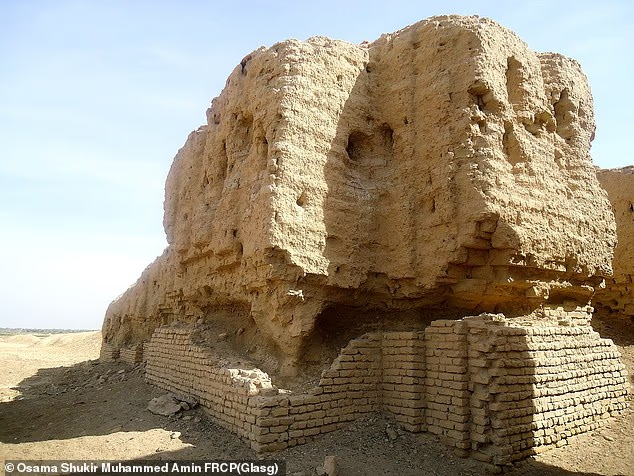
Ruins of the temple of the goddess Ishtar near the ziggurat at Tell Al-Uhaimir, in the ancient city of Kish

The Kish cylinders (Pictured) offer a new perspective on Nebuchadnezzar II, a historical figure who is an agent of destruction in the Bible
Nebuchadnezzar II was a famous warrior king who defeated Pharaoh Necho II in his early years, before turning his attention to so-called rebellious states such as Israel.
The tale of how he besieged Jerusalem, destroying it and the kingdom of Judah before deporting much of its population in the ‘Babylonian captivity,’ appears in the Old Testament books 2 Kings, 2 Chronicles, Jeremiah, Ezekiel and Daniel.
In the Bible, he was infamous for abducting Israelites, including the prophet Ezekiel, and ending the independent kingdom of Judah. Their exile would not end until 538BC.
However, the cruel king who is described as a ‘destroyer of nations’ in Jeremiah 4:7 also built an empire which was the largest in the world at that time, stretching from the Persian Gulf to the Mediterranean, and including parts of present-day Kuwait, Iraq, Syria, Jordan, Israel, Lebanon and Turkey.
Now, the Kish cylinders show another side to the warrior-king, one that ties closely to his description in Daniel as walking on the roof of Babylon’s royal palace and saying, ‘Is not this great Babylon, which I have built by my mighty power as a royal residence and for the glory of my majesty?’
The Kish inscription highlights his role as a builder. This particular ziggurat was named É-u-nir-ki-tuš-maḫ, which means ‘House, temple-tower, exalted abode.’
Translated to English, the inscription says: ‘The ziggurat of Kish, which a king of the past had built, but its walls had buckled and a former king had restored (the damaged walls), and made its structure suitable, with the passage of time, it again became weak, buckled, and showers of rain carried away its brickwork.’
Nebuchadnezzar then described his motivation as being devotion to the Gods. In particular, the king mentioned Zababa, described as ‘the strongest one, the one who kills my enemies’ and Ishtar ‘who magnifies my kingship.’

King Nebuchadnezzar II (Pictured) depicted in the Old Testament book of Daniel

The cylinders were translated from cuneiform and revealed that the ziggurat at Tell Al-Uhaim was rebuilt by King Nebuchadnezzar II to honor the Mesopotamian god and goddess of war
According to the findings, published in the journal Iraq, the inscription continued: ‘Zababa and Ishtar had pushed my heart (to do it). (So) I put its brickwork in good order, I built its collapsed sections anew, and I completed it and raised its superstructure.
‘I embellished its outward appearance and made it shine like the daylight for Zababa and Ishtar, my lords.’
‘Zababa and Ishtar, look on account of this and, by your exalted command, may my days be long, may I attain very old age, may I conquer my enemies, and may I kill my opponents, with your fierce weapons, cut down and bind my enemies.’
Although these sacred time capsules were typically buried underneath the temples, the Kish inscriptions were reportedly found on the surface in Tell Al-Uhaimir.
A team from Iraq’s State Board of Antiquities and Heritage said the cylinders confirm previous archaeological excavations which referred to three kings, the builder, the first restorer and Nebuchadnezzar II.
Previous archaeological excavations found that the ziggurat went through four major stages of construction and excavation, the last of which was carried out by Nebuchadnezzar.
Zababa has multiple temples built to him in the area, and bricks bearing Nebuchadnezzar’s name were found in the ruins of the ziggurat.
Kings in the Neo-Babylonian period were expected to restore temples, and ancient Babylonian religion saw the duty of kings as to build and maintain religious order.
Lauren K McCormick of Biblical Archaeology wrote: ‘The biblical authors, writing in the aftermath of exile, understandably portray Nebuchadnezzar as a destroyer because he literally did destroy their temple.’
‘Babylonian inscriptions, on the other hand, depict the same ruler as a restorer of temples – a deeply pious and reverential figure.’