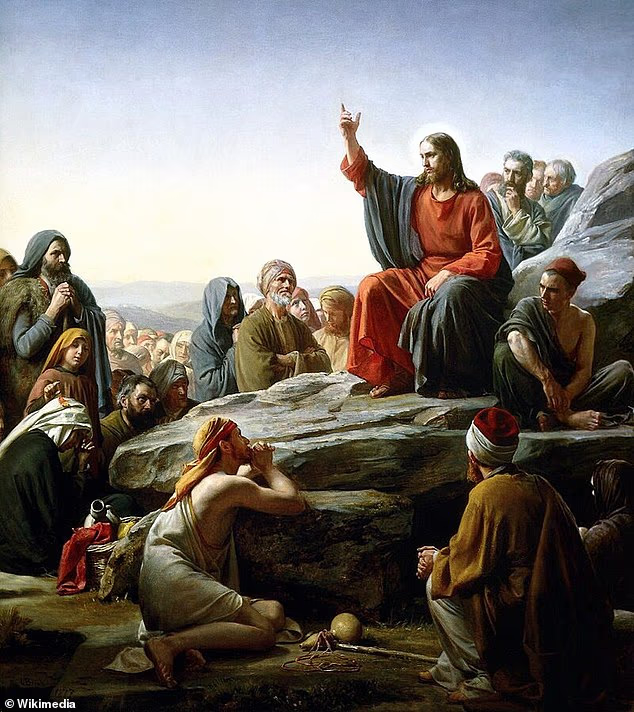
Ancient writings of two Roman historians have been highlighted as some of the strongest evidence that Jesus was a real person.
The records come from Tacitus, one of Rome’s most respected historians, and Flavius Josephus, a Jewish aristocrat and historian who lived just decades after Jesus’ death.
Neither man was a Christian, and neither was trying to prove the claims of the New Testament.
Yet both left behind accounts that place Jesus in Judea, connect him to the origins of Christianity and link his death to the Roman governor Pontius Pilate.
In one of the texts, Tacitus wrote that a man called Christus was executed during the reign of Emperor Tiberius.
In another, Josephus referred to James as ‘the brother of Jesus-who-is-called-Messiah,’ identifying Jesus as a real person known to his readers.
The references have drawn renewed attention as historians continue examining evidence for Jesus that exists outside the Bible.
For many scholars, the accounts represent some of the clearest non-Christian evidence that Jesus was a historical figure rather than a legend.
Ancient writings of two Roman historians have been highlighted as some of the strongest evidence that Jesus was a real person
The evidence was recently reviewed on Thursday by biblical scholar Lawrence Mykytiuk, who examined ancient Roman and Jewish sources that mention Jesus, as reported in the Biblical Archaeology Society.
Most historians already accept that Jesus was a real historical figure, with debate focusing less on whether he existed and more on the details of his life and teachings.
That is why the ancient writings of Roman historian Tacitus and Jewish historian Flavius Josephus remain so important; they provide some of the earliest non-Christian references to Jesus, placing him in first-century Judea and linking his death to Pontius Pilate.
While the New Testament remains the primary source for information about Jesus’ life, many skeptics have long argued that writings produced by Christians cannot be considered independent evidence.
That is why historians often focus on references written by people outside the faith.
One of the most important comes from Tacitus, a Roman senator, historian and one of the ancient world’s most respected chroniclers.
Writing around 116 AD in his work Annals, Tacitus described Emperor Nero’s efforts to blame Christians for the Great Fire of Rome in 64 AD.
According to Tacitus, Nero targeted a group known as Christians, whose name came from a man called Christus.

The highlighted passage contains Tacitus’ reference to Christians, stating that their founder, Christ, was executed during the reign of Emperor Tiberius by the Roman governor Pontius Pilate
Tacitus wrote that Christus had been executed during the reign of Emperor Tiberius by Pontius Pilate, the Roman governor of Judea.
The passage is significant because Tacitus was openly hostile toward Christians.
Far from promoting their beliefs, he described Christianity as a dangerous superstition and expressed contempt for its followers.
Historians argue that this makes his reference to Jesus particularly valuable because he had no reason to invent details that supported the movement.
The account independently confirms several details found in the Gospels, including that Jesus was executed under Roman authority and that his followers continued spreading his teachings after his death.
Another major source comes from Josephus, a Jewish historian born only a few years after Jesus is believed to have been crucified.
Josephus fought against Rome during the First Jewish Revolt before eventually settling in Rome under imperial protection, where he wrote extensive histories of the Jewish people.
In his work Jewish Antiquities, Josephus referred to the execution of James, a leader of the early church.
To explain which James he meant, he identified him as ‘the brother of Jesus-who-is-called-Messiah.’
The reference appears almost casually in the text, but historians say that is precisely what makes it important.
Jesus is not the focus of the passage, but is mentioned only to identify another person.

The 15th-century manuscript, now housed at the Bibliothèque Nationale de France, contains one of the most famous references to Jesus outside the Bible. In the highlighted passage, the Jewish historian Josephus describes Jesus as a wise man, writing: “Around this time there lived Jesus, a wise man, if indeed one ought to call him a man.
Scholars argue that such a reference would make little sense unless Jesus was already recognized as a real historical figure.
Josephus also included a longer passage describing Jesus as a wise teacher who attracted followers and performed remarkable deeds.
That section remains the subject of debate because many scholars believe later Christian scribes altered parts of the text.
However, the majority still conclude that the passage was based on an original reference to Jesus written by Josephus himself.
Taken together, the writings of Tacitus and Josephus support several key details about Jesus’ life.
They indicate that he existed as a real person, was known by the name Jesus, gathered followers in Judea and was executed under Pontius Pilate.
The sources also show that his followers continued to spread his teachings long after his death and that the Christian movement had already reached Rome within a few decades.
Perhaps most strikingly, historians note that ancient critics of Christianity attacked Jesus in many ways but rarely questioned whether he existed.
Jewish and pagan writers accused him of false teaching, deception and even sorcery.
However, according to the historical record, virtually none argued that he was entirely fictional.