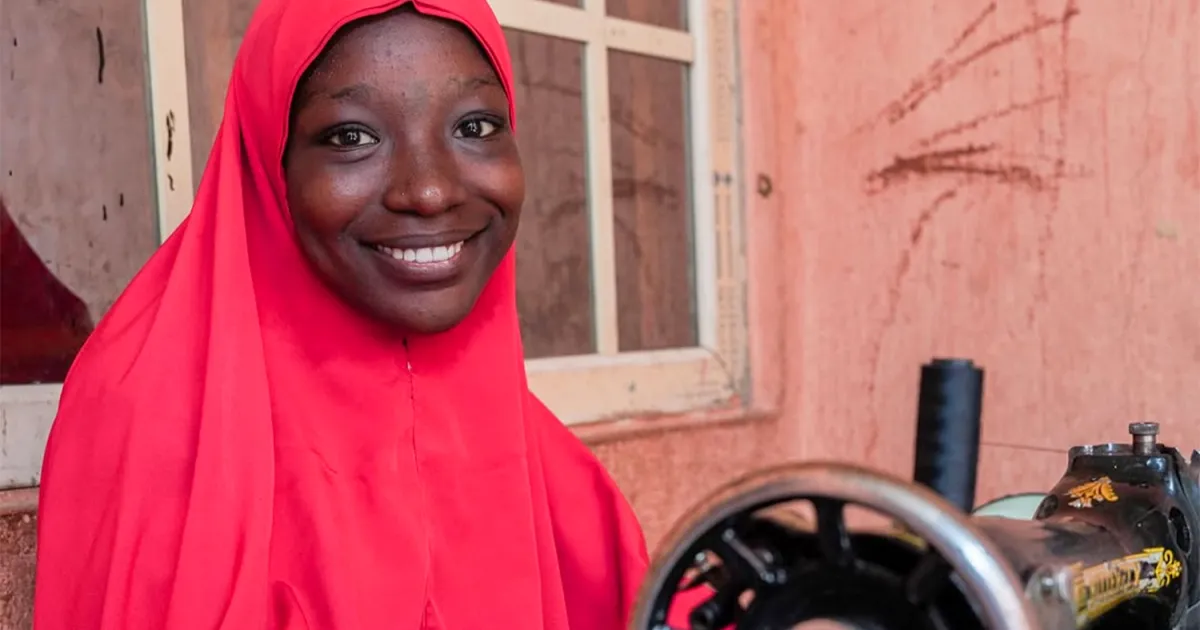
Jibia, Katsina State, Nigeria – Safiya Musa’s sewing machine has given her something violence had taken away: a way to provide for her children.
But the livelihood she built after losing her husband and two of her children has left her facing a painful choice: whether to return home or risk losing the fragile independence she has created after being forced to flee.
Safiya cannot remember which month it was, only that it was 2023, when armed bandits raided the town of Kankara in Katsina State, where she and her husband had built their life after moving from their hometown of Batsari. Kankara is a small rural community where farms sit close to homes, and her husband worked as a farmer and foodstuffs trader. They lived there with their two youngest children, Umar (4) and Maryam (6), while their three older children, Sani (12), Hajara (10) and Zubaida (8), were staying with relatives in Batsari.
The attackers had come to kidnap the town head, but the attempt failed. As gunfire spread through the community, Safiya locked herself inside her room while Umar and Maryam were outside playing with other children. Her husband had left for the farm when the attack happened. The bandits killed about 20 people as they left the town.
Three days later, after she had learned that her husband had also been killed during the attack, she fled to Batsari, where she was reunited with Sani, Hajara and Zubaida. When another bandit attack reached Batsari, she fled again with her three surviving children – now aged (15), (13) and (11) – to Jibia, where they eventually settled in a camp for displaced people.
She still remembers the night she lost much of her family.
“Minutes later, silence overwhelmed the atmosphere,” she recalled. “Then I started thinking about my husband, who had left for the farm, and my children, who were outside playing with other kids.”
The thought of them pushed her out of hiding.
But she was too late.
“They were all killed,” she told Al Jazeera.
Safiya’s experience reflects a wider crisis affecting communities across northwest Nigeria. For more than a decade, the region has faced attacks, kidnappings and village raids by armed groups commonly called bandits.
The violence has forced thousands of families from their homes, disrupted farming and trade, and left many people struggling to rebuild their lives.
Katsina State, which borders Niger, has been among the areas hardest hit.
After arriving in Jibia, Safiya survived by taking whatever work she could find. She ground grain for local residents and relied on temporary jobs to support her children.
She was then selected for a handbag-making training programme organised by the United Nations Development Programme (UNDP) through its Climate Security Project.
The initiative provides women affected by conflict with vocational training and equipment to help them start small businesses.
Months later, the programme gave her a source of income. The work brought stability, but it also created a new uncertainty: whether she could continue the business if she returned home.
“The essence is to give them an opportunity to become self-reliant,” said Muhammad Hamisu, the project coordinator in Jibia.
A skill that changed her circumstances
After completing the training, Safiya turned handbag-making into a source of income for her family.
With sewing materials and new skills, she began cutting fabric, stitching designs and producing handbags she could sell to support her children.
The work did not erase the pain of what she had lost, but it gave her something she had struggled to regain since fleeing: the ability to provide for herself.
“I used to wake up with nothing to offer my children,” she said. “There were days I sent my boys out with bowls to beg for food because I had nothing to give them. Now I can feed them myself.”
In March 2024, the Climate Security Project trained 20 women in Jibia in handbag production and provided sewing machines and materials to help them begin working.
Jibia’s location near the border with Niger also gives traders access to cross-border markets, including those in the Maradi region, one of Niger’s major commercial areas.
For some women, the business has become an important source of income.
“I make approximately $50 a month,” said 30-year-old Karima Sule, who has lived in Jibia since fleeing violence four years ago. “When demand is high, I earn even more. I help my husband and pay the school fees for my two older children from this business.”
A business shaped by insecurity
But building a business in a conflict-affected area remains difficult.
Safiya said her biggest challenge is finding enough money to buy materials.
“Sometimes I run out of stock and don’t have the funds to buy more,” she said. “When that happens, I lose customers.”
Karima said violence continues to affect sales.
“Whenever violence happens, market activities slow down for days,” she said. “People stop buying, and we lose income.”
Their growing economic activity may also expose them to new risks, according to Abdussamad Ahmad Yusuf, a human security researcher at HumAngle, a Nigerian newsroom that reports on conflict.
“Kidnapping for ransom in that region is becoming more targeted,” he said. “Authorities should conduct regular conflict and security risk assessments to identify high-risk trading routes, markets and emerging threats before expanding commercial activities.”
The Katsina government established the Community Watch Corps in 2023, a local security initiative that uses community members to gather intelligence and support responses to attacks.
Officials said security has improved in some communities, but many families who fled violence remain uncertain about returning home.
An uncertain future
Safiya hopes to return home one day and reunite her children with their relatives.
But the livelihood she has built in Jibia has become a reason to hesitate.
The handbag business has allowed her to buy food, support her children and depend less on unstable work. Leaving it behind could mean losing the independence she has worked hard to build.
She has been told that conditions in her hometown are improving, but she remains unsure whether she could rebuild the same source of income there.
For Safiya, returning home is not only about finding safety again. It is also about whether she can continue providing for her family.
“I want to go back home because my children need their relatives,” she said. “But I am afraid of losing this business. If I cannot continue it there, how will we survive?”