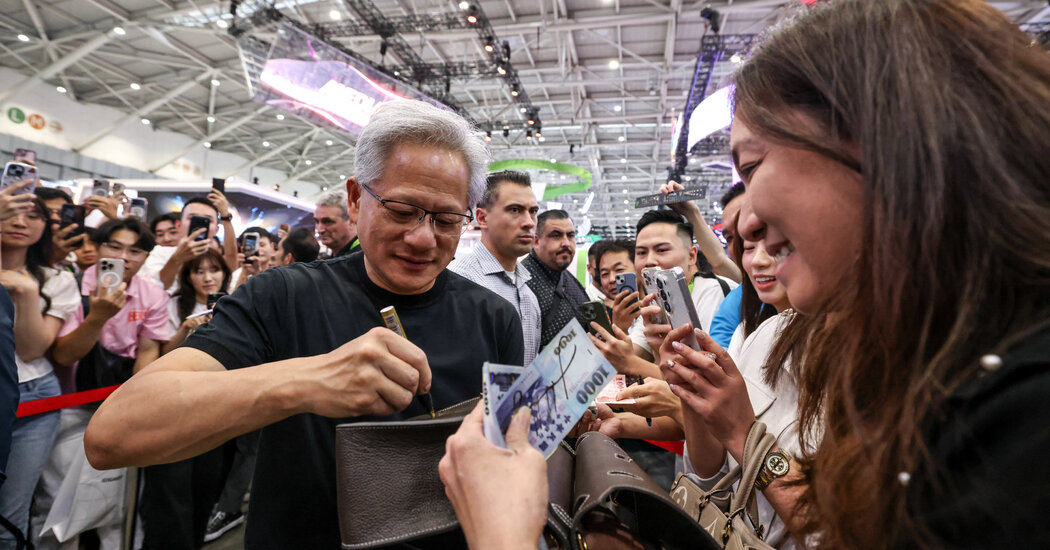
At Taiwan’s biggest computing show this month, Jensen Huang, the chief executive of Nvidia, was mobbed as if he were a rock star, trailed by a crowd from booth to booth as he signed autographs and posed for selfies.
At the stand of SK Hynix, one of his most important South Korean suppliers, Mr. Huang picked up a marker and left a message. Atop a reflective wafer of memory — a component of Nvidia’s A.I. supercomputers now in short supply — he wrote: “Please make more :).”
It was only half a joke. As tech giants pour hundreds of billions of dollars into data centers across the world, demand for the chips, wiring and power systems that run artificial intelligence is racing ahead of supply.
Nvidia became the world’s most valuable publicly traded company because of this spending boom. Now the bonanza is lifting a constellation of less famous semiconductor companies — among them many Asian firms few Americans have heard of — that make the essential, unglamorous parts of the data centers being built across the globe.
“This was a boring industry that no one cared about, but now it’s become the most critical infrastructure for the world,” said Timothy Arcuri, a semiconductor analyst at UBS. “They’re basically putting down the tracks, and there will be all this commerce on those tracks for years.”
The gold rush is redrawing the map of technological power. Chips are the brains of A.I. systems that process huge amounts of information. They also need memory technology that holds the information the systems are thinking about. In recent years, A.I. models have grown so vast that holding the information has become as valuable as processing it.
The most advanced memory comes, overwhelmingly, from South Korea and Taiwan, and soaring prices caused by supply limitations are piling new wealth into the two Asian democracies.
A decade ago, memory was a cheap commodity, priced in brutal cycles at the whim of larger tech firms. This year, prices have more than doubled. At the high end, just three companies make it: South Korea’s SK Hynix and Samsung and the American company Micron, whose most advanced factories are in Taiwan.
None of them are Chinese. Despite years of spending, Beijing has been locked out of much of the supply chain for advanced A.I. servers. For Washington, it is an accidental triumph: Subsidies meant to pull manufacturing from China achieved less than the boom has, almost overnight.
The success comes with a catch. Much of the technology is designed in the United States, but the supply chain still runs through Taiwan and South Korea, neighbors of China and North Korea where U.S. officials have long feared tensions could erupt.
South Korea’s stock market has roughly doubled in 2026, the best performance of any major market. Taiwan’s has set records of its own. Samsung and SK Hynix made South Korea the first country other than the United States with more than one company to top $1 trillion in market value at once. Micron joined the trillion-dollar club as well.
The evidence of the boom was everywhere at Computex, the Taipei trade show, which is an industry fixture devoted to deeply technical wares: data-center plumbing, voltage converters and memory products with names like HBM4E and SOCAMM2.
This year, there was even a little dazzle in the air. Strikingly international crowds gathered around exposed cooling pipes and lingered over bare silicon wafers in glass cases. At Nvidia’s stand, a lone server rack revolved on a plinth. Onlookers stopped to take selfies with the box.
At the SK Hynix booth, where Mr. Huang signed the wafer, an engineer named Vincent Wang said he had never seen the rally coming. A veteran of leaner years — when a crash in the memory market gutted Taiwan’s chip industry and nearly forced a government rescue — he did not even own shares in his own company.
To Mr. Huang’s plea to make more, Mr. Wang had a counteroffer: “Please pay more.”
In South Korea, where chip workers at Samsung and SK Hynix are collecting profit-linked bonuses, reports of lavish employee spending have filled the local news. Chip workers have set off a buying spree in exotic cars. Speculators are chasing apartments along the commuter-shuttle routes that serve the two chip makers. One matchmaking service raised its “spouse index” for Samsung employees, ranking them at the lofty heights of lawyers and doctors.
At Micron, which spent years buying up pieces of Taiwan’s memory industry, the good times are also rolling. In its home city, Boise, Idaho, it is building a 43,200-square-foot hangar for its corporate jets, with office space, a kitchen and a bay marked “executive parking.” It is part of a multibillion-dollar expansion in the state, among the largest private investments in Idaho’s history.
Samsung did not respond to emailed questions. Micron declined to comment. SK Hynix said it was accelerating construction of its chip-making factories and increasing production to meet demand.
Mr. Huang has become the industry’s kingmaker. Last year, Nvidia invested $5 billion in Intel, the struggling Silicon Valley chip maker, and committed to developing chips with it. Intel’s shares have risen nearly fourfold since.
“Everyone has a smile on their face right now,” said Frank Seifert, an executive at Adata, a Taiwanese memory company. He had followed Mr. Huang’s keynote address at Computex like thousands of industry fans. When Mr. Huang praised a partner, the chip design firm Marvell, and said it would be the next trillion-dollar company, Mr. Seifert bought the stock. It rose more than 25 percent that day.
The opportunities are lifting a new generation of start-ups in both Asia and the United States. A decade ago, venture capitalists didn’t want to touch chip companies, said Aaron Jacobson, a partner at NEA, a venture capital firm. They required huge investments to prove their technology worked, and their customers were tech giants that demanded low prices. Now the market is bigger and the customers are everywhere.
“If you look at what’s happening in the A.I. data center, there are so many roadblocks and things that need to be reinvented,” Mr. Jacobson said.
The moment is an inversion of the last great hardware boom. Twenty years ago, the smartphone turned China into the world’s factory floor. The United States, betting that commerce would bind the two countries and keep the peace, was content to let it happen. That seeded the manufacturing base that helped make China a rival.
This time, China is conspicuously absent. U.S. tariffs and technology restrictions have frozen Beijing out of a big part of the A.I. frenzy.
The South Korean and Taiwanese companies that once helped build that industry in China — through joint ventures, chip factories on the mainland and engineers lured away — are now harvesting a boom all their own. And the windfall extends beyond chips, into the racks, power systems and cooling that surround them.
Foxconn and Quanta, which became huge by assembling smartphones and laptops, now build A.I. servers in Mexico, Southeast Asia and Taiwan. Once-boring firms like Delta Electronics, which made its fortune on power supplies and cooling fans, are growing fast on the power converters and liquid cooling that A.I. data centers demand.
In Taiwan, where past boom-and-bust cycles bankrupted companies and rattled the economy, many remain wary. They were reminded of the risks last week when chip stocks tumbled on worries that the A.I. rally may fall short of Wall Street’s sky-high expectations.
But it has not stopped engineers from piling in. Smartphones beaming stock charts have become an ever more common sight around Taipei — in gyms, doctors offices and cabs.
The wafer that Mr. Huang signed will probably end up framed on a wall at SK Hynix’s headquarters in South Korea, Mr. Wang said.
Whether it reads, in time, as a souvenir of a historic boom or a relic of a bubble, it already marks something larger: the arrival of a nearly China-free supply chain for the world’s most advanced A.I., built on two of the most contentious locations on the map.
Joe Rennison contributed reporting from New York.