On Wednesday, fans across England will hold their breaths as the Three Lions take on Argentina in the nail–biting World Cup semi–final.
So, does England have what it takes to win the game?
If their headers are anything to go by, the answer is yes.
Scientists from Northeastern University have analysed the headers performed by teams at the World Cup so far.
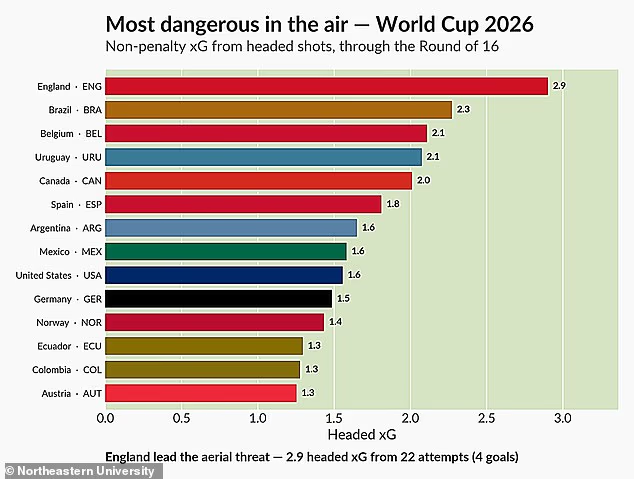
And their results suggest that England is the most dangerous team in the air, while Argentina is seventh on the list.
‘The most dangerous team in the air still in the tournament is England,’ the researchers explained.
‘England has a significantly higher total xG [expected goals] from headed shots (2.9 xG, with four goals on 22 attempts) than any other team.’
The news will come as no surprise to England fans, who were treated to header goals by Harry Kane during the games against Croatia and Mexico.
Scientists from Northeastern University have analysed the headers performed by teams at the World Cup so far. And their results suggest that England is the most dangerous team in the air, while Argentina is seventh on the list
![England has a significantly higher total xG [expected goals] from headed shots (2.9 xG, with four goals on 22 attempts) than any other team](https://i.dailymail.com/1s/2026/07/14/12/110004701-15976095-image-a-60_1784026827938.jpg)
England has a significantly higher total xG [expected goals] from headed shots (2.9 xG, with four goals on 22 attempts) than any other team
For their analysis, the team looked at the headers performed at the World Cup so far, and compared the results to those at the 2018 and 2022 tournaments.
Overall, they found that headers have accounted for a shrinking percentage of goals this year, dropping from 23.7 per cent in 2018 to just 17.9 per cent in 2026.
However, headers are becoming more accurate, converting at a higher rate (11.4 per cent), and producing more shots on target (33.5 per cent).
In addition, header assists have increased significantly.
Throughout the entire 2018 and 2022 tournaments, there were just two header assists – while there have been 10 already this year.
‘A trend from the past season of international club soccer offers a potential explanation,’ they researchers said.
‘There are more preplanned strategies executed on set pieces, specifically throw–ins and corner kicks.’
The analysis also found that the 2026 World Cup has seen a 38.8 per cent increase in long throw–ins into the box.

Interestingly, the researchers found that the majority of header goals have come towards the end of the halves
‘Off corner kicks and throw–ins, more players are making flick–on passes with their heads—a quick, redirecting touch of the ball—to teammates to finish, instead of attempting header shots directly off corner kicks,’ the team added.
Interestingly, the researchers found that the majority of header goals have come towards the end of the halves.
Nearly a quarter (24 per cent) came toward the end of the first half, while a third occurred late in the game.
This may come down to desperation, according to the experts.
‘Teams tried to get higher–quality scoring chances toward the end of the halves by moving players higher up the pitch toward the net, seeking either to gain momentum with a goal before halftime or to tie or take the lead in the game’s final minutes,’ they said.
The analysis comes shortly after the same research team built an algorithm that measures and ranks World Cup games for their level of excitement.
The model assesses five key factors – stakes, chances, drama, spectacle, and payoff.
Overall, it gives each game a rating from 0 to 10, with 10 being the most exciting game you could watch.
According to the model, Belgium’s game against Senegal tops the list as the most exciting game so far, scoring an impressive 9.65/10.
This is just ahead of Norway’s match against the Ivory Coast, which scored 9.49/10.
However, England fans might be surprised to learn that none of England’s clashes have even made it into the top 10.
Professor Brennan Klein acknowledged: ‘Reducing soccer to data risks stripping out some of its human richness – such as the Mexico–England match which, despite a tense atmosphere and exciting finish, didn’t crack the top 10.’