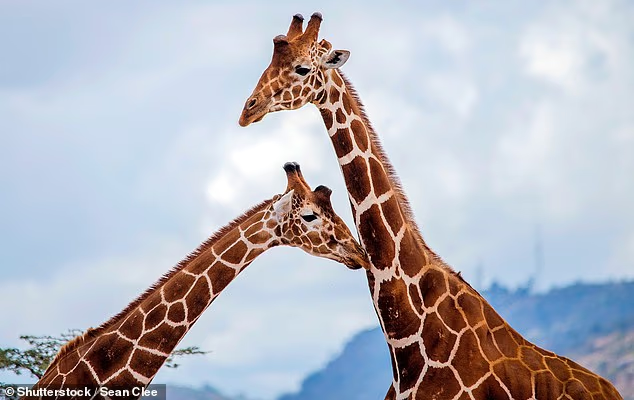
Giraffes are head and shoulders above the savanna competition when it comes to crunching numbers, according to a new study.
Researchers have shown that these long-necked grazers are capable of simple mental arithmetic.
The gentle giants can work out which of two options contains more food after mentally combining two quantities.
Scientists say that this process is comparable to carrying out simple addition sums.
This means giraffes could have a cognitive foundation that could support more complex arithmetic skills.
These surprisingly advanced skills may have evolved to help giraffes survive the demanding climate and social conditions they naturally thrive in.
Giraffes live in communities that split and regroup according to environmental conditions, and their main food source, acacia trees, is scattered across the savanna.
Co-author Iker Loidi, a PhD student at the University of Barcelona, says that this could ‘encourage the need to estimate where, when and in what quantities these resources are available in order to optimise foraging decisions.’
Researchers have shown that giraffes are able to carry out simple mathematical sums, such as addition, to work out where the most food can be found
Giraffes are part of the ungulata family of animals, which includes species such as hippos, camels and deer.
Some of these animals have demonstrated strong numerical abilities, such as performing simple statistical calculations, but giraffes’ mathematical abilities are relatively untested.
Scientists worked with four adult giraffes living at the Barcelona Zoo to see if they could be taught to do a few basic sums.
In the study, published in the journal Scientific Reports, giraffes were shown two yellow containers, each containing a certain number of carrots.
After a few seconds, the containers were closed, and the giraffe was shown a green container with a few more carrots inside.
These carrots were added to one of the yellow boxes, without showing the animal how many were now inside.
Alternatively, the green container was shown to the animals empty before a few carrots were taken from one yellow box and placed inside – demonstrating subtraction.
It was the giraffe’s job to try and pick which container contained the most carrots by adding up the quantities they had seen.

The researcher shows each animal two different quantities of carrots in two yellow containers and, after a few seconds, closes them. He then shows them another green container, which contains the amount of food that was added to one of the original containers.
The key is that the quantities were kept hidden from the giraffes after those initial few seconds, meaning they need to keep track of the numbers entirely in their heads.
Mr Loidi explains: ‘If this information were available to the giraffes, we could not conclude that the subjects are performing mental operations, as they might base their choice solely on the perceptual information available after the manipulation.’
However, despite these strict requirements, two of the giraffes in the study were able to consistently find which box now contained the most carrots.
This shows that giraffes remember quantities they have observed, mentally update that information following changes, and make decisions based on those ideas.
However, while they might be smart for ungulates, giraffes’ mathematical skills weren’t always quite so impressive.
None of the giraffes tested was able to keep track of the subtraction tests or ‘sequential operations’, such as removing food from one option and adding it to the other.
‘These results are consistent with what we observe in humans: there are individual differences in numerical problem-solving and, in general, subtraction is more difficult than addition,’ says Mr Loidi.
‘Furthermore, subtraction activates areas of the brain specialising in complex, controlled processing that addition does not stimulate.’

Two of the four giraffes tested were able to solve the combination (addition) sums with ease, but dissociation (subtraction) proved to be much more challenging
Even still, these findings show that giraffes’ mathematical abilities are far more advanced than expected.
Nor is this the first time that scientists have uncovered mathematical abilities in unusual parts of the animal kingdom.
Research has shown that chimpanzees and African grey parrots can solve sums using Arabic numerals, reaching sums up to four and eight, respectively.
Meanwhile, crows, pigeons, monkeys and even certain types of fish have demonstrated the ability to do simple sums.
Studies have even shown that bees can be taught to solve very simple maths problems.
Scientists from RMIT University in Australia managed to train 14 bees to add or subtract one from various numbers – getting questions correct up to 72 per cent of the time.
Co-author Dr Álvaro López Caicoya, of the Research Institute for Farm Animal Biology, told the Daily Mail: ‘This study builds upon a broader research program where we have previously demonstrated that giraffes possess an array of cognitive abilities, including object permanence, quantity discrimination, and the capacity to make statistical inferences.
‘Altogether, this contributes to the growing evidence that complex cognitive and quantitative skills are not exclusive to primates, but may emerge in other species in response to their own socio-ecological demands.’