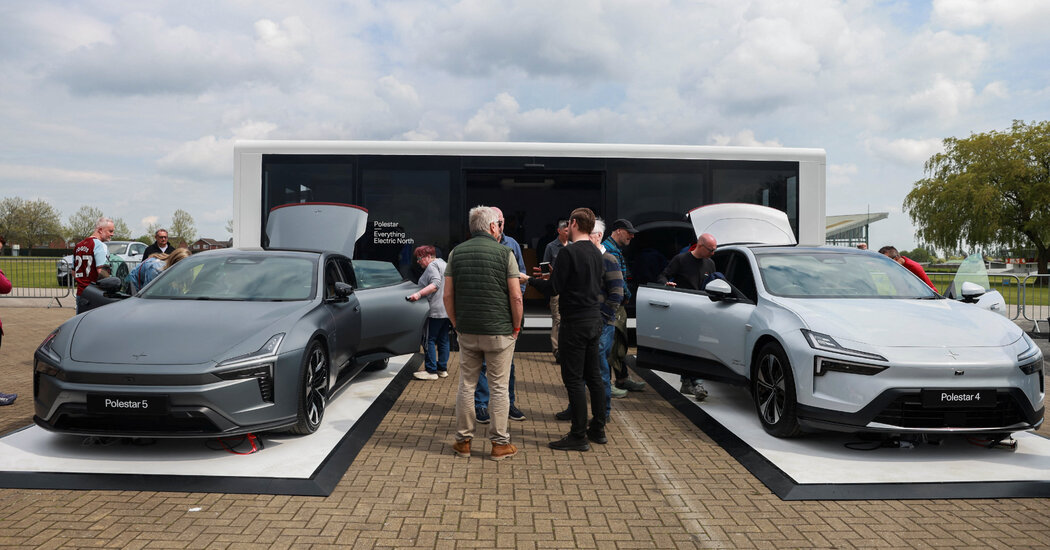
While dozens of car brands have disappeared over the ages (DeLorean, anyone?) experts say the Polestar exit looks less like Fisker, a defunct car company that suddenly shuttered, leaving owners to fend for themselves, and more like Suzuki, which exited the United States in 2012, but honored warranties in a yearslong wind-down. Because Suzuki is still operating, parts remain available, though independent mechanics now do the servicing. Polestar, too, will continue operating elsewhere, including in Canada and Mexico.
So who is the ideal buyer for the Polestar 4? Shoppers who are considering the Cadillac Lyriq, Porsche Macan Electric or Taycan, but are balking at the prices, the experts say.
First and foremost, it’s someone who trusts Polestar’s promise to provide parts, service and software.
This buyer is also willing to take what’s on the lot. These are people who appreciate a somewhat quirky luxury car, and don’t care about resale value. “The residual values are shot,” Mr. Shefska said. “Nothing is depreciating faster than a Polestar right now.”
One way to avoid the resale issue is to lease a Polestar 4. “The leasing could be a real deal out there,” said Kevin Roberts, an analyst for CarGurus. The lowered prices have brought lease numbers down to $399 a month for the single motor and $499, with $1,499 at signing, for the dual. Terms vary by geographic location.
Of course, there is the possibility that the value will increase if the cars become rare, and therefore collectible. “Maybe 30 years from now one shows up at a Barrett-Jackson auction and someone pays too much for it,” Mr. Shefska said. “There are always collectors of everything.”