At 18, Jan van Hövell brought a soccer ball to the Buduburam refugee camp in Ghana during a 2004 internship with the UN Refugee Agency. He said it was a terrible system, just one ball from one intern, and thousands of kids with nothing to do.
“I was the one bringing my football, and we would play, and we would connect, and we would have good times,” he says. “But I was also the one bringing my football, and I thought this couldn’t be the solution.”
He studied law, then spent five years in mergers and acquisitions at a top Amsterdam firm—lucrative, prestigious, and completely wrong for him. In 2016, he quit and wrote to his contacts at UNHCR, asking: “Can you give me a chance to go to a refugee camp and work with the community to find a solution for the lack of sports opportunities in refugee camps?”
The UN said yes. To pay his bills during the startup phase, van Hövell moonlighted as a professional DJ at weddings and corporate events while building what would become KLABU, Swahili for “club,” and formally launched as a foundation in 2019. The social enterprise builds sports clubhouses inside refugee camps: each one is a repurposed shipping container outfitted with solar panels, wifi, a TV screen, and a music system. Attached to it is a sports “library” where residents borrow equipment, like soccer balls and volleyball nets, to chess sets and running shoes, and then return the items so thousands of others can share them.
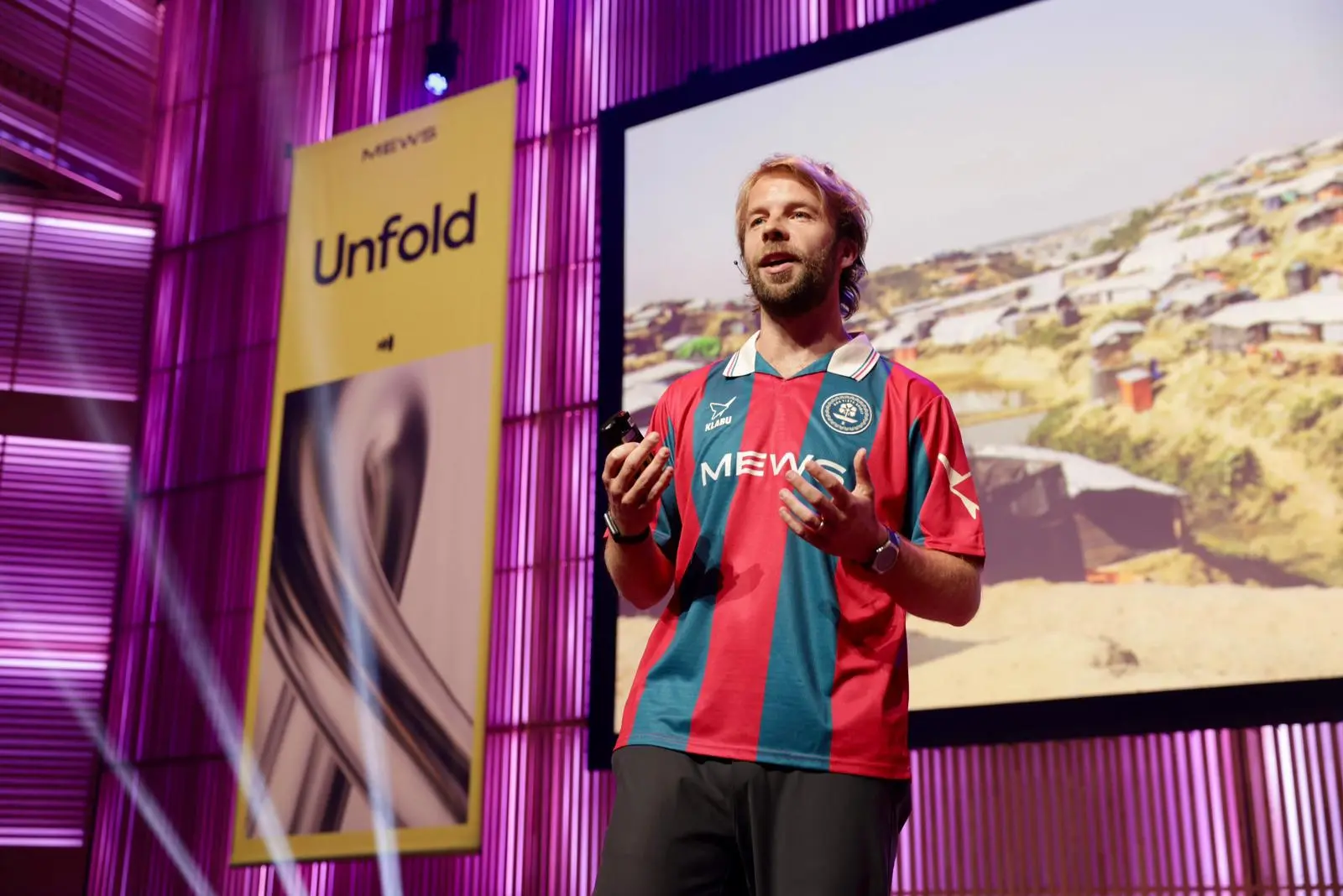
The average stay in a refugee camp is 21 years, not two or five as how most people assume, van Hövell said at the Mews Unfold conference in Amsterdam. “Children are born in refugee camps, they grow up in refugee camps. These are their new homes.” With 120 million forcibly displaced people worldwide, the number still rising. Camps provide schools and water, but almost nothing beyond survival.
“They need equipment, they need balls, they need nets, they need proper clothing. There are schools, there is water, but there’s not more than that.”
Faster than van Hövell expected, KLABU now runs 10 clubhouses across Kenya, Bangladesh, Jordan, Brazil, and Mauritania. “We now have 10 of these clubhouses, but what drives us every day is that we have a waiting list of 20,” he said. “We work with the UN and UNHCR, and they come to us almost on a weekly basis, and they ask us to come to Mexico, to Uganda, to Zimbabwe, to Malawi. So we have a lot of work to do.”
The scale challenge is most acute in Bangladesh, home to Cox’s Bazar—the world’s largest refugee camp, housing more than one million Rohingya. There, KLABU partnered with Paris Saint-Germain to deploy a mobile clubhouse that travels through the settlement, because no single fixed location could reach everyone.
Beyond PSG, the adidas Foundation, architecture firm MVRDV, hospitality tech company Mews, and Amsterdam streetwear brand Filling Pieces have all signed on. Mews became the main sponsor of KLABU’s newest location in Boa Vista, Brazil, home to Latin America’s largest shelter for indigenous Venezuelan refugees.
Part of the funding model involves designing and selling sportswear globally, which are also worn in the camps.
“Instead of them wearing our secondhand Messi shirts, let’s turn the story around,” van Hövell said. “Let’s have their shirt, their club, so that people can play the game.” Each clubhouse gets its own unique badge and kit, and 50 percent of sportswear profits flow to the foundation, with full commercial self-sufficiency as the long-term goal.
In March 2026, KLABU launched a membership program at €1 per month—exactly what it costs to give one person access to a clubhouse. Van Hövell’s ambition is to surpass Bayern Munich’s 400,000 members to make KLABU the largest sports club in the world by headcount. “It’s incredible what you can do with one euro, to give people that sense of community,” he said. The 2050 target is bolder still: 300 clubhouses reaching two million refugees.
“It brings everyone together. It gives that joy, that connection that we all need to not give up, that unbeatable spirit.”