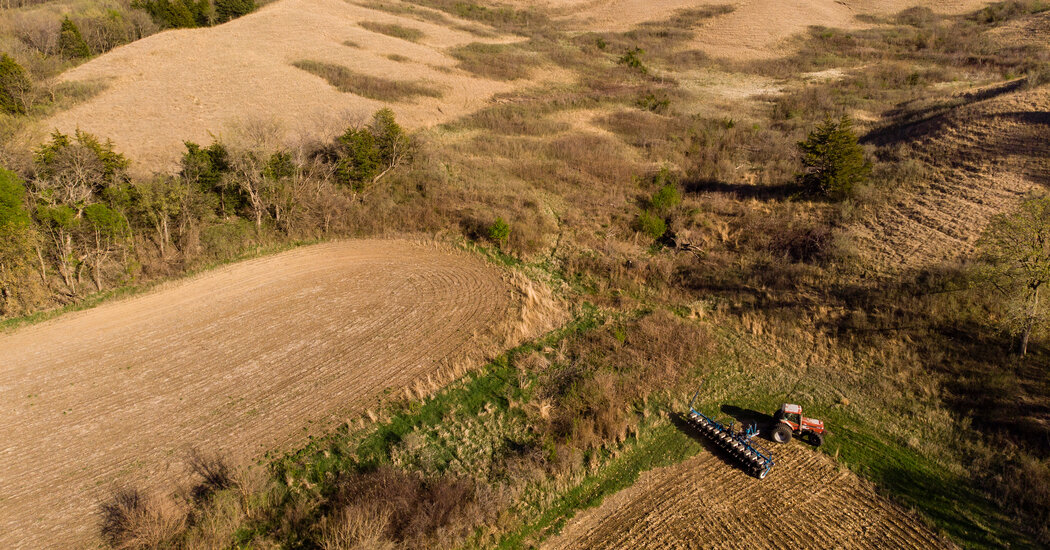
When 36 acres of pristine northwest Iowa farmland came up for auction in December, Bob Wassenaar knew he had to have it. Plots in this region rarely go on the market, and the land — with fertile soil and gentle slopes for drainage — is only a mile from a feedlot that he used to own and has since passed down to his sons.
But competition for the land was fierce. Four other bidders quickly pushed up the price at the auction. The $1.13 million Mr. Wassenaar ultimately paid is considered to make it the most expensive sale of Iowa farmland, on a per acre basis.
He never had any intention to grow and sell crops. Since buying the land, he has rented it out to his sons to grow more feed for the cattle that they fatten.
“If you are just going to buy that land and crop farm, no, it won’t work,” Mr. Wassenaar said. “It don’t add up.”
As agricultural costs rise and the prices for corn, soybean and other cash crops fail to keep pace, farmers are increasingly treating their land as real estate investments, focusing on the value of the soil — not what can be grown from it.
Traditionally, the value of farmland was mostly based on the profitability of its crop production, said Rabail Chandio, an assistant professor of economics at Iowa State University. Now many owners treat farmland as a separate asset, she said, divorced from the crops grown on it, instead of a farm input, like seeds and fertilizer.
Call it the financialization of farmland. It is keeping land values high and helping to stave off waves of bankruptcies and collapses that plagued American agriculture four decades ago, when farmers also faced dire economic conditions.
Most American crop farmers will lose money in 2026, the third straight year of losses. Farm income is down and debt is increasing, according to the Agriculture Department. Farm loan delinquency rates have ticked up, the Federal Reserve Bank of Kansas City found.
At the same time, land value is on the rise. The Agriculture Department says the value of cropland has risen a whopping 47 percent since 2020.
Some of the most valuable land is in Iowa, which averages $10,700 an acre, federal data shows, compared with the national average of $6,020.
Mark Zomer was the auctioneer of the plot that Mr. Wassenaar bought, and he sells much of the farmland in northwest Iowa. Two-thirds of his sales are to nearby farmers looking to add to their portfolio. But he estimated that up to a third of sales are to investors, who then rent the land out to local farmers. (The share of investors would probably be higher if not for Iowa’s restrictions on corporate ownership of farmland.)
“They realize it is a 1 or 2 percent return,” Mr. Zomer said. “Sometimes it is a 5 to 6 percent return. They like the steadiness.”
While some farmers are struggling to generate enough operating capital to pay for day-to-day expenses, the agricultural economy is staying afloat because of the equity they have in their land. Farm bankruptcies were up 16 percent in the first half of 2026 compared with the first half of 2025, according to Epiq AACER, a bankruptcy data provider, but are still on a pace to be lower than the number of farm bankruptcies in every year of the 2010s.
“I feel like Chicken Little. I keep expecting the ag economy to tank, with this extended run of losses and persistently high land prices, and it keeps rolling along,” said Austin Peiffer, an Iowa bankruptcy lawyer.
Today, 84 percent of Iowa farmland is owned debt-free. At the beginning of the 1980s farm crisis — when many farmers faced annual interest payments that exceeded their crop revenue and the rate of farmer suicides soared — the figure was only 62 percent.
Farmers then tended to have smaller plots and were more indebted, so when crop prices fell precipitously, catastrophe followed. More than 200,000 farms across the country went bankrupt, were foreclosed on or had their operations restructured in the 1980s.
“A lot of the family farms have been wiped out,” said John Rigler III, the president of Peoples Bank, one of Iowa’s largest farm lenders. “All the smaller little guys are out of the business.”
Mr. Wassenaar, 82 years old, was almost one of them. As a younger farmer in the 1980s, he said, he had to walk away from 40 acres of land he owned and allow the bank to repossess it. When he recovered financially, he resumed buying land. He says property he paid $3,000 per acre for 25 years ago is now worth more than $25,000 per acre.
He now owns about 1,100 acres.
Farmland as an investment is nothing new. Ms. Chandio traces the first big financialization of American farmland to the end of World War I, before the Great Depression brought much of the investment to a halt.
Institutional investors looking for stable, inflation-resistant returns have led the recent waves of investment, first after the 1980s crisis and then after the financial crisis of 2007 to 2009. Today, it is logistically and financially easier than ever to invest in a few huge farms and outsource their management.
“Each boom and bust, each wave of institutional capital and each improvement in management slowly turned farmland into a modern, financialized ‘real asset,’” Ms. Chandio said.
Only about 1 percent of agricultural land in the Midwest comes up for sale a year, which can help explain why bidding for it is so fierce.
“These farms don’t come up for 100 years or more,” Mr. Rigler said. “These guys are notorious for ‘overpaying.’ You say they overpaid 10 years ago, but that is a fair price today.”
Even when buyers of land are nearby farmers and not out-of-state investors, they tend to be older and wealthier farmers, like Mr. Wassenaar, whose holdings are worth millions of dollars.
The Gesink family, which owned the land Mr. Wassenaar bought in December, farmed it for decades before finally selling it for inheritance planning purposes. When the land went to auction, bidding began at $20,000 per acre — double the state average, and more than triple the country’s. By the time he outbid his competitors, Mr. Wassenaar paid $32,000 an acre.
Being so close to the feedlot means lower trucking and equipment costs for his sons, which was one of the things that attracted him to the land.
The federal government also plays a large role in increasing land values. The Agriculture Department estimates it will spend more than $44 billion on direct payments to farmers this year, and the Trump administration is seeking $11 billion more. Research from Ming Wang, an agricultural economist from North Dakota State University, found that about 45 percent of every dollar spent on commodity programs — which pay farmers when crop revenue or prices fall — ends up as higher cropland rent over time.
In essence, the government subsidy becomes permanently baked into the land’s rent, and therefore value, propping it up. “Any subsidy like that just kicks the can down the road and distorts the free market,” Mr. Rigler said.
The high price of land makes Mr. Wassenaar wistful. He was able to get his own start in farming. Even though he failed in the 1980s, he was able to revive his fortunes and give his children a head start. But it is evermore challenging for young farmers to afford the land, or the equipment, they need to get started. The average farmer is nearing 60, according to the Agriculture Department.
“As a young farmer, I could afford to go out there and buy some of this ground and make it work,” he said, “but the young farmer can’t these days.”