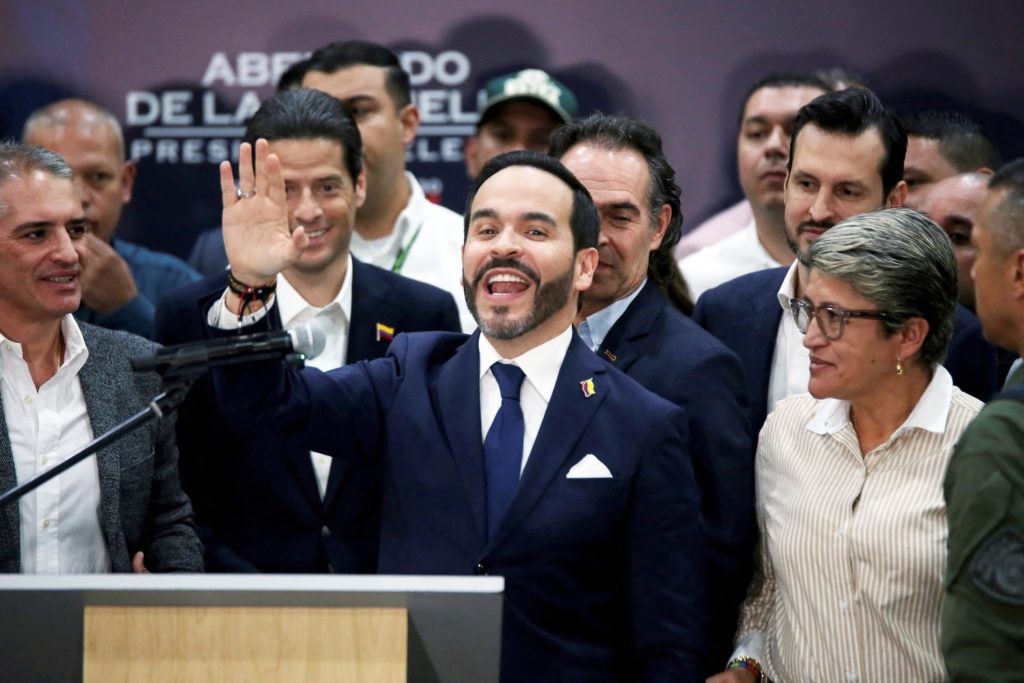
The new president of Colombia was inaugurated on Friday. Abelardo de la Espriella won a tight race in June, ending Colombia’s leftist movement with a sharp pivot to the right. Liz Landers takes a look at the president and his tight relationship with the Trump White House.
Amna Nawaz:
The new president of Colombia was inaugurated just a short time ago. Abelardo de la Espriella won a tight race in June that halted Colombia’s leftist movement with a sharp pivot to the right.
Liz Landers takes a look at the man and his tight relationship with the Trump White House.
Liz Landers:
In Colombia today, a wave of yellow jerseys and a tidal wave of change, as the South American nation ushered in a new era of its political future.
Abelardo de la Espriella Abelardo’s unprecedented actions began even before his presidency. The self-described political outsider and right-wing leader opted to move his inauguration out of the country’s capital of Bogota to the city of Santiago de Cali. It’s a move he said would get the ceremony away from Colombia’s Congress and seat of power and closer to the people.
Even with the promise to be a president for all, it was clear some were not happy with the political change. Security forces establish a heightened presence before the inauguration. Police seized a bus loaded with explosives in Southern Colombia which they believe was headed toward the inauguration site.
And across the country, hundreds gathered to protest, disavowing the incoming president. Outside the ceremony in Cali, some voters met the new president’s term with skepticism.
Ramiro Parra, Cali, Colombia, Resident (through interpreter):
Mr. de la Espriella’s inauguration won’t change the city itself. It will change the policies he implements, because the inauguration, like what they’re doing here, is more a matter of beauty, a fleeting decoration that will only last this week and the next. It could also lead to social conflicts, because he knows this is a city where he is not welcome.
Gimena Sanchez, The Washington Office on Latin America: Colombia now going to the hard right is basically shifting the entire region, especially South America, towards the right.
Liz Landers:
Gimena Sanchez is the human rights and anti-racism advocate at The Washington Office on Latin America. She has concerns about the mano dura, or iron fist approach, that de la Espriella promised to use in Colombia.
Gimena Sanchez:
It has had serious consequences in terms of human rights. We saw an incredible rise of extrajudicial killings committed by the armed forces during that period. And we also saw that there was a disproportionate impact in the rural areas that are governed and where you have the highest presence of indigenous and Afro-Colombian peoples.
Liz Landers:
Just weeks ago, de la Espriella competed in a closely watched run-off election against Ivan Cepeda, a left-wing candidate and human rights advocate. De la Espriella won by a razor-thin margin.
After the election, outgoing President and Cepeda supporter Gustavo Petro alleged widespread voter fraud without evidence to back up his claims.
Gustavo Petro, Former Colombian President (through interpreter):
So we are facing a fraud and an undoubtedly profound institutional problem. And that is the possession of an illegitimate presidency because the person who won is named Ivan Cepeda.
Liz Landers:
Cepeda conceded days after the vote. And, today, de la Espriella laid out his vision for the country.
(Cheering)
Abelardo Gabriel De La Espriella, Colombian President (through interpreter):
I serve the homeland.
Liz Landers:
De la Espriella is one of the latest right-wing Latin American leaders to be championed by President Trump.
Andres Martinez-Fernandez, The Heritage Foundation:
I think that there is going to be very little daylight between the United States and Colombia under these two leaders.
Liz Landers:
Andres Martinez-Fernandez is a senior policy analyst at the conservative Heritage Foundation.
Andres Martinez-Fernandez:
There is just a massive wave of pro-U.S., more conservative leaders coming to office in Latin America, Colombia and Peru being the latest, but you have had half-a-dozen just in the past year or so coming to power.
Liz Landers:
In June, Trump endorsed a then-candidate de la Espriella, writing — quote — “de la Espriella fights tirelessly for and loves his great country and people, just like I do for the United States of America.”
And Trump showed his support for the new president by sending a U.S. delegation that included acting Attorney General Todd Blanche.
Todd Blanche, Acting U.S. Attorney General:
We’re also excited for what we expect to be a great rekindling of a great partnership between the United States and Colombia.
Andres Martinez-Fernandez:
I think there is very much a response to the opportunity that the region has now with the Trump administration being so actively engaged with the Western Hemisphere to a level that we really haven’t seen before in American history. And that is opening up very important and unique opportunities for pursuing very important security gains.
Liz Landers:
Do you think that de la Espriella is going to feel a need to answer to Trump because of the aid and the economic situation that Colombia is in?
Gimena Sanchez:
I think that de la Espriella is probably feeling the pressure to make really big moves from the get-go, because there’s so much expectation from him from the U.S. that he’s going to be hard on narcotraffickers. So, yes, I think that the U.S. is going to have a tremendous influence on the direction that Colombia takes as things evolve.
Liz Landers:
That evolution will include new partnerships with fellow Latin American leaders for this new president, who hopes to usher in a transformation for Colombia.
For the “PBS News Hour,” I’m Liz Landers.