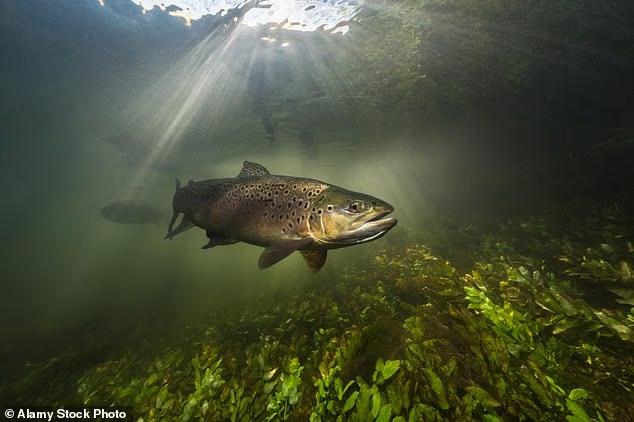
Artificially enlarged ‘Franken–trout’ that have ballooned to 20 times their usual weight are taking over Scottish lochs, activists claim.
Campaigners have accused Cooke Aquaculture, a Canada–based multinational, of allowing fish food to leak from its salmon cages.
This is being hoovered up by wild trout, who are devouring the food in a process called ‘cage–grazing’.
While the average Scottish loch trout weighs around 1lb (0.45kg), those near the salmon cages have been reported growing up to 20lbs (9kg).
This is unbalancing the ecosystem, activists say, with the large trout now eating smaller fish.
‘You can’t drop a factory farm into a wild loch and pretend you have control of where the feed, the chemicals, the faeces and the medicines go,’ Dale Vince, founder of the Green Britain Foundation, said.
‘You don’t, it all goes into the water, and the water goes where it will.
‘These monster fish, wild trout grown to a size nature never intended, are a direct result – Frankentrout, gorging on what pours out of the cages.’
Artificially enlarged ‘Franken–trout’ that have ballooned to 20 times their usual weight are taking over Scottish lochs, campaigners say (stock image)
Cooke operates fish farms in 16 countries and keeps young salmon in net cages in the north of Scotland, operating a number of fish nurseries across Shetland’s lochs.
One of the places where the super–sized trout are most common is the Loch of Cliff, the longest loch in Shetland, the campaigners say.
‘The loch was once noted for many small brown trout, but since fish cages were installed the native fish have grown much larger,’ a local fishing guide states.
A spokesman for Cooke, which supplies the likes of Waitrose, M&S and Tesco, said this site is ‘subject to strict environmental regulations and ongoing monitoring’.
Nick Underdown, Scotland director at WildFish, which campaigns to protect fish and their habitat, told the Daily Mail: ‘This is just another symptom of a woefully unregulated industry that is polluting our seas and lochs with virtual impunity.
‘Artificially fattening wild trout on industrial salmon feed can dramatically distort their natural distribution and role as predators within a loch.’
He also warned that elsewhere in Scotland, antibiotics are used at salmon farms to limit disease outbreaks.
These are usually administered through feed and can also slip through cages to be ingested by wild fish.

While the average Scottish loch trout weighs around 1lb (0.45kg), like this one pictured, those near the salmon cages have been reported growing up to 20lb (9kg)
‘An angler hooking a big trout should never be in the position of unknowingly taking home a fish that has been exposed to chemicals discharged by an industrial salmon farm,’ Mr Underdown added.
A spokesman for Cooke said that it had not used antibiotics at Loch of Cliff ‘for many years’.
The concerns raised by activists are part of a broader campaign urging the British public to avoid eating farmed salmon.
Campaigners and anglers argue that salmon farms act as breeding grounds for sea lice – parasites that latch onto migrating wild salmon and feed on their skin and flesh.
They also warn that escaped farmed salmon can interbreed with wild fish, potentially weakening the genetic resilience of native populations.
As well as concerns over salmon feed, the impact of the large volumes of fish faeces released from salmon farms into surrounding waters remains highly contentious.
Some scientists say high concentrations of waste can reduce water quality and harm local ecosystems, although the salmon farming industry disputes these claims.
A Scottish government spokesman said: ‘There are a small number of freshwater lochs in Scotland which are used to produce young Atlantic salmon for ongrowing in sea cages.
‘Some wild brown trout will forage on uneaten fish farm pellets as they pass through cages and these individuals may attain a larger size than other fish.
‘There is no evidence that localised excess food derived from these sites affects the viability of brown trout populations.’
Figures released by Salmon Scotland last month revealed how demand for the oily fish has soared over the last year.
Sales are up 7.3 per cent, with more than 81,000 tonnes of salmon sold in the 12 months to April.
According to Tavish Scott, chief executive of Salmon Scotland, the increase in sales is partly being driven by health–conscious diners.