A dad’s relaxing day of paddleboarding turned into a nightmare when he was bitten by the UK’s only venomous snake – and was left with an ‘elephant leg’ and unable to walk.
Zak Brown was paddleboarding with a friend at Cavenham Heath National Nature Reserve in Suffolk last month when he decided to pull over for a break.
The 39-year-old stepped onto the river bank where he inadvertently trampled on an adder lurking in the grass.
Within seconds, the business owner felt a sharp stabbing sensation on his left ankle and looked down to see a snake attached to his heel.
Describing the pain as ‘instant’ and ‘burning’, Mr Brown quickly realised he needed to seek medical treatment, but with no immediate way to leave the area, he and his companion had no alternative but to paddle for two hours back to the car.
After heading to hospital, he was given an injection of anti-venom and remained overnight for observation.
Doctors said Mr Brown was lucky the adder was just a juvenile, as the effects of venom from an adult snake may have been more serious.
The father of two says the pain was so ‘unbearable’ he was left unable to walk, and the snake’s fast-acting venom left his leg swollen and looking like it belonged to an ‘elephant’.
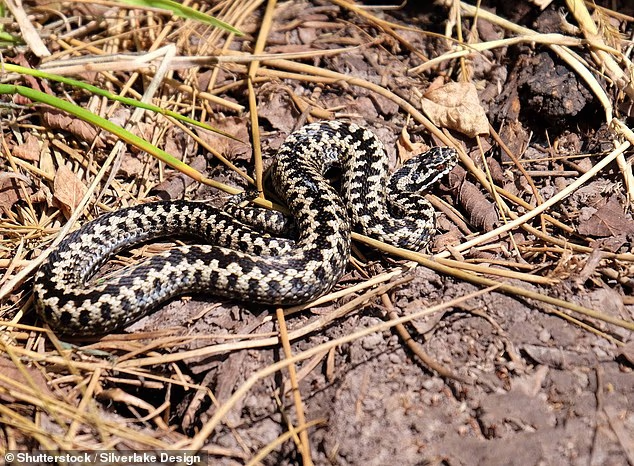
The common European adder, also known as the common European viper, is Britain’s only venomous snake


Doctors said Zak Brown was lucky the adder was just a juvenile, as the effects of venom from an adult snake may have been more serious. The pain was so ‘unbearable’ the dad of two was left unable to walk, and the snake’s fast-acting venom left his leg swollen and looking like it belonged to an ‘elephant’
The common European adder, also known as the common European viper, is Britain’s only venomous snake.
It is found across England, Scotland and Wales, mainly in heathlands, commons and woodland, and reaches lengths of up to one metre.
An adder bite is very painful and can make a person quite unwell, but it is rarely fatal to healthy adults. The last lethal bite recorded in the UK occurred in June 1975, when a five-year-old boy was bitten in Perthshire, Scotland.
Mr Brown, who lives in St Ives, Cambridgeshire, admits he now constantly checks the grass around him for snakes.
He said: ‘Me and my mate took the Friday off because it was going to be a 30-degree day so we planned a day out.
‘It had been ages since we’d been out on the river paddleboarding and kayaking. We set off and were cruising down the river nicely when we decided to stop for a little break.
‘As I climbed off my paddleboard, I walked up the grass verge and within seconds of standing there I just felt this bang on the back of my left ankle.
‘I jumped up because of the pain and saw this snake hanging from my ankle. It was a juvenile snake around half a metre. I was lucky it wasn’t a full adult adder.’


The business owner felt a sharp stabbing sensation on his left ankle and looked down to see a snake hanging from his heel. The pain was ‘instant’, he said. Within half an hour of the bite, his ankle had started to swell up

Mr Brown, who lives in St Ives, Cambridgeshire, admits he now constantly checks the grass around him for snakes

Mr Brown, who was paddleboarding with a friend at Cavenham Heath National Nature Reserve in Suffolk, stepped onto the river bank and was bitten by an adder lurking in the grass
The pair decided to make the two-hour paddle back to the car to have Mr Brown’s ankle examined. But within half an hour, his ankle began to swell.
‘The pain was spreading up my leg,’ he said. ‘I thought I might have to phone the air ambulance.
‘I couldn’t even stand on my leg – I just fell straight over. My whole foot and calf were swollen like an elephant. The pain was unbearable.’
After arriving at Addenbrooke’s Hospital in Cambridge, Mr Brown says his whole leg had swollen due to the snake venom.
Doctors promptly gave him an anti-venom injection and he was discharged the following day.
‘The doctors said if the snake was a full-grown adult, it could’ve been a different story, and I was lucky in that sense,’ Mr Brown said.
‘I couldn’t get anything back on my foot for four or five days because of the swelling.
‘Now, I’m non-stop cautious of snakes, constantly looking around the grass checking because I don’t want it to happen again.’
Experts have previously warned that adders in the UK could become extinct in 15 to 20 years.
Nick Milton, the author of The Secret Life Of The Adder : The Vanishing Viper, said there are only 260 sites with the snakes left in the UK.
He told Radio 4’s Today show that because many habitats have fewer than ten adders, the risk that the snake could be wiped out in the next two decades is high.
Mr Milton said one of the greatest threats to adders is pheasants – they kill and eat reptiles, including adders, on sight, pecking at adults and swallowing young snakes whole.
Nigel Hand, a trustee of Amphibian and Reptile Groups of the UK (ARG UK), who has been studying adders for 20 years, said: ‘The adder is on the brink of extinction in many sites across Britain… and it is the uncontrolled release of millions of pheasants by shooting estates which is pushing it over the brink.’
During the shooting season, around 47 million non-native pheasants and 10 million partridges are released into the countryside by estates and shoots across Britain.