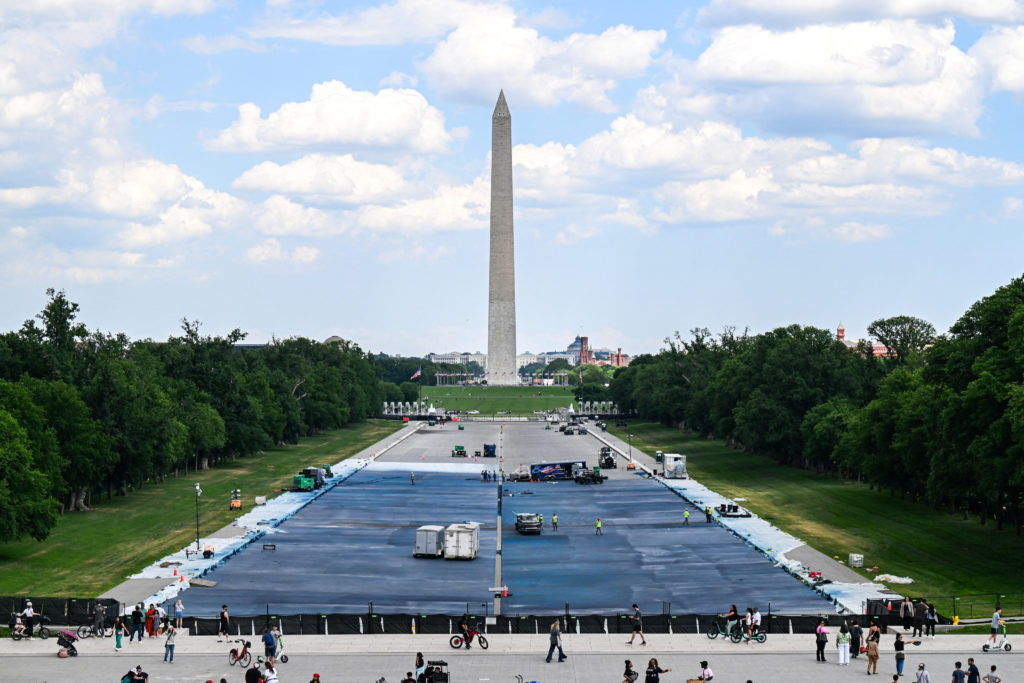
A non-profit group suing to stop President Trump’s Reflecting Pool renovation on the National Mall claims the project breaks federal law. Last month, the president announced the pool would be repainted blue. The New York Times is also reporting that its initial cost of less than two million dollars has now ballooned to seven times that figure. Amna Nawaz discussed more with David Fahrenthold.
Amna Nawaz:
A nonprofit group trying to stop President Trump’s reflecting pool renovation on the National Mall claims the project breaks federal law.
The Cultural Landscape Foundation filed a lawsuit today, saying the National Park Service violated an historic preservation act by repainting the pool — quote — “American flag blue.” The complaint says the new color — quote — “will fundamentally alter the visual and experiential character of the pool.”
The president announced the project last month and drove through the pool’s construction site just last week. The New York Times is also reporting that its initial cost of less than $2 million has now ballooned to seven times that figure.
For more on the project, I’m joined now by one of the reporters covering that story. That’s David Fahrenthold of The New York Times.
David, welcome back.
Let’s begin with your reporting on this that shows that initial cost estimate from the president of $1.8 million now up to $13.1 million. What happened there?
David Fahrenthold, The New York Times:
Well, the — President Trump has said multiple times that this project is only going to cost $1.8 million or less than $2 million. That’s never been right.
From the beginning, the federal government had expected to pay $6.9 million for this contract. And then, on Friday, that cost jumped again by another 88 percent. So now we’re talking about $13.1 million.
Amna Nawaz:
And the contractor for this project, your reporting also showed, had no previous federal contracts. How unusual is that for a renovation like this?
David Fahrenthold:
It’s quite unusual for a renovation of this size and this sort of importance.
Remember, this is not a swimming pool. This is a pool that’s about 2,000 feet long. It’s been around since the 1920s. It has a lot of complicated problems that come from both its age and its size. And the contractor they chose to do it, not only is this their first federal contract, but it’s not clear this is a swimming pool contractor at all.
Their Web site is more about lining pipes and culverts and fuel tanks. It’s clear this is a very different project than the ones that they appear to be used to.
Amna Nawaz:
So folks will remember the images from last week that showed the president and his motorcade driving through that pool area. When we saw those, I know a lot of folks had the same question was, is that going to impact the pool in any way? What does your reporting show you on that?
David Fahrenthold:
Well, from folks we have talked to, it will not probably make the pool look any different in terms of reflectivity. If you’re standing on the steps of the Lincoln Memorial, you’re standing at the World War II Monument on the other end, and you’re looking across the pond at a low angle, it’ll probably still be reflective.
The difference, though, may come when you see it from a higher angle, from an airplane or the top of the Washington Monument. This is a space that’s meant to sort of be invisible. It’s supposed to reflect back the gray stone and the trees all around it.
If what you see instead is kind of an artificial blue, like a — the water hazard at a mini golf course, that could stand out in a very jarring way on the National Mall.
Amna Nawaz:
We know that the president has framed some of these renovations as part of a broader beautification effort ahead of those America 250 celebrations. What do we know about what that means about who’s paying for much of this?
David Fahrenthold:
Well, in the cases — in this case and in the case we wrote about recently about changes to the fountains around D.C., the government is paying for it.
It’s not private donors. And the money they’re using in this case is coming from people that go to national parks. If you go to a national park and pay an entrance fee, some of that money goes to the Park Service to pay for renovations. And that’s the fund they’re using here.
Amna Nawaz:
I know as we reported earlier that at least one nonprofit is trying to block this project. But this is one of several renovation projects that we know the Trump administration is looking to at least partially fund with taxpayer money.
We have seen the Kennedy Center renovation, the White House ballroom, and others. As you track this, as ethics watchdogs and other track this, what are some of the concerns that are coming up here?
David Fahrenthold:
One of the biggest concerns about this project and others around the area is that these are no-bid contracts. The government is supposed to let multiple vendors bid on jobs like this so the taxpayers get their best bang for the buck.
In this case, the Trump administration used sort of a special power to block out all competition and hand this job directly to a firm that President Trump says is close to him. He says, this is a company that worked on the swimming pools at his golf club in Northern Virginia.
And so what happens when you give a contract directly to somebody with no competition, you don’t really know you’re getting the best deal. You don’t know that you’re getting the best person for the job. And so it raises questions about why they’re circumventing the normal contracting process and what we’re losing in the process in terms of quality or maybe overpaying.
Amna Nawaz:
David, in the 45 seconds or so I have left, I know you track the money often when it comes to the president’s decisions around things like this. Where does this latest project fit into the broader pattern?
David Fahrenthold:
Well, we have been looking at the way President Trump has been doing two things with these projects around D.C., both using no-bid contracts to direct money to firms that are close to him, and also circumventing the historic review process that’s supposed to keep the Washington core, the monuments of Washington looking consistent and preserved.
And what we’re seeing here is that he evaded both those systems here and just sort of went around them all to have the reflecting pool painted blue because that’s what he wanted.
Amna Nawaz:
David Fahrenthold of The New York Times, always good to talk to you. Thank you so much.
David Fahrenthold:
Thank you.