The world is on track for ‘extraordinary extreme weather’ later this year, scientists have warned.
The first four months of 2026 have already seen more land burned by wildfires than ever before, according to experts from World Weather Attribution (WWA).
Around the world, 150 million hectares (580,000 square miles) of land have already been destroyed – more than twice the recent average.
However, with record-breaking temperatures now likely, a panel of leading experts now says the situation is only expected to get worse.
Researchers say that a developing El Niño weather pattern is now poised to make 2026 the hottest year on record.
While El Niño is a natural cycle, its effects will combine with human-caused climate change to trigger devastating consequences.
Scientists now anticipate an ‘unprecedented year of global fire and record-breaking weather events’.
Dr Zachary Labe, climate scientist at Climate Central, says: ‘From unseasonable heat waves and growing wildfires to missing snow on the highest mountain peaks, 2026 is flashing a warning sign of how climate change amplifies extremes.’
The world is on track for ‘extraordinary extreme weather’ later this year, scientists have warned, as global ocean temperatures indicate a record-breaking heat is likely

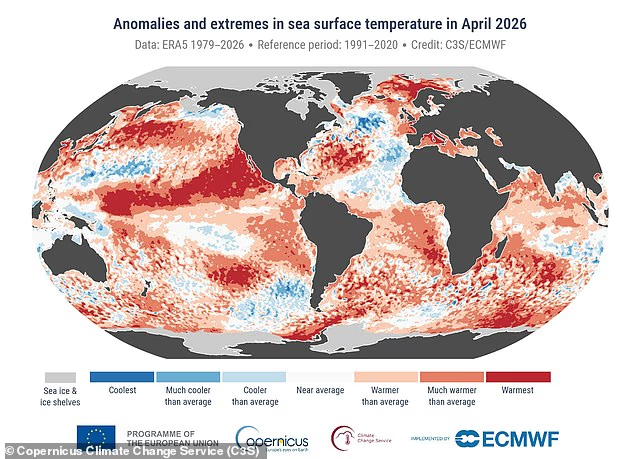
Copernicus’ latest data shows that the average sea surface temperature (SST) last month over 60°S–60°N was 21°C (69.8°F), approaching the hottest they have ever been
This dire warning comes as scientists have begun to track the development of a ‘Super El Niño’ phase in the natural cycle of the El Niño–Southern Oscillation.
The El Niño–Southern Oscillation is a natural climate pattern which cycles between a hot El Niño and a cool La Niña phase every two to seven years.
During the El Niño part of the cycle, warm waters that build up in the Pacific spread out and raise the Earth’s average surface temperature.
Currently, global warming is being held in check by a cooling La Niña pattern that is making 2026 a little bit less hot than previous years.
However, sea surface temperatures are now approaching the highest levels ever recorded, with some days exceeding the record levels set in 2024.
According to a number of leading scientists, this is a clear indication that the world is about to feel one of the strongest El Niño years of the century.
The concern is that the natural El Niño variation will combine with warming already in place due to climate change, and trigger extreme weather well beyond the norm.
Dr Friederike Otto, leader of the WWA and climate scientist at Imperial College London, told reporters: ‘El Niño is a natural phenomenon that comes and goes, but of course it now happens on an increasingly warm baseline.

Scientists predict that the latter half of 2026 will see the formation of a ‘Super El Niño’ phase in the natural cycle of the El Niño–Southern Oscillation, which could make this the hottest year on record
‘What makes it so dramatic is not the El Niño event itself, but that it’s happening in a dramatically changed climate.’
A recent study predicted that 2026 has a good chance of being the hottest year on record, coming in 0.06°C (0.11°F) hotter than the record set in 2024.
Dr Daniel Swain, climate scientist at the California Institute for Water Resources, says: ‘In modern human history, we’ve never experienced a strong or very strong El Niño event amid pre-existing conditions that were this warm globally.
‘It would not be surprising to see some unprecedented global impacts by later in 2026 into 2027 in terms of flood, drought, and wildfire-related extremes.’
The most pressing concern is that this will lead to an increase in wildfires all over the world.
This year has already seen extreme temperatures that would have been ‘virtually impossible’ to achieve without climate change, according to the WWA.
In the US, several states broke records for the hottest winter on record, while a heatwave in March was the most geographically widespread in American history.
Meanwhile, temperatures in parts of India have soared to 46°C (115°F).

The added heat from El Niño will combine with existing global warming to trigger an unprecedented wave of wildfires
This has led to massive wildfires in the Americas, with Chile and Argentina losing nearly 25 acres every minute, while Nebraska, Florida, and Georgia have all seen historically large fires.
Fires have also spread across Asia, where thousands were forced to flee their homes in Japan as 1,400 firefighters battled to hold back days of blazes.
Scientists warn that the hot, dry conditions associated with an El Niño year are likely to combine with existing climate change to make these conditions even worse.
These changes will be felt most in the rainforests of the Amazon, Oceania and Southeast Asia.
Dr Swain says: ‘Here, a strong El Niño against the backdrop of elevated baseline temperatures could increase the risk of widespread or unusually intense fires in normally damp regions where such fires are not common.’
Dr Swain warns that this could lead to ‘large impacts’ on ecosystems and human populations.
Likewise, Dr Theodore Keeping, an expert on extreme weather from Imperial College London, adds: ‘El Niño has a strong effect on hot and dry conditions.
‘We would particularly expect to see this impact in hot and dry places along the South American west coast, including parts of the Amazon.’

This year has already seen devastating wildfires around the world, including in Japan, where thousands have been forced to flee their homes (pictured)
Besides extreme wildfires, the elevated temperatures coming later this year will also trigger extreme weather events all around the globe.
El Niño years typically lead to hotter and drier summer conditions in Europe, Australia, Southeast Asia, and southern Africa.
However, the additional heat means the atmosphere can also hold more water and energy, leading to extreme rainfall and violent storms in other regions.
This leads to regions experiencing back-to-back periods of drought followed by flooding.
Spain, for example, has had its wettest January and February, just a few years after suffering the driest climate in at least 1,200 years.
This ‘climate whiplash’ makes events such as flash flooding significantly more likely and weakens governments’ ability to mitigate the impacts of climate change.