It’s known as one of the most remarkable summers of British history – but 1976’s 30°C record has been broken, experts have revealed.
Scientists at Reading University have recorded 15 days over 30°C so far this year, following a run of heatwaves that have left the nation sweltering.
This has overtaken the previous record of 14 days recorded 50 years ago – and we’re only halfway through summer.
The Reading University Atmospheric Observatory recorded its first 30°C day on Sunday 24 May, when 30.8°C was reached.
Over the next seven weeks this threshold was breached another 14 times, including yesterday when 30.7°C was recorded.
Commenting on the new record, Professor Andrew Charlton–Perez, from the University of Reading, said: ‘For half a century, 1976 was the benchmark every hot summer got measured against.
‘Now 2026 has taken its place. We’ve recorded 15 days above 30°C so far this year, overtaking the 14 days set in 1976, and there’s still six weeks of summer left to go. That tells you something important.
‘Our climate is shifting, not just having a warm spell. Summers this hot and dry used to be rare, once–in–a–generation events. Now they will be far more frequent, and that brings real dangers for public health that we cannot afford to ignore.’
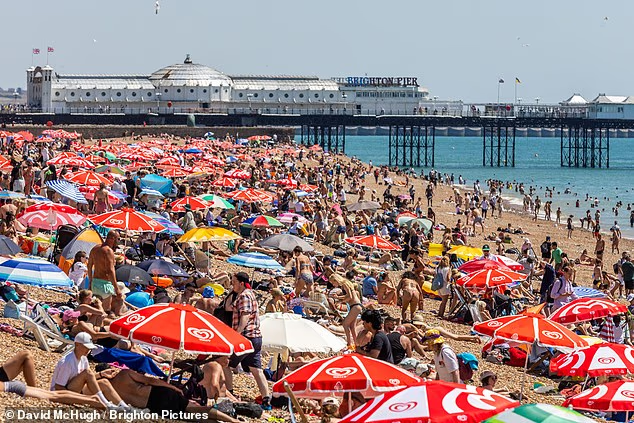
Scientists at Reading University have recorded 15 days over 30°C so far this year. Pictured: Thousands flocked to the beach in Brighton, East Sussex on Saturday to enjoy the weather

The record has overtaken the previous one set 50 years ago. Pictured: Brits take to the sea in their droves at Brighton Beach during the summer of 1976
The University of Reading’s observatory has been recording data on temperature since 1908.
‘On the university’s records, the previous greatest number of such hot days in any year was 14 days in the legendary summer of 1976,’ the experts said.
‘Before that another exceptional summer, in 1911, reached this level on 13 days.
‘Prior to this summer, only four years since 1908 have ever attained 10 or more such instances.’
As warm temperatures are forecast to continue this week, there’s a chance an even higher record could be set in the next few days.
The Met Office recently confirmed that last month was England’s hottest June on record with an average temperature of 17.1°C.
The exceptional warmth was driven by an intense and record–breaking heatwave at the end of the month. It was also bolstered by a slew of ‘tropical nights’, when the temperature did not drop below 20°C.
June’s temperature record was broken several times – with the hottest recording of 37.7°C being registered at Lingwood in Norfolk.

In June, the Met Office issued extreme heat warnings for large swathes of the UK. Experts predict 2,200 people died as a result of heat during the month

The 2020s has already seen more 30°C days compared to other decades, experts at the University of Reading revealed
Professor Stephen Belcher, Met Office Chief Scientist, said: ‘To see temperatures like this in the UK in June is sobering.
‘Events like this bring home the implications of climate change, with very high temperatures and humidity bringing significant health implications from heat stress, as well as impacts to a range of sectors such as transport, energy and water supply.’
2026 has also become the first year where temperatures of 35°C were recorded in the UK on six separate days.
The record was formerly held by 1976 and 2020, during which five days were recorded with temperatures over 35°C.
Met Office projections indicate that hot spells will become more frequent in our future climate, particularly over the south–east of the UK. Temperatures are expected to rise in all seasons, but the heat would be most intense in summer.
Experts have also warned that a ‘super El Niño’ could bring even hotter conditions to the UK later this summer.
NASA satellites have confirmed that the weather phenomenon – characterised by warmer water in the equatorial Pacific – is ‘underway’.
The space agency predicts this El Niño event will have ‘widespread effects’, including bringing wetter conditions to the American Southwest and drought to countries in the western Pacific. But experts say we can also expect extreme heat ‘almost everywhere’ – including the UK.

The 2020s has also seen more average sunshine hours compared to previous decades, as this chart reveals

These maps show average changes in temperature across England throughout May and June, with the south east experiencing the greatest change
While its influence on British weather is indirect, a particularly strong El Niño event could raise global temperatures and supercharge the heating effects of climate change.
This weekend, it emerged that the May and June heatwaves are thought to have claimed more than 2,700 lives.
A team from Imperial College London said almost half of these deaths have been fuelled by climate change.
They warned that the UK now experiences ‘dangerously hot summers’ that claim thousands of lives.