Images from NASA show the exterior and interior scan of samples taken from the asteroid Bennu on a mission in 2020.
The surface of asteroid Bennu has long left questions for scientists after a NASA planetary science mission showed the asteroid was actually more rough and jagged than previously expected.
NASA’s Origins, Spectral Interpretation, Resource Identification and Security-Regolith Explorer (OSIRIS-REx) departed Earth in 2016 to collect samples of Bennu, a near-Earth asteroid.
NEW DEVELOPMENTS IN NASA ELECTRONICS WILL LEAD TO FURTHER INTERPLANETARY EXPLORATION
Images taken by NASA’s Spitzer Space Telescope in 2007 indicated low thermal inertia, meaning Bennu’s surface rapidly heated up and cooled down as it moved in and out of sunlight.
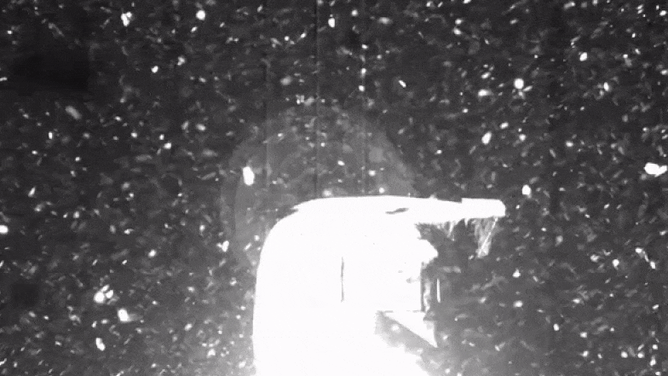
SamCam imager’s field of view as the OSIRIS-REx spacecraft approached asteroid Bennu’s surface and tapped it to collect a sample. The images were taken on Oct. 20, 2020.
(NASA/Goddard/University of Arizona / NASA)
OSIRIS-Rex arrived in December 2018, and scientists were surprised to find that the asteroid was actually covered in large boulders, not smooth patches like researchers and the prior observations from Earth had shown, according to a report by NASA’s Science Editorial Team.
What this should’ve meant is the boulders held onto heat for long periods of time, not rapidly cooled down.
NEW DEVELOPMENTS IN NASA ELECTRONICS WILL LEAD TO FURTHER INTERPLANETARY EXPLORATION
“We expected some boulders, but we anticipated at least some large regions with smoother, finer regolith that would be easy to collect. Instead, it looked like it was all boulders, and we were scratching our heads for a while,” Andrew Ryan, a scientist with the University of Arizona’s Lunar and Planetary Laboratory, said in the report.
OSIRIS-Rex collected its samples of Bennu and returned to Earth in 2023. Since then, NASA scientists and researchers have been studying the samples and collecting data from them to better understand the early solar system and how asteroids impact Earth.
MARCH SKYWATCHING GUIDE: CATCH A BLOOD MOON, PLANET CONJUNCTION, AURORAS, AND MORE
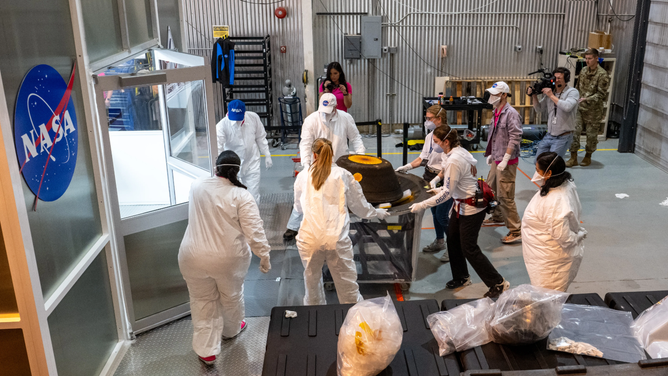
OSIRIS-REx’s sample capsule in September 2023 after its return to Earth from collecting samples on Bennu.
(NASA)
Multiple techniques were used by Ryan’s team to study the samples.
A study published in Nature Communications showed that the boulders are indeed porous enough to account for some of the heat loss, but not all of it. Many of the boulders turned out to be riddled with cracks.
NASA launched ESCAPADE (Escape and Plasma Acceleration and Dynamics Explorers) on Nov. 13, 2025, which is a mission to investigate how the Sun continues to influence Mars and will begin to study space weather in new ways.
In order to determine if the cracks were the reason for the heat loss, more tests and research began. One such test, done by Nagoya University in Japan, used lock-in thermography to measure the sample’s inertia.
The study revealed the thermal inertia to be much higher than what OSIRS-Rex recorded.
NASA STILL ON TRACK TO LAUNCH ARTEMIS II TEST FLIGHT AFTER ROLLBACK DUE TO REPAIRS
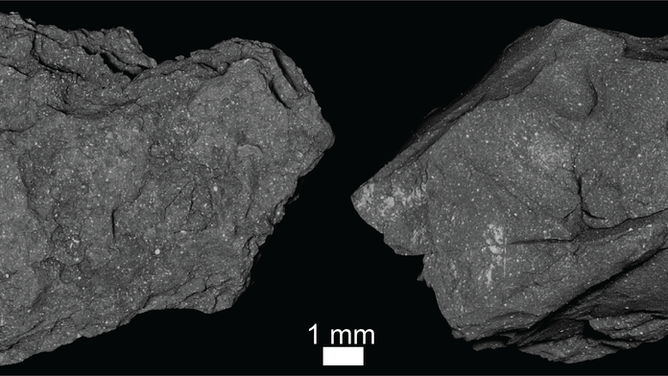
Exterior images of Bennu’s samples examined under X-Ray CT.
(NASA)
NASA’s Johnson Space Center in Houston conducted another test to determine how the boulders would behave on the asteroid, scaling up the operation.
Using a glove box, the team sealed samples in an airtight container under a protective nitrogen atmosphere, then transferred them to a lab where they could perform X-ray computed tomography, or XCT scans.
SEE IT: METEOR CAUGHT ON CAMERA STREAKING OVER PITTSBURGH, REPORTS OF LOUD BOOM ACROSS OHIO VALLEY
After it was scanned, the particles were returned to the glove box.
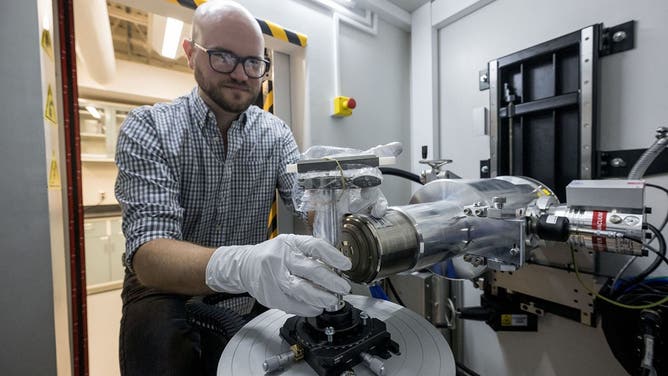
Scott Eckley, X-ray scientist within NASA Johnson Space Center’s Astromaterials Research and Exploration Science (ARES), demonstrates the process for placing a container holding a piece of asteroid material in an X-ray Computed Tomography (XCT) machine. XCT scans let researchers image particles through airtight containers and visualize a rock’s shape and internal structure without damaging the sample.
(NASA/Robert Markowitz / NASA)
“X-ray computed tomography allows us to look at the inside of an object in three dimensions, without damaging it,” study co-author and NASA Johnson X-ray scientist Scott Eckley said in the report.
DANGEROUS ASTEROID NO LONGER EXPECTED TO HIT THE MOON IN 2032
The XCT scan created a permanent three-dimensional scan of the sample, including its shape and interior.
Ryan’s team then used the XCT data to model heat flow and thermal inertia, scaling it up to boulder size. Doing this matched OSIRIS-REx’s findings on Bennu, the report said.
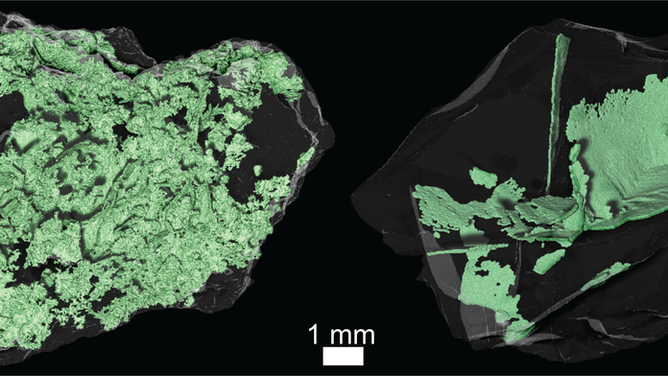
Internal structure of Bennu’s samples taken via X-ray CT.
(NASA)
The samples revealed exactly what they needed to know.
“It turns out that they’re really cracked, too, and that was the missing piece of the puzzle,” Ryan said.
SEE IT: FIRST-OF-ITS-KIND NASA ROTORCRAFT NEARLY READY TO EXPLORE SATURN’S MOON IN 2034
The research done into Bennu’s surface will help future research into asteroid studies.