
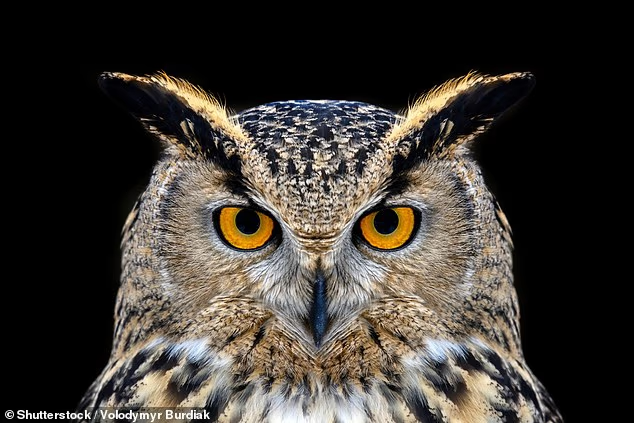
You may think of yourself as being a night owl or a morning lark – but do you know what type of early bird or evening person you truly are?
Experts believe people fall into one of five different camps – rather than just two – when it comes to their sleeping patterns.
In fact, a team of neurologists and psychiatrists say there are three kinds of ‘night owl’.
One group tends to be high performers who like a drink, typically drive fast and excel at problem-solving, as well as being more likely to have children.
Then there are the risk-taking energetic night owls, typically men, who love social groups, are very physically active and enjoy drinking alcohol.
But a third group are more likely to be physically inactive and at risk of developing depression.
Among morning people, there is a group many would imagine when picturing early risers: those who live stable lives with few risk-taking behaviours who are not likely to drink very much.
But there is a second group of early birds, more likely to be women, whose early schedule appears to be a cause of tiredness and who may struggle more with anxiety.
Experts believe people fall into one of five different camps – rather than just two – when it comes to their sleeping patterns
The five groups were identified by using an AI algorithm to analyse more than 27,000 people in the UK Biobank health study, published in the journal Nature Communications.
Researchers looked at whether participants identified as night owls or early birds, then sorted them into smaller groups based on similarities in their brain structures and connections, also asking about their personality traits, behaviours and physical and mental health.
Le Zhou, a neuroscience and data researcher from McGill University in Canada, who led the study, said: ‘Two people who both prefer late nights can have very different brains, lifestyles and health-related behaviours.
By identifying subtypes, we can better understand why some people thrive on late schedules while others struggle, and why being an early riser doesn’t guarantee good health.
‘Depending on your subtype, you might need to focus on curbing impulsive behaviour, staying active or getting the right social support, rather than simply changing your bedtime.’
The first night owl group, the high-performers, had faster reaction times and were better at puzzle-solving but struggled with emotional regulation.
The energetic night owls, like the first group, were risk-takers, tended to be heavy drinkers and smokers and had a relatively low risk of depression.
The third, who were more likely to smoke and be sedentary, had a greater risk of depression and cardiovascular problems, which may be linked to their late sleep schedules.
In comparison, the first group of early risers, the stable morning larks, usually spent more time watching television and less time drinking, and tended to worry in their everyday lives, but weren’t risk-takers and didn’t struggle with emotional regulation.
Meanwhile, the second group was often more tired, anxious and vulnerable to depression.


