A routine patrol mission over the Arctic turned into a nuclear accident that shook the Cold War.
Nearly 60 years ago, a US B-52G Stratofortress departed Plattsburgh Air Force Base in New York on a mission to circle 35,000ft above Thule Air Base in Greenland, monitoring the Ballistic Missile Early Warning System.
With seven crew members aboard, the bomber was flying over Greenland when a fire broke out and destroyed the aircraft’s electrical systems.
The pilot declared an emergency and radioed Thule Air Base, just seven miles away. But black smoke filled the cockpit, forcing the crew to bail out and leaving the bomber to crash alone.
At 3.39pm local time on January 21, 1968, the bomber plunged into the ice, triggering the conventional explosions of four thermonuclear weapons. While the bombs’ safety systems prevented a full nuclear detonation, radioactive debris was thrown for miles across the ice. One crew member died in the crash.
Jeffrey Carswell, a shipping clerk for a Danish contractor, was at Thule when the bomber crashed, and said: ‘The massive building shook as if an earthquake had hit.’
The accident deeply damaged US–Danish relations because Denmark had long enforced a nuclear-free policy dating back to 1957, banning nuclear weapons on its soil and in its territories.
The Thule crash revealed that the US had been routinely flying nuclear-armed bombers over Greenland despite that ban, and one of those secret missions had now contaminated a fjord.
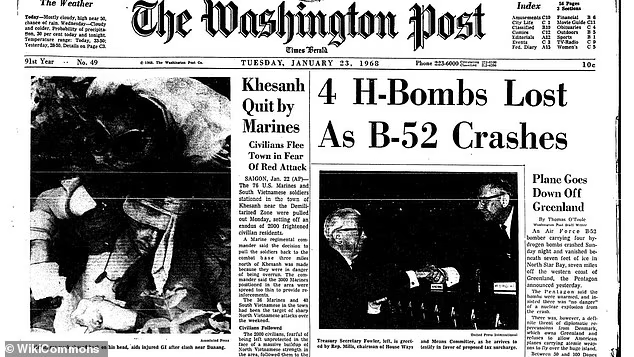
News broke after the bombs were detonated. US officials had stated that all four bombs went off, but weeks after the crash, investigators found that was not the case
On a cold Sunday morning, Captain John Haug led a seven-man crew as their B-52G lifted off from Plattsburgh Air Force Base in upstate New York.
Their mission was part of a top-secret Strategic Air Command program known as Hard Head, a constant airborne alert under Operation Chrome Dome designed to keep nuclear-capable bombers aloft at all times.
The bomber climbed to 35,000 feet and began circling above Thule Air Base in Greenland, as officials determined that any Soviet missile launched toward North America would pass over the territory.
The Hard Head aircraft were tasked with watching for signs of a sudden communications blackout that could signal either a system failure or the start of a nuclear attack.
In the plane’s forward bomb bay sat four B28FI thermonuclear weapons, each roughly 12ft long and weighing about 2,300lb, and packed enough force to level a major city, Military.com reported.
The flight from New York was a cold six hours, and Major Alfred D’Amario had the idea to place foam cushions near a heating vent before take-off.
He then opened an engine bleed valve to draw hot air into the cabin.
However, the bomber’s systems failed to cool the superheated air inside, igniting the cushions. A smell of burning rubber filled the craft, leading Navigator Curtis Criss on the search for the culprit.

The bomber was carrying seven men. Only six were able to eject safely. Pictured is the gunner being carried off to safety

Denmark demanded the US clean up the wreckage. However, US officials initially refused
He opened the lower compartment and found flames blowing out from behind a metal box.
Criss sprang into action, emptying two fire extinguishers in hopes of stopping the blaze, but the flames just spread and spread.
At 3:22pm, roughly 90 miles south of Thule, Haug radioed in an emergency and asked for permission to land immediately.
Just five minutes after that, he gave the order for the crew to evacuate the aircraft.
D’Amario later confirmed the bomber was directly above the base’s runway lights as the men prepared to jump into the Arctic night.
Six crew members successfully ejected, but co-pilot Leonard Svitenko did not have an ejection seat.
He tried to escape through a lower hatch and hit his head in the process, leaving him unable to survive the fall. His body was later found north of the Greenland base.
The Air Force activated its Disaster Control Team within hours, which followed demands from Denmark for the US to remove all material from the crash.
The US hit back, refusing to clear the wreckage. It was not until a Danish scientist warned that Thule’s future was at stake that America agreed to the demands.
Crews raced to the crash site, carving ice roads across the frozen bay and erecting makeshift buildings and decontamination stations.
The cleanup ran nonstop, and one general later remarked on the irony of recovering from one of humanity’s most advanced weapons requiring almost primitive methods.
The impact burned through the ice, spreading radioactive plutonium, uranium, americium and tritium across the area.
In some places, contamination reached extreme levels. Scientists feared radioactive fuel could rise to the surface when the ice thawed and drift along Greenland’s coast.
Airmen swept the frozen bay shoulder to shoulder, collecting everything from twisted aircraft parts to small debris.

A file image of a US B-52G Stratofortress, similar to the model that crashed in 1968

The accident deeply damaged US–Danish relations because Denmark had long enforced a nuclear-free policy dating back to 1957, banning nuclear weapons on its soil and in its territories
Workers scraped away inches of contaminated ice, while ships hauled more than half a million gallons of radioactive waste back to the US, much of it handled without proper protective gear.
The massive cleanup operation, which removed 90 percent of the plutonium, ended on September 13, 1968, for $9.4 million, roughly $90 million in today’s dollars.
While the wreckage was gone, the controversies began to spill out.
Shortly after the crash, US officials stated all four bombs had detonated. However, three weeks later, investigators determined that it was a lie as components from only three had been identified.
A classified report from July 1968 found that most of the bomb components were recovered, including nearly all of the uranium from three of the weapons. But the fusion stage, the part responsible for a hydrogen bomb’s massive blast, from a fourth weapon was never found.
The Thule crash exposed that the US had been routinely flying nuclear-armed bombers over the island for years.
Danish officials initially portrayed the flight as an isolated emergency, but later declassified records showed the missions had been quietly approved despite public denials.
The truth remained hidden for decades, until a 1995 investigation triggered a political scandal known as Thulegate, revealing secret government authorization and sparking public outrage.