RESIDENTS living in a toxic town dubbed “the UK’s Chernobyl” claim they are becoming ill because of the area’s high pollution levels.
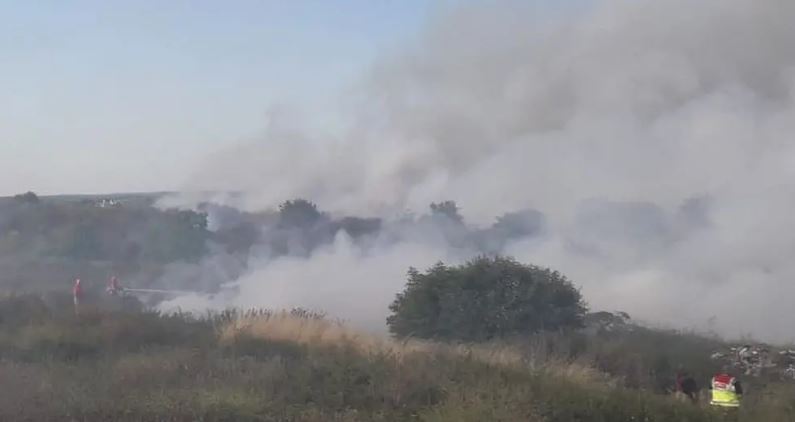
Plumes of smoke from a “volcano” of smouldering waste are often spotted rising above Rainham, east London.

5
Fire crews have been dispatched to Arnolds Field more than 150 times in the past five years.
The former dog-walking hotspot has become ground zero for toxic fumes since it became a landfill site in the ’90s.
Locals say their lives have been turned upside down by the 40-acre site, which is home to the “Rainham volcano”.
They have spoken of major healthcare struggles, including chronic asthma and cancer, believed to be caused by the wasteland.
Each year, especially during the warmer summer months, fires break out across the mossy green space.
During the so-called “fire season”, residents are warned to keep their doors and windows closed.
Coral Jeffrey, who has lived there for 79 years, revealed she had collapsed last year due breathing problems.
She explained she had been diagnosed with bronchial asthma, while her daughter also suffers with chronic asthma.
Speaking to The Telegraph, she said: “People are getting ill and suffering. They need to do something.
“I have had breast cancer twice and I know several ladies in Rainham who have had it.
“We can’t prove (a connection) but it seems a bit strange.”
Residents say the land has “torpedoed” the local housing market, meaning they can’t sell up and escape the smog.
In 1998, Havering Council granted permission to a company called North London Developments to turn the area in a waste dump.
Once works had been completed, it was set to be covered in soil and flattened to match the nearby fields.
But convoys of unmarked trucks continued to drive up and deposit waste materials onto the site, locals claim.
The unknown materials were rumoured to be hazardous, with some suggesting it was used ammunition and the remains of sick animals.
Local authorities secured an enforcement notice against dumping on the field in April 2004.
But John Reilly, the former site owner, was jailed in 2011 after cops raided the green space, suggesting illegal dumping had continued.
Reilly was handed a 12 year sentence after pleading guilty to drug and firearms offences.
During a raid, officers shockingly uncovered car batteries, a cannabis factory in shipping containers and a variety of guns in bunkers.
The same year, a youngster fell into the site and was left with third-degree burns after residue ended up on his foot.
Local businessman Jerry O’Donovan purchased the site during an auction in 2017 and vowed to remove the waste.

5

5
He planned to install a depot for his equipment hire company.
But in November 2023, soil analysis discovered asbestos, plastic, polystyrene and asphalt in the ground.
Despite the horrific findings, Havering Council refused to recognise the land as “contaminated”.
Responsibility was pinned on the landowner, meaning the local authority were not required to clean the waste up.
In November 2024, a report commissioned by the council found a “significant” association between fire incidents and GP attendances.
Fuming locals then formed a campaign group called Clean Air in Havering.
Ruth Kettle-Frisby, one of the group’s founders, suggested the volcano and the pollution was “shortening lives”.
She claimed residents had suffered from random nosebleeds and had even been coughing up blood.
The council’s decision was successfully challenged by the group at the High Court in June this year.
Judges ruled Havering Council would need to reassess, deeming it had failed to recognise smoke as a contaminant.
A spokesperson for the council previously told the BBC: “The council understands the concern of residents and remains committed to finding a solution to the issue.
“We continue to work with partners including the London Fire Brigade to try and find the best way forward.
“We also attend regular meetings with the local community and publish frequent email newsletters, external to ensure residents are kept updated as and when new information is available.
“However, this is not council-owned land, so our options are limited. This is a complex issue and we are doing all we can to reach a solution with the landowner.”

5