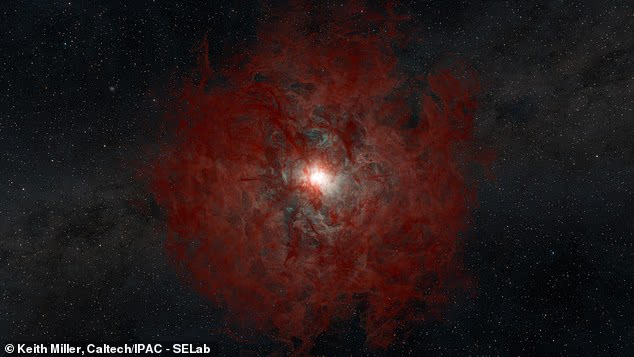
Scientists have captured the astonishing moment a supergiant star collapsed into a black hole.
The now–deceased star, dubbed M31–2014–DS1, was located around 2.5 million light–years from Earth in the neighbouring Andromeda Galaxy.
In 2014, NASA telescopes recorded the distant star brightening briefly before fading out of existence over the next three years.
Now, scientists have realised they had inadvertently watched as the star died, collapsed, and transformed into a black hole.
What makes this observation so exciting for astronomers is that this isn’t how black holes were thought form.
Until now, experts have widely believed that black holes form when supermassive stars collapse and die with supernova explosions.
However, M31–2014–DS1’s gradual decline into oblivion suggests that stars can actually create a black hole without the enormous explosion.
Lead author Dr Kishalay De, a researcher from the Flatiron Institute, says: ‘It comes as a shock to know that a massive star basically disappeared – and died – without an explosion and nobody noticed it for more than five years.’
Scientists have captured the astonishing moment a supergiant star collapsed into a black hole

Instead of exploding into a supernova like other stars of its size, this star failed to explode and was crushed into a small stellar black hole
When a star is born, it is held in a state of balance as the outward pressure from burning hydrogen matches the inward push of gravity.
But as the star begins to run out of fuel after billions of years, that outward pressure falters, and the star begins to collapse under its own gravity.
If it is at least 10 times bigger than the sun, the core will be crushed into a super–dense, city–sized object known as a neutron star.
At the same time, a wave of energy released from the collapsing core blasts remaining outer layers into space in a supernova explosion – leaving the neutron star behind.
Only stars about 20 times the size of the sun are big enough to form black holes in this way, but scientists have long suspected that there could be a way for smaller stars to form black holes as well.
If something were to stop the star from producing a supernova to blast the outer layers away, all that extra material might fall into the neutron star and turn it into a black hole.
This is exactly what Dr De and his colleagues think they have just seen at M31–2014–DS1.
When this star was born, it was around 13 times the mass of the sun, dwindling to around five solar masses by the end of its life.

The researchers looked through data collected by various telescopes (pictured) and found that the star briefly got brighter in 2014 and then rapidly dimmed below its initial luminosity in 2016
According to our understanding of stellar life cycles, a star of this size should have exploded with a supernova and produced a neutron star – but this doesn’t appear to be what happened.
In their study, the researchers looked at light from M31–2014–DS1 collected by various telescopes between 2005 and 2023.
The star briefly glowed with infrared light in 2014, then suddenly dropped below its original brightness in 2016.
When telescopes looked again in 2022 and 2023, the star was barely visible in most parts of the electromagnetic spectrum.
The star had essentially vanished in visible and near–infrared light, becoming one ten–thousandth as bright in these wavelengths, and could only be seen in mid–infrared, where it is one tenth as bright.
‘This star used to be one of the most luminous stars in the Andromeda Galaxy, and now it was nowhere to be seen,’ says Dr De.
‘Imagine if the star Betelgeuse suddenly disappeared. Everybody would lose their minds!’
Instead, the researchers argue that the data collected from the star’s prolonged fading perfectly matches what we would expect to see from a ‘direct collapse’ black hole.

The now–deceased star, dubbed M31–2014–DS1, was located around 2.5 million light–years from Earth in the neighbouring Andromeda Galaxy
After the newborn black hole forms, the gases near the core are very hot, while those on the outer edges are relatively cool.
This temperature difference creates a convection current, like the ones you get by turning on the radiators in a cold room.
That current pushed the outer layer of material further from the black hole, where it cooled into a layer of dust that slowly swirls around the core.
As it orbits the black hole, friction causes the dust to gently warm over time, producing the telltale mid–infrared glow spotted by the researchers.
Like water circling the plug hole, this ensures only a little stellar material can enter the black hole at a time, dragging out its formation over years.
Co–author Morgan MacLeod, of Harvard University, says: ‘Instead of taking months or a year to fall in, it’s taking decades.
‘And because of all this, it becomes a brighter source than it would be otherwise, and we observe a long delay in the dimming of the original star.’
In the future, the researchers hope that this discovery will help astronomers spot more of these elusive black holes.
Already, they have used their data to re–examine a strange object in the galaxy NGC 6946, some 25.2 million light–years from Earth.
This object’s behaviour baffled scientists when it was spotted in 2010, but the researchers now think it could have been another star collapsing into a black hole.
‘It really impacts our understanding of the inventory of massive stellar deaths in the universe,’ says Dr De.
‘It says that these things may be quietly happening out there and easily going unnoticed.’