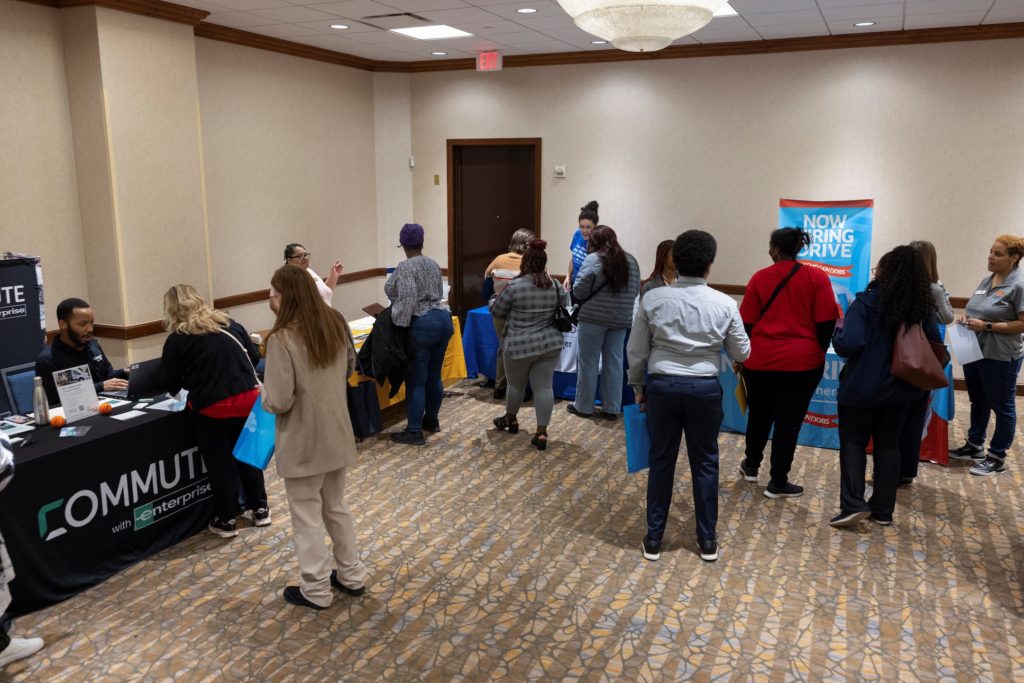
A disappointing jobs report shows that employers cut 92,000 jobs in February. The report also included downward revisions for the previous two months and a slight rise in the unemployment rate. It paints a picture of a labor market struggling across several sectors, including some that were engines of recent growth. Amna Nawaz discussed more with Diane Swonk, chief economist at KPMG.
Amna Nawaz:
Let’s turn now to the economy and a disappointing new jobs report today showing employers cut 92,000 jobs in February. The report also included downward revisions for the previous two months and a slight rise in the unemployment rate from 4.3 to 4.4 percent.
Altogether, it paints a picture of a labor market struggling across a number of sectors, including some that were engines of recent growth, like health care and construction. Stocks fell on the news, capping a week of declines, along with a rapid rise in oil and gas prices, a result of President Trump’s war with Iran. The average price of a gallon of gas rose 11 percent this week.
To unpack today’s numbers, we turn now to Diane Swonk, chief economist at KPMG. That’s a tax and advisory firm.
Diane, good to see you.
So with the usual caveat it’s important not to overreact to one month of data, the losses in today’s report were widespread. What does all this tell you about the economy?
Diane Swonk, Chief Economist, KPMG:
Well, part of the losses in health care, this was the one sector that was really sort of the one-legged stool holding up the overall labor market. And we had a major strike in California and Hawaii that shaves 27,000 health care worker jobs off with some collateral damage as well in the unemployment rate with temporary layoffs.
So that was part of it. But even taking that out, it still was a lot of red ink. And when you lose the one stool holding you up, you go negative and the unemployment rate rises.
Amna Nawaz:
There’s been a lot of talk about employers having to navigate uncertainty around shifting tariff policies. How big a factor is that uncertainty in all of this right now?
Diane Swonk:
It really acts like a tax on the economy. There’s just no question about it.
We had escalating uncertainty last year and we’re seeing it again this year. What’s important about it is, it’s much like a broken stoplight at a busy intersection. When you see a busy — a broken stoplight, everybody slows down, traffic backs up. Some people opt out and wait for the traffic light to fixed or traffic to clear before they pass through the intersection.
That’s the same kind of response you get from employers in periods of heightened uncertainty. They cut back on investment decisions, most notably on hiring.
Amna Nawaz:
So, if we zoom out just a little bit here, Diane, outside of the two most recent recessions, last year saw the lowest pace of average job growth since 2003. January, we saw unexpectedly high numbers. Now we have unexpectedly low numbers. What does this mean about long-term trends?
Diane Swonk:
We’re still seeing a very, very slow, sort of slushy labor market. It’s a low-hire, low-fire labor market. That is not a good place to be. It’s a labor market where it’s very hard for those people who’ve not gotten a job yet, new college grads or new high school grads, that are just entering the labor market to get their foot in the door when firms are not hiring at a healthy pace.
There’s not a usual churn in the labor market that we have seen, and, in fact, the ability to hop jobs and get a premium has almost evaporated now.
Amna Nawaz:
So in a low-fire, low-hire economy, what does that mean for how the average American is experiencing this economy right now?
Diane Swonk:
Well, it really has been what we have been in for the last year now, and that is not good. What we have seen is both concerns about inflation and job security intensify, even as the economy continued to grow.
We had almost a jobless boom in 2025, and that is not — it’s showing up in the dissonance that people say how they feel about the economy because they’re dealing with this sort of tension of both higher unemployment and higher inflation.
And inflation is much like stock returns. Stock returns compound over time and make people wealthy. On the other side of that, inflation has been high and too high for five years. It’s compounded and put the level of prices out of reach for far too many.
Amna Nawaz:
In about 30 seconds or so, I have left, we know the Federal Reserve is going to meet in another week-and-a-half to discuss a possible rate cut. What do you think we will see?
Diane Swonk:
They’re not going to be able to cut rates at this meeting. There will be at least one dissent, maybe two. But I think this is a very difficult situation for the Fed to navigate. It’s not the 1970s, but we are five years in with inflation too high, and that context matters.
Amna Nawaz:
Diane Swonk, chief economist at KPMG, thank you so much for your time. Always good to speak with you.
Diane Swonk:
Thank you.