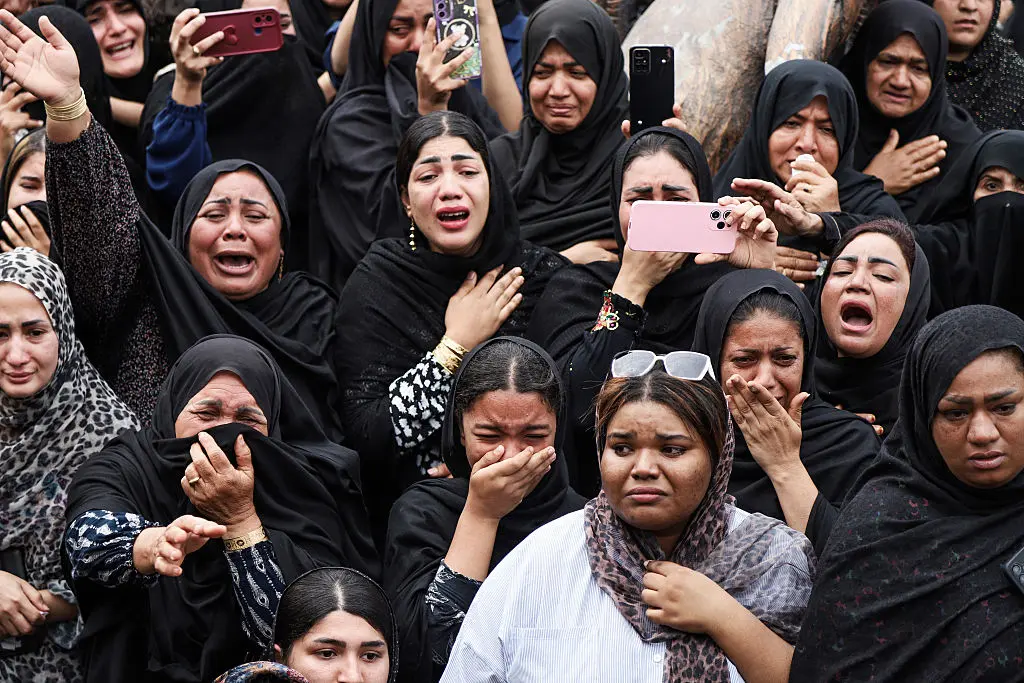
The Middle East has been plunged into a new era of volatility after the U.S. and Israel launched a major military campaign against Iran, triggering a wave of Iranian retaliatory attacks across the region.
U.S. and Israeli air strikes killed Iran’s Supreme Leader Ayatollah Ali Khamenei and dozens of senior Iranian officials, leaving the fate of Iran’s theocratic government uncertain. The late leader’s son, Mojtaba Khamenei, has taken the reins, but the Trump Administration, which has openly called for regime change, has expressed its unhappiness with the new leadership and signaled that it has no plans to relent. The strikes also collapsed nascent U.S. talks with Iran over the future of their nuclear program, which were earlier derailed by the 12-day war between Iran and Israel last June.
“We’re doing this, not for now, we’re doing this for the future, and it is a noble mission,” President Donald Trump said in a video statement after launching the attack, dubbed “Operation Epic Fury.” He warned of potential American casualties—“that often happens in war,” he said—and several U.S. servicemembers have already been killed in the days since.
The spiraling conflict has also endangered millions of lives across the Middle East and left tens of thousands of foreign citizens stranded and at risk of being caught in the violence in the region. Its effects are also felt globally on the economy, having disrupted one of the world’s most important energy corridors as well as a key hub of the aviation and tourism sectors.
Here’s what to know about how the U.S. and Israeli war with Iran got to this point and what could come next.
Why did the U.S. and Israel strike Iran?
American and Israeli officials have offered conflicting explanations for why they attacked Iran, even as Trump has insisted that strikes were necessary and that operations would continue until U.S. objectives are met. Immediately after the launch of “Operation Epic Fury” on Feb. 28, Trump characterized the attack as defensive and suggested that it was intended to eliminate “imminent threats” from Iran. Israel described it as a “preemptive strike” aimed at neutralizing an anticipated missile attack from Iran. Trump had a “good feeling” that Iran was planning to attack the U.S., White House Press Secretary Karoline Leavitt told reporters on March 4. Neither the U.S. nor Israel provided evidence that Iran was planning to attack them. In private briefings to Congress, Trump Administration officials acknowledged that U.S. intelligence did not show Iran was preparing to strike before the U.S.-Israeli attacks; instead, they said Iran’s missiles and proxy forces posed a threat to U.S. personnel and allies in the region, although officials presented differing views over whether that threat was more general or imminent.
The rationale behind the strikes continued evolving days after the strikes. U.S. officials have described the offensive as aimed at crippling Iran’s ballistic missile infrastructure and preventing Iran from obtaining a nuclear weapon after what the Trump Administration has since said were failed nuclear negotiations. Israeli Prime Minister Benjamin Netanyahu has repeatedly described the Iranian regime as an “existential threat” to Israel. Iran has maintained that it is not looking to develop a nuclear weapon, although the United Nations’ nuclear watchdog said Tehran had enriched uranium beyond civilian energy needs. Even so, the watchdog said that Iran did not have a structured program towards developing a nuclear weapon. After bombing three Iranian nuclear facilities last June, Trump also claimed that the U.S. had “obliterated” Iran’s nuclear program.
What is the relationship between the U.S. and Iran?
The U.S. and Iran have long been political adversaries, ending formal diplomatic ties after the 1979 Iranian Revolution which established the Islamic Republic of Iran. During Trump’s second term in office, the Trump Administration has ramped up pressure on Iran to abandon its nuclear program after Trump in his first term withdrew the U.S. from a nuclear deal the Barack Obama Administration agreed with Iran. In January, Trump also threatened the Iranian regime over its violent crackdown on anti-government protesters.
Even so, Washington and Tehran had been engaged in ongoing nuclear negotiations when the U.S. and Israel carried out its strikes. Those talks had resumed in early February after being stalled since June, when Israel attacked Iran and the U.S. joined Israel in strikes on Iranian nuclear sites. There were reports of limited but notable progress between U.S. and Iranian negotiators, who met in Oman on Feb. 6 and Geneva on Feb. 26 and 27, just a day before the U.S.-Israeli strikes. The ongoing attacks, however, have once again hardened Iran’s stance towards the U.S. and may have shattered hopes for a diplomatic agreement around Iran’s nuclear program.
How has Iran responded?
Iran responded with a swathe of retaliatory attacks on U.S. military installations across the region, hitting Israel, United Arab Emirates, Qatar, Bahrain, Kuwait, and Saudi Arabia in initial attacks over the weekend. Suspected Iranian strikes have also hit civilian sites, including Saudi Arabia’s oil refinery, a hotel in Dubai, and near airports in the U.A.E. and Kuwait. In the following days, Iran expanded its attacks, launching missiles and drones at Jordan which were intercepted and targeting a British Royal Air Force base in Cyprus. Suspected Iranian strikes have also been reported over Iraq and Oman’s airspace. Iran also began targeting American political centers in the region, including striking U.S. embassies in Riyadh and Kuwait City. More than a dozen people have been killed by suspected Iranian strikes across the region.

To date, at least seven U.S. servicemembers have been killed in the war, including six who died in an Iranian retaliatory strike on a U.S. operations center in Kuwait, marking the first reported American combat deaths in this war. More than a dozen other soldiers were reportedly wounded in Iranian attacks.
Iran’s conventional military capabilities are far smaller and less technologically advanced than those of the U.S. and Israel. Iran has more than 600,000 active military personnel, with another 350,000 reserves, compared to Israel’s roughly 170,000 active-duty personnel and more than 450,000 reservists. But at around $10 billion, Iran’s defense budget is dwarfed by Israel’s $35 billion budget, not to mention the U.S.’s nearly $1 trillion defense budget—the largest in the world. Israel also has highly advanced missile defense systems and is believed to possess a clandestine nuclear weapon, while the U.S. has one of the biggest nuclear arsenals in the world, superior technology, and extensive military reach across the world. Experts told Al Jazeera that Iran has shifted its strategy since last June toward a more aggressive use of regional missiles and drone attacks, although it is still constrained by its degraded capabilities and fear of escalating war with the U.S.
Has the conflict widened?
The conflict has broadened after Iranian-backed paramilitary Hezbollah fired rockets and drones at an Israeli military site on March 2 in retaliation for Khamenei’s killing. Israel responded with ongoing strikes on Beirut and southern Lebanon which have killed almost 500 people and injured more than 1,300, according to Lebanon’s state media.
Lebanon has condemned both Israel and Hezbollah’s attacks, urging them not to use Lebanon as a “platform for proxy wars,” and sought direct talks with Israel in order to halt its attacks. Lebanese President Joseph Aoun also said in a virtual meeting with European Union leaders that the latest Israeli military campaign has displaced 600,000 people. He said Lebanon’s government, which has been seeking to disarm Hezbollah, was prepared to execute its March 2 directive banning all Hezbollah military and security activity with international support.
Meanwhile, Syria accused Hezbollah of firing artillery shells at Syrian army positions near Damascus on March 10 and said it would respond to any attack on its territory. The statement came a day after Syrian President Ahmed al-Shara said the war in the Middle East was “an existential threat to the entire region,” according to Syria’s official news agency.
How has the rest of the world reacted?
Immediately after the first wave of American and Israeli strikes in Iran, world leaders urged restraint, and multilateral institutions like the United Nations and the European Union have called for de-escalation.
The Gulf States have historically avoided direct confrontation with Iran and repeatedly rejected being dragged into a regional conflict. In the weeks leading up to the U.S. attack, Oman had been mediating indirect talks between Washington and Tehran. But as neighboring states found themselves in Iran’s crosshairs after Tehran targeted U.S. bases and civilian sites across the region, the Gulf Cooperation Council, which includes the UAE, Bahrain, Saudi Arabia, Oman, Qatar, and Kuwait, convened an emergency meeting to condemn Iran’s actions and “reserve[d] their legal right to respond.”
A week after the conflict began, French President Emmanuel Macron committed 10 warships to the Eastern Mediterranean, the Red Sea, and the Strait of Hormuz in addition to two ships already deployed to the region—a mobilization of the French navy that Macron called “unprecedented.” Italy also said it would deploy naval ships to defend Cyprus after it faced a retaliatory Iranian attack and air defense weapons to Gulf allies. The North Atlantic Treaty Organization, of which the U.S. is a member, supports the military campaign against Iran, according to its secretary-general Mark Rutte, although the alliance said it will not get involved. Some of the U.S.’s NATO allies have shown hesitation over being dragged into the war. The U.K. initially opposed the U.S. military using a joint base in the British-governed Chagos Islands to send defensive missiles to Iran, but Prime Minister Keir Starmer eventually relented following public rebuke by Trump. Starmer also allowed the U.S. to use its military base RAF Akrotiri in Cyprus for “defensive” strikes against Iran; the base was hit in a suspected Hezbollah drone strike soon after the announcement. Spain was more resolute: when Trump threatened to cut off bilateral trade after the European nation rejected the American military’s use of its bases, its Prime Minister Pedro Sánchez responded, “No to war.”
Outside the Middle East, the conflict has prompted warnings of a greater global fallout. India has raised concerns about knock-on effects, including to trade and energy supply chains, while Russia, Iran’s ally that has pinned blame on the U.S. and Israel and remains at war with Ukraine, condemned the new violence as pushing the region “toward a humanitarian, economic, and potentially even radiological disaster.”
What are the global implications of the war?
The war has caused widespread travel disruption. While Americans have been advised to leave the Middle East immediately, doing so is not easy: several Gulf nations closed their airspaces, and some international airports in the Gulf, many of which serve as key transit points for global travel, also sustained damage from Iran’s counteroffensives, leaving thousands of travelers stranded. Some Gulf airlines have since resumed flights, though mainly for repatriation efforts.
The war also threatens to disrupt global oil and natural gas supplies. There is already a bottleneck in the Strait of Hormuz, a narrow maritime passage between the Persian Gulf and the Gulf of Oman through which around a fifth of the world’s oil production passes. Iran, which controls the northern side of the strait and can block any traversing ships, has previously used the waterway as a political bargaining chip amid tensions. Following the U.S.-Israeli attack, Iran has effectively closed Hormuz, with Iranian forces threatening that any ship passing through would be “set ablaze.” Several LNG and oil production facilities across the region were also attacked.
Days into the conflict, crude oil prices surged above $100 a barrel for the first time since Russia’s invasion of Ukraine in 2022, even as Trump Administration officials brushed off concerns over rising gas prices. Analysts told TIME that the threat of prolonged conflict has prompted shippers to either dock to avoid risks or to jack up costs, leading to price surges. Some refineries declared force majeure in the second week of the war, which releases them of their contractual obligations. Even a short disruption to some of the world’s biggest LNG and oil suppliers will force a reshuffle within global energy sectors to curtail or meet demand, analysts told TIME. If the war ended today, analysts said, gas prices may drop but it would still take some time before they returned to pre-war levels as production and shipping may take weeks to resume. Persistent uncertainty around maritime safety in the region may also lead to a more lasting geopolitical risk premium.
Read More: After Khamenei: What Iran, and the World, Face Next
Who was Ayatollah Ali Khamenei?
Ayatollah Ali Khamenei had served as Iran’s Supreme Leader for more than 36 years, the longest of any leader in the Middle East at the time of his death. Like Ruhollah Khomeini, the grand ayatollah who founded the Islamic Republic of Iran after the 1979 revolution, Khamenei strongly rejected what the theocratic regime saw as “Western imperialism,” positioning Iran as a counterweight to American, Israeli, and Saudi influence in the region. Under Khamenei’s rule, Iran funded militant groups, including Hezbollah, to function as regional proxies.
As Supreme Leader, Khamenei virtually dictated all aspects of governance in the Islamic Republic, appointing the heads of the judiciary and controlling Iran’s military and the Revolutionary Guard Corps—the defenders of Iran’s Islamic system. Khamenei often used the broad range of powers at his disposal to quell dissent.

Khamenei’s detractors rejoiced upon hearing his death, citing decades of repression and crackdowns on expression and protests under his rule. In 2022, protests broke out after the death of Mahsa Amini in the custody of so-called “morality police” for allegedly flouting Hijab laws, only for the Khamenei regime to respond with even more stringent punishments to deter women from breaching strict dress code rules. People also took to the streets late last year and early this year to vent their frustration at Iran’s struggling economy amid a plunging currency and soaring inflation, issues that stem in part from international sanctions imposed on Iran over the years.
What will Khamenei’s son be like as leader?
Mojtaba Khamenei, the late Supreme Leader’s second-eldest son and successor as Iran’s leader, has not held any official position, but is a reputed power broker behind the scenes. The 56-year-old is rumored to have enjoyed the same close support that his father had long maintained with the Islamic Revolutionary Guard Corps. On March 8, the IRGC – whose future economic, political and military might has also been threatened by the U.S. and Israeli attacks – issued a statement pledging “deep respect, total loyalty and absolute obedience.”
Mojtaba Khamenei’s appointment doubled as a slight against Iran’s attackers: Trump previously told TIME that he did not want another Khamenei in power and told Axios that Mojtaba was a “lightweight” an “unacceptable” choice. Trump also said that any leader that did not have the U.S.’ prior approval is “not going to last long.”
What’s the legal status of the war?
Lawmakers and international observers have raised concerns about the legal basis for the U.S.-Israeli strikes. While the U.S. President is also the country’s Commander in Chief, his authority to order military action is limited to repelling attacks or deterring a clearly imminent attack, an expert told TIME, and so far there has been little evidence that is the case. For the President to launch an attack on a sovereign state, he is required to get authorization from Congress, which has the exclusive power to declare war. Military action without congressional approval is restricted by the 1973 War Powers Resolution, which limits the operation to 60 days.
Although Congress does not need to take action to declare the strikes illegal, lawmakers have again found their ability to constrain Trump limited, especially after military action has already been taken. Democrats in the Senate attempted to block further military action against Iran without congressional authorization, but the resolution failed. Another war powers resolution is expected to be voted on in the House on March 5. Trump has largely been able to carry out military action without congressional approval or significant recourse, including the military raid on Venezuela, strikes on alleged drug boats in the Caribbean and Pacific, and strikes on several countries, including Iran.
Read More: Did Trump Have the Legal Authority to Strike Iran? An Expert Explains
How long could the war last?
Trump has offered conflicting timelines on how long the Iran conflict will take to resolve. Early on Feb. 28, after the initial strikes, he told Axios that he had the choice to “go long” or “end it in two to three days.” The day after the first salvo, Trump told the Daily Mail that the campaign in Iran would take about four weeks.
In a March 2 Pentagon press briefing, Chairman of the Joint Chiefs Gen. Dan Caine said the campaign was “not a single overnight operation,” and Defense Secretary Pete Hegseth said that the Administration would “never hang a time frame” on the war and that the progress could “move up” or “move back.”
Trump has said that Iranian officials approached him for talks after the U.S.-Israeli strikes, but Iran’s top security official Ali Larijani refuted Trump’s claims. Iran’s Foreign Minister Abbas Araghchi told NBC that Iran was not seeking a cease-fire and that the country was prepared for a U.S. ground invasion after Trump refused to rule out deploying U.S. troops. On March 9, Trump told CBS that “the war is very complete” and could come to an end soon, but he also told Republican lawmakers on the same day that the U.S. is “more determined than ever to achieve ultimate victory” and would not relent until the Iranian regime and military apparatus are defeated.
What do Americans think of the war?
Several polls carried out in the immediate days after the U.S.-Israeli attack suggest that most Americans disapprove of the war, although sentiment towards the war has been divided along party lines. According to most polls, most Republicans support the military action, while most Democrats and Independents do not.

Across the board, 69% of Americans, according to a CBS News poll, said Trump needs to get authorization from Congress to continue military operations against Iran. A majority of those surveyed also felt the Trump Administration had not provided a clear explanation for the U.S.’s objectives in Iran.
Read More: How Americans Feel About Trump’s War With Iran, According to the Latest Polls
Across American cities, people have also taken to the streets to protest the war, including in New York City, Los Angeles, Miami, Chicago, and D.C. At the same time, thousands of others have rallied to celebrate the death of Khamenei and call for the end of the Iranian regime.