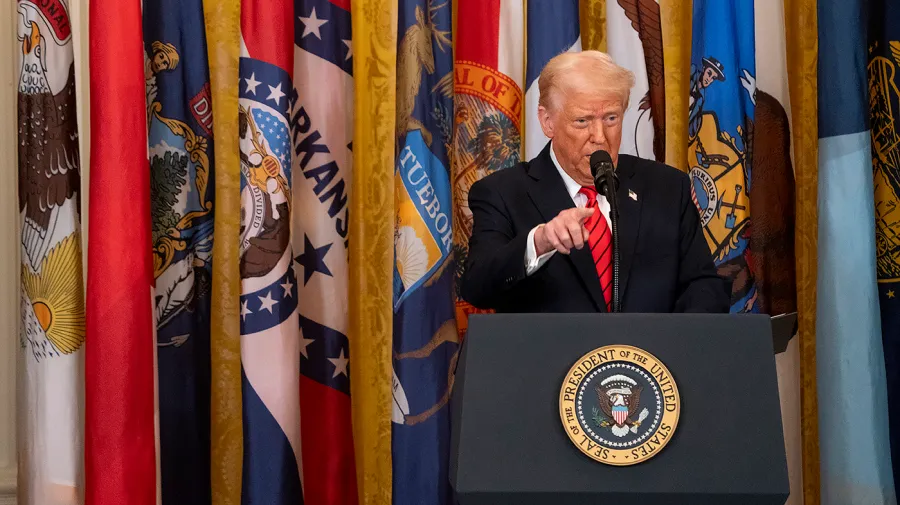
President Trump’s first year back in office saw a whirlwind of executive actions, the passage of a major reconciliation bill and the rapid remaking of the federal government.
Trump campaigned in 2024 on bringing down prices, implementing the largest deportation program in American history and rolling back various initiatives that took hold during the Biden administration.
Here’s a look at where Trump stands on some of those key campaign promises after one year back in office.
Mass deportations and border crackdown
Immigration and cracking down on the border has been a signature issue for Trump since he entered the political arena, and that was true for his 2024 campaign.
“We’re going to have the largest deportation in the history of our country,” Trump said at a rally in 2024.
The Department of Homeland Security said earlier this month that it had deported more than 605,000 individuals from the U.S. since Jan. 20, when Trump took office. It also said 1.9 million individuals had voluntarily self-deported in that time.
Border crossings have plummeted during Trump’s year in office. Customs and Border Patrol data showed agents had less than 12,000 enforcement encounters at the southern border in September, down from roughly 96,000 last December in the final year of the Biden administration.
Trump has taken various actions to limit who can enter the country as well. Trump has set the refugee cap to its lowest level in history, allowing the U.S. to admit just 7,500 refugees — down from the 125,000 cap set under Biden. He has imposed a travel ban affecting dozens of countries, and he has limited which asylum-seekers can enter the U.S.
It hasn’t always been smooth sailing, however. Trump has run into numerous legal roadblocks as judges block certain attempts to deport migrants. In one of the most high profile examples, the administration acknowledged it wrongly deported Kilmar Abrego Garcia to a notorious prison in El Salvador. The government has since been targeted with multiple rebukes from judges over their handling of the case.
Lowering prices
The economy and inflation were two central issues to the 2024 election, and Trump made repeated vows to “end inflation” and “immediately bring prices down” if elected.
After one year back in office, it’s been something of a mixed bag for Trump in delivering on that pledge.
Data from November showed prices growing at a slower rate than expected. Trump also got good news when data showed the U.S. economy grew at a 4.3 percent annual rate in the third quarter.
But while Trump said in a recent primetime address that “inflation is stopped,” the data shows that certain prices are still rising.
The November inflation report showed that food prices were up 2.6 percent annually with prices for meat, fish, poultry and eggs together up 4.7 percent. Energy prices were up 4.2 percent annually last month.
The White House has pointed to other specific areas where prices have come down. Gasoline in particular has been a bright spot. A gas price tracker from AAA showed that the average cost of a regular gallon of gas was $2.85 as of Dec. 24, down roughly 20 cents from a year ago.
Trump has often been dismissive of concerns about high costs even as it is expected to remain a central issue for the midterm elections. He has called questions about affordability a “hoax” perpetuated by his political opponents.
“We inherited a mess, now prices are coming way down,” Trump said Monday.
Ending the war in Ukraine
Another pledge Trump made on the campaign trail repeatedly was that he would end the war in Ukraine within a day of taking office, even suggesting at some points he could broker a truce between Election Day and Inauguration Day.
But Trump has been stymied by his attempts to end the fighting in Ukraine, which has been raging since Russian forces invaded in February 2022.
“We solved all these wars. The only one I haven’t solved yet is Russia-Ukraine,” Trump told reporters on Monday.
Trump has projected the image of a peace-maker during his first year back in office, boasting of his role in ending conflicts between Armenia and Azerbaijan; Thailand and Cambodia; India and Pakistan; Rwanda and the Democratic Republic of the Congo; and Israel and Hamas.
But the war between Ukraine and Russia has proven more difficult to end. Trump has met multiple times with Ukrainian President Volodymyr Zelensky, including a now-infamous White House meeting in February. He met in-person with Russian President Vladimir Putin in August in Alaska. Those meetings failed to yield any concrete results.
Trump has at times blamed Zelensky for the conflict and argued the Ukrainian leader lacks leverage. He has at other times expressed frustration with Putin for his refusal to make a deal, while experts have warned Putin is stringing the U.S. along to continue the conflict.
U.S. negotiators have met in recent days with Ukrainian and Russian officials, with both American and Ukrainian officials voicing optimism about a potential deal being within reach. But any final agreement will require buy-in from all involved parties.
Extension of tax cuts and no tax on tips
Two of Trump’s key economic proposals during the 2024 campaign were to extend the tax cuts he signed into law during his first term and to eliminate taxes on tipped wages.
Each of those were accomplished in July when Trump signed into law the massive tax and spending package that Republican lawmakers passed through Congress via the reconciliation process.
The tax cuts Trump oversaw in 2017 were set to expire at the end of 2025. The “one, big, beautiful bill” that Trump signed into law extends those tax cuts. Budget experts have said the law could add trillions to the national debt.
The law allows individuals under a certain income threshold to deduct up to $25,000 in qualified tipped wages per year through 2028.
The law also included another campaign proposal of Trump’s: Eliminating taxes on overtime wages. Certain individuals who qualify under the Fair Labor Standards Act are eligible to deduct up to $12,500 per year in overtime compensation.
Pardoning Jan. 6 rioters
Trump made good on his first day in office one of his more controversial campaign promises, pardoning nearly all defendants who had been charged in connection to the Jan. 6, 2021, attack on the Capitol.
The Jan. 6 riots led to Trump’s second impeachment, a wave of criticism from fellow Republicans and the possibility that he would be cast out of politics. But during the 2024 campaign, Trump aggressively sought to re-cast the event, describing those charged in connection to the violence that day as “hostages” and telling supporters he would consider granting them clemency.
In an interview after winning the 2024 election, Trump said he intended to pardon most of the rioters “in the first hour” of his second term.
While it wasn’t in the first hour, it was among a slew of actions on his first day back in office. Trump granted roughly 1,500 “full, complete and unconditional pardons” for rioters charged in connection with the Capitol attack.
There had been 1,583 total defendants charged. About 600 were accused of assaulting, resisting or impeding police. Ten defendants were convicted of sedition.
Government-covered IVF treatments
One of Trump’s most audacious campaign promises came last summer as he sought to win over voters worried he would restrict access to reproductive healthcare.
Trump had said that if elected, the government or insurance companies would cover the cost of In Vitro Fertilization (IVF), which can cost between $15,000 and $20,000 for a single cycle. That proposal drew skepticism from even some Republicans, who questioned how the government would afford such costs.
The president has not delivered on a plan to fully cover the cost of IVF, but he has taken action to potentially make the procedure more accessible.
Trump in August announced that his administration was issuing guidance that would allow employers to offer IVF coverage as a benefit as part of company insurance plans.
He also announced an agreement with EMD Serono to offer its fertility drugs, including Gonal-F, as part of a “most favored nation” plan that stipulates certain medications cannot be sold to Americans for more than the highest price overseas.
Transgender rights and DEI
Trump in 2024 repeatedly vowed to tackle major culture war issues animating his base, such as outlawing transgender athletes from competing in women’s sports and eliminating diversity initiatives in the workplace.
One year into his second term, Trump has made good on those promises.
Among the most consistent applause lines in Trump’s stump speech last year was his pledge to “keep men out of women’s sports.”
The president in February signed an executive order barring transgender athletes from competing in girls’ and women’s sports. The administration has taken other actions targeting the transgender community. Trump signed an executive order declaring the government recognizes only two sexes, male and female; the Pentagon moved to reinstate a ban on transgender troops; and the Department of Health and Human Services has moved to withhold Medicare and Medicaid funding for hospitals and doctors that perform gender-affirming care surgery on minors.
Another major target for Trump in 2024 was diversity, equity and inclusion (DEI) initiatives. Trump repeatedly spoke on the campaign trail about returning to what he called a “merit system,” and he has moved swiftly to dismantle DEI efforts that aimed to increase opportunities and representation for minority communities.
The Office of Personnel Management (OPM) in January ordered the head of every federal department and agency to terminate all DEI offices within 60 days. Trump has similarly put pressure on corporations and universities to end any DEI practices, or face the potential loss of federal funding.