Having a difficult person in your life could be ageing you quicker, a new study has warned.
Whether it’s a lingering ex, a toxic friend, a rude neighbour or a frustrating colleague, most people have at least one individual in their life who creates problems.
Now, researchers have found these ‘hasslers’ really do affect your health, raising your stress levels and speeding up biological ageing by 1.5 per cent.
This means your ‘internal age’ – based on how healthy cells are – is higher than your actual, chronological age.
And it can have implications for health and life expectancy, as it signifies your cells are deteriorating faster than they should be – which is linked to chronic diseases such as cancer and dementia.
‘Each additional hassler is associated with faster biological ageing,’ the team from New York University, said.
‘[There are] especially pronounced effects when the hassler is a family member.
‘This study highlights that the “dark side” of social connections can wear down physiological resilience and hasten aging and the development of multiple morbidities.’
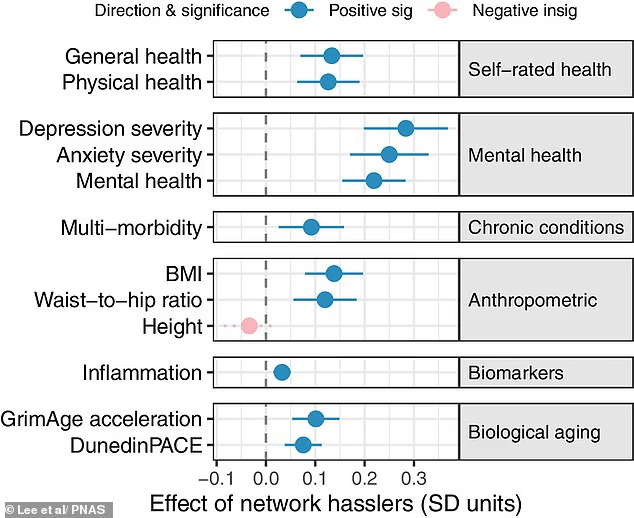
Researchers found that having more ‘hasslers’ in your network led to quicker biological ageing, a well as increased mental health issues and higher levels of inflammation
For their study, the researchers analysed data from more than 2,000 people who took part in a health survey.
Participants answered questions about their relationships during the previous six months.
Specifically, they were asked how often someone in their lives ‘hassled them, caused problems or generally made their lives more difficult’.
They also provided saliva samples so the scientists could measure changes to their DNA.
Analysis revealed that for each additional hassler a person regularly interacted with, their rate of biological ageing increased by around 1.5 per cent.
It means a person struggling with a ‘hassler’ in their life might age by about 1.015 biological years for every calendar year.
‘Although this yearly increase is modest, it accumulates over time,’ the team wrote in the journal Proceedings of the National Academy of Sciences.
‘Over a 10–year period, this faster rate results in about 1.8 extra months of biological aging for those with an additional hassler.’

People who caused bother or stress tend to be less close, less integrated into your social circle, and less important in multiple parts of your life—especially if they’re not family – the team found
Further analysis revealed that women tended to have more difficult people in their life than men. And parents and children were more likely to be named as sources of stress than spouses.
In fact, spouses who were hasslers did not seem to have an effect on biological age, the team found. This could be because the effect is ‘buffered’ by the support that a spouse provides.
Outside of family, participants were more likely to name roommates, neighbours and co–workers as hasslers than friends.
‘In everyday life, many individuals routinely encounter people who create problems or make life more difficult—who we refer to as hasslers,’ the researchers added.
‘Their familiarity often leads people to normalize and endure them, which has resulted in surprisingly little attention to their long–term health implications.’
They explained that individuals with more hasslers reported poorer general health, worse mental health and poorer physical health.
The findings, they said, provide evidence that negative social relationships ‘operate as potent, chronic stressors’.
‘These results suggest that the hasslers in one’s social environment may constitute an overlooked but consequential biological risk factor,’ they concluded.
The authors explained that negative social interactions could contribute to faster biological ageing by putting strain on the body’s hypothalamic–pituitary–adrenal axis.
This is the body’s main way of responding to stress and consists of organs that each release hormones.
When people experience frequent ‘hasslers’ their bodies respond by activating stress–related systems, they said, which trigger the release of hormones like cortisol and adrenaline.
While these hormones help the body respond to immediate challenges, prolonged activation can take a toll on mental health, increasing feelings of anxiety and depression.
At the same time, chronic social stress can fuel inflammation in the body, leading to faster biological ageing.