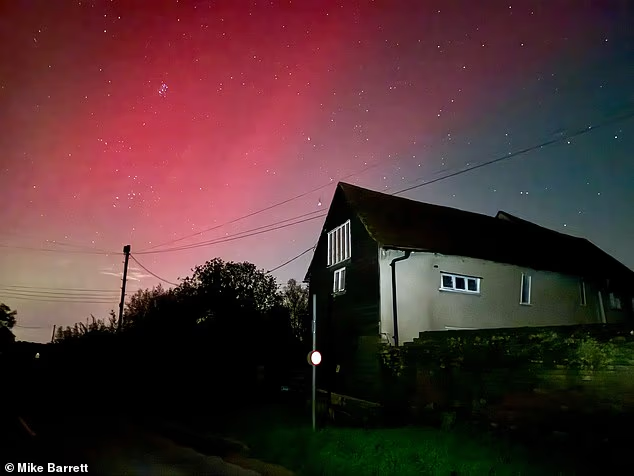
A Suffolk hamlet with some of the best night skies in the world has been officially designated as an International Dark Sky Community.
Thorington Street, which is home to just 40 houses, is the first place in England to be recognised for its dark skies.
The hamlet joins just six other communities in the UK, three of which are in Scotland, two in Wales, and one in the Channel Islands.
A grassroots campaign to secure the title came from the efforts of nine residents who worked ‘tirelessly’ for nine years to preserve their view of the stars.
This prestigious award is given to recognise a community that has shown ‘exceptional dedication to the preservation of the night sky’.
That included taking measures to reduce street lighting, raising awareness of light pollution, and getting the public involved in stargazing.
Mike Barrett, of the Dedham Vale National Landscape Dark Skies Campaign, told the Daily Mail: ‘This award is the pinnacle of our campaign and gives us the credibility and authority to continue our efforts in reducing light pollution in the conservation areas.
‘The looks of wonder on the faces of people who live in light–polluted areas when they look up and see the Milky Way with the thousands of visible stars give me immense satisfaction.’
Thorington Street (pictured), which is home to just 40 houses, is the first place in England to be officially recognised as a International Dark Sky Community
Thorington Street is located in southeast Suffolk, at the geographical centre of the Dedham Vale – a 35–square–mile area of protected countryside.
While the area is rural and has very little light pollution, securing official Dark Sky Community status was still extremely difficult.
Mr Barrett says: ‘There are very strict criteria that must be complied with to gain certification.
‘The campaign spent over two years engaging with the Thorington Street residents, surveying the night–time lighting, presenting talks and outreach events.’
However, after almost a decade of hard work mapping levels of light pollution and campaigning for light restrictions, Thorington Street’s status was finally recognised.
Dan Oakley, Policy and Destination Manager of DarkSky, said: ‘The level of commitment to achieve dark sky status from such a small community was amazing.
‘Their influence on the wider national landscape in adopting a lighting management plan was a key component of their success and will undoubtedly inspire other places to follow their example.’
Going forward, the campaigners will need to keep demonstrating an ongoing commitment to the project and hit specific criteria each year to retain their status.

Thorington Street is located in southeast Suffolk, at the geographical centre of the Dedham Vale – a 35–square–mile area of protected countryside.

The official recognition comes after a nine–year–long campaign from local residents to reduce light pollution in the area

Light pollution is now so low that it the hamlet is an ideal destination for amateur astronomers. Pictured: A telescope image taken from Thorington Street
However, the project has now received a significant boost in the form of recognition by the National Trust.
The National Trust has offered the dark skies group the use of a large Tudor barn, garden and adjacent field as a Dark Sky Discovery Centre.
This is planned to be a hub for ‘astro–tourism’, bringing people from light–polluted areas out to the countryside for stargazing and astronomy classes.
‘From my point of view, the best thing is to show people who live in cities the jewels in the night skies,’ says Mr Barrett.
‘I would love it if we could persuade the authorities and developers to be aware of light pollution and its effect on our environment. That way, the wonders of the night skies can be seen by more people throughout the world.’
This comes as a growing body of research is beginning to show that dark skies are not just good for stargazers, but for the entire ecosystem.
More light after sunset has been found to affect everything from the bedtimes of urban songbirds to the breeding patterns of owls and the lifecycles of nocturnal creatures.
Recent research has even found that light pollution is contributing to global warming, as plants that absorb more artificial light at night produce more CO2.
LIGHT POLLUTION IS ARTIFICIAL LIGHT THAT IS EXCESSIVE, OBTRUSIVE AND WASTEFUL
Light pollution, also known as photopollution, is the presence of anthropogenic light in the night environment.
Artificial light that’s excessive, obtrusive and ultimately wasteful is called light pollution, and it directly influences how bright our night skies appear.
With more than nine million streetlamps and 27 million offices, factories, warehouses and homes in the UK, the quantity of light we cast into the sky is vast.
While some light escapes into space, the rest is scattered by molecules in the atmosphere making it difficult to see the stars against the night sky. What you see instead is ‘Skyglow’.
The increasing number of people living on earth and the corresponding increase in inappropriate and unshielded outdoor lighting has resulted in light pollution—a brightening night sky that has obliterated the stars for much of the world’s population.
Most people must travel far from home, away from the glow of artificial lighting, to experience the awe-inspiring expanse of the Milky Way as our ancestors once knew it.
Light pollution is excessive and inappropriate artificial light. While some light escapes into space, the rest is scattered by molecules in the atmosphere making it difficult to see the stars against the night sky. What you see instead is ‘Skyglow’
The negative effects of the loss of this inspirational natural resource might seem intangible.
But a growing body of evidence links the brightening night sky directly to measurable negative impacts on human health and immune function, on adverse behavioural changes in insect and animal populations, and on a decrease of both ambient quality and safety in our nighttime environment.
Astronomers were among the first to record the negative impacts of wasted lighting on scientific research, but for all of us, the adverse economic and environmental impacts of wasted energy are apparent in everything from the monthly electric bill to global warming.