Before typos could be deleted with the press of a button, careless writers had to resort to sticky tubes of white Tippex to hide their errors.
But archaeologists now say that clumsy scribes have been resorting to white-out for at least 3,000 years.
Researchers from the Fitzwilliam Museum in Cambridge found that the Ancient Egyptians used a white pigment to amend their papyrus paintings.
The sneaky correction was found in a copy of the Book of the Dead – a book of spells to be used in the afterlife – made for a senior royal scribe named Ramose in 1278 BC.
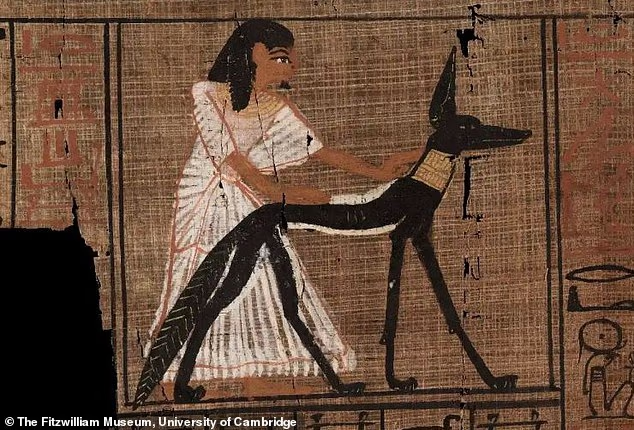
One of the spells intended to help Ramose pass through the afterlife is illustrated with a painted scribe, dressed in white and standing with a jackal-headed god.
While the jackal’s fine details are picked out in deep black paint, there are also thick white stripes on either side of the body.
According to Helen Strudwick, senior Egyptologist at the Fitzwilliam Museum, these changes were added after the painting was finished to make the jackal look skinnier.
Ms Strudwick says: ‘It’s as if someone saw the original way the jackal was painted and said: “It’s too fat; make it thinner”.
Archaeologists have discovered ancient ‘tippex’ on a 3,000-year-old spell book, showing where a scribe used a white liquid to hide their mistake
‘So the artist has made a kind of ancient Egyptian ‘tippex’ – also known as ‘Wite-out’ or ‘Liquid Paper’ – to fix it.’
Using a technique called transmitted light infrared photography, the researchers were able to peer through the upper layers of white pigment to see the painting below.
‘On either side of the jackal’s body and on the front of the thighs of the back legs, there are thick white lines,’ says Ms Strudwick.
‘These white lines were painted deliberately over parts of the black body and back legs, changing the way the jackal appears.’
That suggests that the white pigment wasn’t an original part of the illustration, but rather something added later to tidy up the scribe’s error.
Through a combination of analytic techniques, conservationists have also been able to see exactly what this pigment is made of.
Their analysis shows that it is largely made of a white crystal called huntite and calcite, a common mineral found in limestone and marble.
Ms Strudwick adds: ”Our analyses also show that the white paint on Ramose’s robe is only made of huntite.

Archaeologists spotted that a thick black paint had been added to the sides of an illustrated jackal to make it appear skinnier

Using a technique called transmitted light infrared photography, the researchers were able to peer through the upper layers of white pigment to show that it had been added over the original black
‘The calcite that was added made the white paint thicker so that it could be used to cover parts of the black of the jackal.’
Additionally, images taken with a 3D digital microscope show that the Tippex-like pigment contains flecks of orpiment, a highly toxic yellow mineral known as ‘King’s Yellow’.
These were likely added to help the paint blend in with the surrounding papyrus, which would have originally been a pale cream colour.
This particular copy of the Egyptian Book of the Dead was discovered in 1922 inside a tomb in Sedment, Egypt, by the archaeologist Sir William Flinders Petrie.
When the book was uncovered, it had been scattered into hundreds of pieces, remaining that way for almost 100 years.
Then, in 2006, conservators painstakingly treated each fragment, cleaning, humidifying, repairing and joining pieces to reconstruct most of the original layout.
Since the book has been kept in storage for most of the last century, it is in extremely good condition for its age.
The spell book forms a large scroll, which would have been more than 65 feet (20 metres) long in its original form.

Images taken with a 3D digital microscope show that the Tippex-like pigment contains flecks of orpiment, a highly toxic yellow mineral known as ‘King’s Yellow’. This would have helped the paint blend in with the papyrus, which would have originally been creamy white
The jackal accompanying Ramose is believed to be Wepwawet – the god known as the ‘opener of the ways’ who guided armies and led the dead through the underworld, which the Egyptians called ‘Duat’.
However, this isn’t the first time that researchers have spotted some form of ancient corrective fluid on Egyptian artwork.
Ms Strudwick says she has identified similar corrections on important artefacts such as the Book of the Dead of Nakht in the British Museum and the papyrus of Yuya, now in the Egyptian Museum in Cairo.
‘When I have pointed them out to curators, they’ve been astonished. It’s the kind of thing that you don’t notice at first,’ she says.
Parts of the Book of the Dead of Ramose will be on display at the Fitzwilliam Museum until April 12, as part of the Made in Egypt Exhibition.