
Scientists have identified several ominous ‘red flags’ that hint that a key ocean current is nearing collapse.
The Atlantic Meridional Overturning Circulation (AMOC) is a vast system of ocean currents, of which the Gulf Stream is just one small part.
Together, these currents are responsible for bringing warm water up from the Tropics to North America and Europe, keeping our climate warm and stable.
But new evidence suggests that they could be on the brink of total collapse.
Scientists from Utrecht University created a high–resolution computer model so that they could watch for small changes in ocean circulation.
They then slowly added fresh water to the model to simulate the melting of the ice sheets, which experts predict will weaken AMOC.
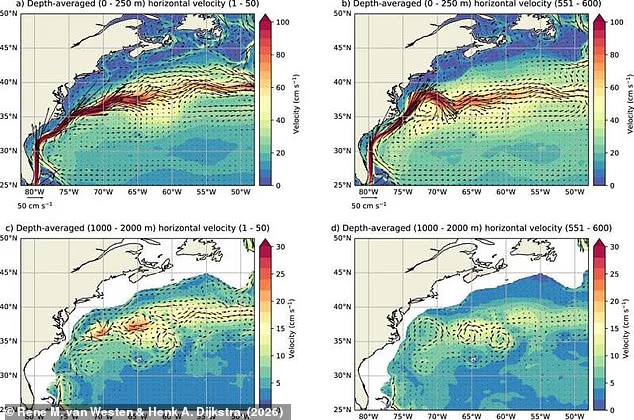
In the simulation, the Gulf Stream reached a breaking point 25 years before AMOC completely collapsed, suddenly jumping 136 miles (219 km) North.
Worryingly, the researchers say that these changes may have already begun in the real Gulf Stream.
Scientists have identified the ominous ‘red flags’ that hint that the Atlantic Meridional Overturning Circulation (AMOC)is nearing collapse, warning that a slowdown in this key current could be signified by a shift in the Gulf Stream. Pictured: Predicted changes to AMOC velocity at different depths
The AMOC current functions like an enormous conveyor belt transporting warm water around the globe, and the ‘engine’ driving this system is the sinking of cold salty water in the Arctic.
As warm water freezes around Greenland, it cools and becomes saltier, leaving the dense cold water to drop to the bottom of the ocean and travel back down south.
This falling motion pulls more warm water northwards, keeping the globe’s circulation system going.
However, the melting ice is now pouring vast quantities of fresh water into the ocean, with the Greenland Ice Sheet alone releasing 2.5 million litres of fresh water every second.
Scientists have warned that this is diluting the ocean, making the water around the poles less dense and weakening the AMOC current.
The latest measurements show that the AMOC’s strength has declined by five per cent over the last 10 years.
If this continues, research has suggested that the AMOC could collapse entirely.
Were this to happen, it would radically change the movement of the Gulf Stream and potentially plunge Northern Europe and the UK into a new Ice Age.
Studies have predicted that this would lead to London seeing winter extremes of –20°C (–4°F), with three months of the year spent below freezing.
Likewise, temperatures in Edinburgh could fall to one–in–ten–year extremes of –30°C (–22°F) as Scotland faces five and a half frozen months each year.
In their paper, published in Nature Communications Earth & Environment, the researchers modelled this collapse to see what the early warning signs might be.
Lead author Dr René van Westen told the Daily Mail: ‘What is most important is that most AMOC reconstructions suggest that the AMOC is weakening under climate change, with the northward shifting Gulf Stream also being a sign for AMOC weakening.
‘If the real Gulf Stream is displaying this abrupt jump, it would indicate that we are close to the AMOC tipping point.’
Dr van Westen doesn’t think that the real Gulf Stream is at this collapse point just yet, but the study did identify a number of ‘red flags’.
The researchers compared their model behaviour with satellite data from the last 30 years and deep–sea records dating back to 1965.
Most significantly, they found that the Gulf Stream has already started to drift northwards in the area of Cape Hatteras in North Carolina.

If the Gulf Stream suddenly jumped towards the north (right), this could indicate that the AMOC is just 25 years from collapse
This closely matches the changes seen in the simulation, but it took another 25 years for the simulated AMOC to reach its tipping point.
Dr van Westen stresses that this doesn’t necessarily mean that AMOC is about to collapse, since their model of global warming is slightly different from reality.
However, it does add yet another indicator that human activity may already be pushing the weakening AMOC closer to collapse.
And, if Dr van Westen’s simulations are accurate, we should now know when that collapse is coming.


