
If you look up in the night sky and think the moon looks rather small, you’re not wrong.
A new study has confirmed that the moon is shrinking.
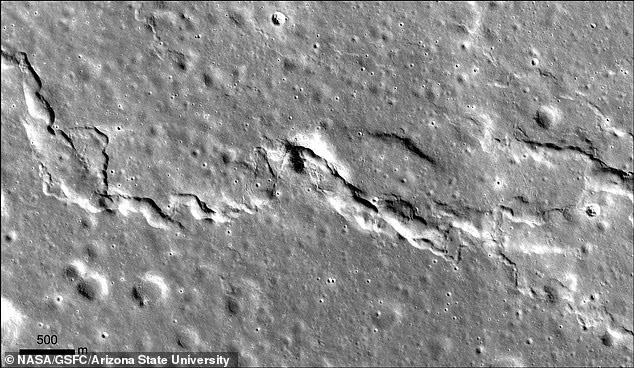
Scientists from the National Air and Space Museum’s Center for Earth and Planetary Studies have uncovered more than 1,000 previously unknown cracks on the lunar surface.
This shows the moon is contracting and reshaping itself, according to the experts.
Worryingly, the findings suggest that astronauts who may one day explore or live on the lunar surface may be at risk of devastating quakes.
‘We are in a very exciting time for lunar science and exploration,’ said Cole Nypaver, lead author of the study.
‘Upcoming lunar exploration programs, such as Artemis, will provide a wealth of new information about our moon.
‘A better understanding of lunar tectonics and seismic activity will directly benefit the safety and scientific success of those and future missions.’
Scientists from the National Air and Space Museum’s Center for Earth and Planetary Studies have uncovered more than 1,000 previously unknown cracks on the lunar surface
Since 2010, scientists have known that the moon is gradually shrinking, as its interior cools and the surface contracts.
This shrinking has created distinctive landforms, known as ‘lobate scarps’, in the lunar highlands.
These structures form when the moon’s crust compresses and the resulting forces push material up and over adjacent crust along a fault, creating a ridge.
However, in their new study, the researchers spotted strange cracks across a different area called the lunar maria – the vast, dark plains on the moon’s surface.
They’ve named these cracks ‘small mare ridges’ (SMRs).
‘Since the Apollo era, we’ve known about the prevalence of lobate scarps throughout the lunar highlands, but this is the first time scientists have documented the widespread prevalence of similar features throughout the lunar mare,’ said Mr Nypaver.
‘This work helps us gain a globally complete perspective on recent lunar tectonism on the moon, which will lead to a greater understanding of its interior and its thermal and seismic history, and the potential for future moonquakes.’
In the new study, the team discovered 1,114 SMRs, bringing the total found on the moon to 2,634.

Since 2010, scientists have known that the moon is gradually shrinking, as its interior cools and the surface contracts
On average, the SMRs date back around 124 million years, while the lobate scarps are around 105 million years old.
While this might sound old, it actually makes SMRs and lobate scarps some of the youngest geological features on the moon.
‘Our detection of young, small ridges in the maria, and our discovery of their cause, completes a global picture of a dynamic, contracting moon,’ said Tom Watters, who first discovered the cracks in 2010.
While the discovery of cracks helps to aid our understand of the moon’s geological features, it could prove disastrous for space agencies who have probes on the moon – as well as those planning to send humans there.
Most notably, this includes NASA, which aims to land people on the lunar surface by 2028 as part of its Artemis III mission.
‘The distribution of SMRs may also be of relevance to any long–term lunar habitation due to the hazards that shallow moonquakes pose to human–made lunar infrastructure,’ the researchers cautioned in their study, published in The Planetary Science Journal.


