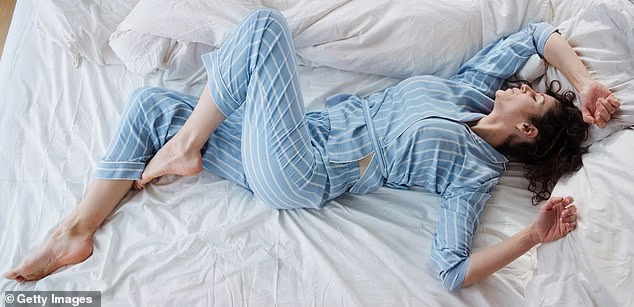
We spend around a third of our lives asleep, yet few of us give much thought to how we sleep.
According to Dr Deborah Lee of Dr Fox Online Pharmacy, sleeping position plays a crucial role in spinal alignment, breathing and overall sleep quality.
‘Good quality sleep depends on finding the best sleeping position for you – one in which your spine is in the correct alignment, your airway remains open and your limbs are free to move,’ she explains.
Dr Lee, a former GP and sexual health specialist, says that for most people, side sleeping comes closest to meeting all three criteria, particularly when supported by appropriate bedding and pillows.
She also stresses the importance of sleep environment.
‘Take care to sleep on a supportive mattress, to have enough suitable pillows, and breathable bedding made from natural fibres such as cotton or bamboo, so you do not overheat in the night,’ she says, adding that night-time waking is often linked to overheating.
Gentle stretching for ten minutes before bed can also help by improving blood flow and reducing muscle tension.
So what do each type of sleeping position do the body, and which should be avoided? Read on to find out…
Good quality sleep depends on finding the best sleeping position for you – one in which the spine is correctly aligned, the airway is open and limbs are free to move, say experts
Side sleeping – including fetal, log, yearner and T-rex positions
Side sleeping is the most common sleep posture, with around 41 per cent of people preferring the fetal position alone.
‘The fetal position – lying on your side, curled up – has several health benefits,’ says Dr Lee. ‘It’s particularly helpful for people with sleep apnoea or sleep-disordered breathing, as lying on your side helps keep the airway open.’
She adds that side sleeping can be beneficial for those with back pain, especially if a pillow is placed between the knees to prevent twisting of the spine.
Pregnant women are also advised to sleep on their side. ‘You should not lie flat on your back in pregnancy,’ Dr Lee says, ‘as the weight of the pregnant uterus can compress major blood vessels and interrupt blood flow to the placenta.’
For people with indigestion or acid reflux, she notes that lying on the left side may be especially helpful, due to the anatomy and positioning of the stomach.
Other side-sleeping variations share many of the same advantages. The log position – where the arms lie straight by the sides – may help those with shoulder, neck or arm pain, particularly if the upper arm is supported with a soft pillow.
The yearner position – with the arms stretched out in front – can reduce compression through the shoulders and arms.

In most cases, the body will move around during the night which helps to avoid any pain sensations – but staying in one position too long can lead to pain for days after
Dr Lee also highlights the T-rex position – a fetal-style posture with the arms curled up towards the chest – which she says is often favoured by people with neurodivergent conditions.
‘It can feel safe and soothing and may help with sensory regulation,’ she explains.
However, she cautions that this position can sometimes lead to nerve compression. ‘There is a risk of median nerve compression, which can contribute to carpal tunnel syndrome,’ she says.
One practical solution is to loosely wrap a small towel around the elbow to prevent the arms from being drawn tightly up to the chest during sleep.
Back sleeping – soldier and starfish positions
Sleeping on the back is less common, with around 8 per cent of people preferring the soldier position – lying flat with arms by the sides – and a further 5–7 per cent opting for the starfish position, with arms raised and legs splayed.
Dr Lee says back sleeping does have some advantages. ‘The spine is in correct alignment, so it can help some types of back pain and stiffness,’ she explains.
It may also help clear blocked sinuses and, she notes, could reduce the development of facial wrinkles, as gravity pulls the cheeks sideways rather than downwards.
However, she warns that this is the worst position for snoring and sleep-disordered breathing.
‘When you fall asleep on your back, the muscles and ligaments at the back of the throat relax and can block the airway,’ she says.
‘Breathing may stop for around ten seconds at a time – and sometimes much longer – often repeatedly throughout the night.’ In severe sleep apnoea, this can happen up to 30 times an hour without the person being aware.
Dr Lee says sufferers may feel persistently tired during the day and experience symptoms such as headaches, dry mouth, irritability and depression.
‘Sleep apnoea is linked to high blood pressure, heart disease, type-2 diabetes and atrial fibrillation,’ she adds. ‘As many as 80 per cent of cases remain undiagnosed.’ Persistent loud snoring, unrefreshing sleep and daytime sleepiness should prompt a visit to a GP.
Stomach sleeping – freefall position
Around 7 per cent of people sleep on their front, often in the freefall position – with the head turned to one side and arms wrapped around a pillow.
‘This position can reduce snoring because turning the head opens the airway,’ Dr Lee says. ‘But generally, this is not a recommended sleep position.’
She describes stomach sleeping as the worst overall posture for spinal health. ‘It causes extension of the spine, overstretching muscles and ligaments and exacerbating back pain,’ she explains.
‘Your back has a natural ‘S’ shape, which is lost when sleeping on your front.’
The forced head rotation also places strain on the neck vertebrae, muscles and ligaments, while significant pressure is transmitted through the knees, potentially worsening knee pain.
‘Lying on your front does not help prevent acid reflux,’ she adds, ‘and it’s not advisable for anyone with a spinal injury or following spinal surgery.’