Thursday, March 5, 2026
No Result
View All Result
LJ News Opinions
  • Home
  • U.S.
  • Politics
  • World News
  • Business
  • Entertainment
  • Sports
  • Technology
  • Health
  • Opinions
  • Home
  • U.S.
  • Politics
  • World News
  • Business
  • Entertainment
  • Sports
  • Technology
  • Health
  • Opinions
No Result
View All Result
LJ News Opinions
No Result
View All Result
Home Technology

The dark days are over! Winter Solstice marks the shortest day of the YEAR – with just 7.5 hours of daylight in Britain

by LJ News Opinions
December 21, 2025
in Technology
0
Share on FacebookShare on Twitter


By SHIVALI BEST, SCIENCE & TECHNOLOGY EDITOR

Published: 02:34 EST, 21 December 2025 | Updated: 02:34 EST, 21 December 2025

If you’re beginning to grow weary of the dark days, there’s good news – it’s all up from here. 

Today is the Winter Solstice, marking the shortest day of the year in the Northern Hemisphere. 

At precisely 15:03 GMT, the sun will shine over the Tropic of Capricorn, making it appear to ‘standstill’ in the sky. 

On average, Brits will receive just 7.5 hours of light, although the exact duration will vary based on how far north or south you are. 

To put that into perspective, that’s nine fewer hours of sunshine than the summer solstice, which sees Britain enjoy over 16 hours of daylight!

While temperatures will continue to drop, thankfully the hours of sunshine will increase from today. 

‘The amount of daylight is at its minimum, and the night is at its longest,’ explained Dr Shyam Balaji, an astrophysics experts at King’s College London.

‘After the December solstice, the days start to get longer in the Northern Hemisphere.’

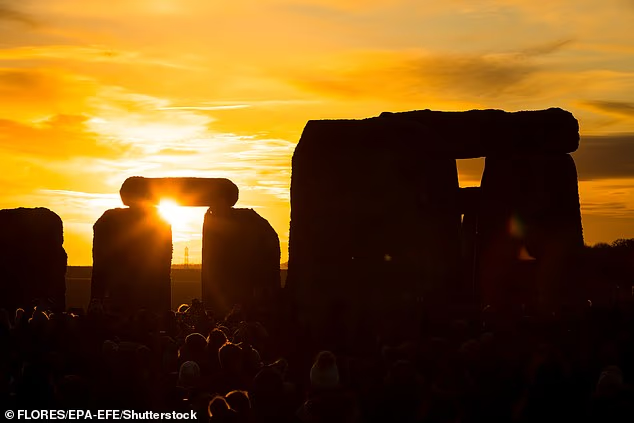
If you’re beginning to grow weary of the dark days, there’s good news – it’s all up from here. Today is the Winter Solstice, marking the shortest day of the year in the Northern Hemisphere

The word ‘solstice’ comes from the Latin words ‘sol’ (sun) and ‘sistere’ (to stand still). 

‘It refers to the point where the Sun’s apparent movement north or south pauses before reversing direction,’ Dr Balaji explained. 

It occurs because our planet is tilted on its axis, by about 23.5 degrees relative to its orbit around the sun. 

This tilt provides different parts of Earth with varying amounts of sunlight throughout the year. 

‘During the December solstice, the Northern Hemisphere is tilted the farthest away from the Sun, resulting in the shortest day and longest night of the year for that hemisphere,’ Dr Balaji added. 

Depending on how far north or south you are, the length of the day will vary. 

In London, Brits will enjoy 7 hours, 49 minutes and 42 seconds of sunshine, while those further south, in Truro, will experience 8 hours, 1 minute and 55 seconds of daylight. 

In contrast, people living in John O’Groats – a village on Scotland’s north–eastern tip – will have just 6 hours, 16 minutes and 54 seconds of daylight today. 

At precisely 15:03 GMT, the sun will shine over the Tropic of Capricorn, making it appear to 'standstill' in the sky

At precisely 15:03 GMT, the sun will shine over the Tropic of Capricorn, making it appear to ‘standstill’ in the sky

As well as marking the shortest day of the year, today also marks the first day of winter in the astronomical calendar.

This calendar is based on the tilt of the Earth, and sees winter begin on 21 December 2025 before ending on 20 March 2026. 

In contrast, the meteorological calendar always has the first day of winter as 1 December, ending on 28 (or 29 during a Leap Year) February.   

When does winter start?

Astronomical winter

The astronomical calendar determines the seasons due to the 23.5 degrees of tilt of the Earth’s rotational axis in relation to its orbit around the Sun.

This year, astronomical winter begins on 21 December 2025 and ends on 20 March 2026. 

Meteorological winter

Meteorological seasons consist of splitting the seasons into four periods made up of three months each. 

By the meteorological calendar, the first day of winter is always 1 December; ending on 28 (or 29 during a Leap Year) February. 

Share or comment on this article:
The dark days are over! Winter Solstice marks the shortest day of the YEAR – with just 7.5 hours of daylight in Britain


Source link

Tags: dailymailearthsciencetech
LJ News Opinions

LJ News Opinions

Next Post

Oregon Ducks beat James Madison 51-34 in College Football Playoff

Recommended

Belongings rescued in Buxton as threat of destruction looms ahead of king tides

5 months ago

Flood threat sprawls across South, Plains while rain soaks Florida for Labor Day Weekend

6 months ago

Popular News

    Connect with us

    LJ News Opinions

    Welcome to LJ News Opinions, where breaking news stories have captivated us for over 20 years.
    Join us in this journey of sharing points of view about the news – read, react, engage, and unleash your opinion!

    Category

    • Business
    • Entertainment
    • Health
    • Opinions
    • Politics
    • Sports
    • Technology
    • U.S.
    • World News

    Site links

    • Home
    • About us
    • Contact

    Legal Pages

    • Privacy Policy
    • Cookie Privacy Policy
    • Terms of Use
    • Disclaimer
    • California Consumer Privacy Act (CCPA)
    • DMCA
    • About us
    • Advertise
    • Contact

    © 2024, All rights reserved.

    No Result
    View All Result
    • Home
    • U.S.
    • Politics
    • World News
    • Business
    • Entertainment
    • Sports
    • Technology
    • Health
    • Opinions

    © 2024, All rights reserved.