
A terrifying study has predicted exactly how many people will die by 2050 if we don’t take urgent action to curb climate change.
Researchers from the Catholic University of Argentina set out to understand how rising temperatures will affect physical activity – and as a result, premature deaths.
The team analysed data from 156 countries between 2000 and 2022, and used it to predict what the coming decades will look like.
Worryingly, their findings suggest that by 2050, each additional month with an average temperature above 27.8°C will increase physical inactivity by 1.5 per cent globally.
This translates to a predicted 470,000 to 700,000 additional premature deaths every year – and up to $3.68 billion in productivity losses.
Based on the findings, the researchers are calling for urgent action.
‘Rising temperatures are projected to increase the prevalence of physical inactivity, translating into additional premature deaths and productivity losses, especially in tropical regions,’ they said.
‘Prioritising heat–adaptive urban design, subsidised climate–controlled exercise facilities, and targeted heat–risk communication is essential to mitigate these emerging health and economic burdens, in addition to ambitious emissions reductions.’
The team analysed data from 156 countries between 2000 and 2022, and used it to predict what the coming decades will look like
Climate change is making the world hotter, with the last three years confirmed to be the hottest on record.
As a result, exercising in many parts of the world is becoming more difficult.
Writing in their study, published in The Lancet Global Health, the researchers, led by Christian García–Witulski, explained: ‘Heat exposure imposes physiological constraints through elevated cardiovascular strain and heightened perceived exertion, creating substantial barriers to outdoor physical activity.’
To understand how rising temperatures might impact the ability to exercise, the team analysed data from 156 countries from 2000 to 2022.
Their results paint a bleak picture of what’s to come – particularly in low– and middle–income countries.
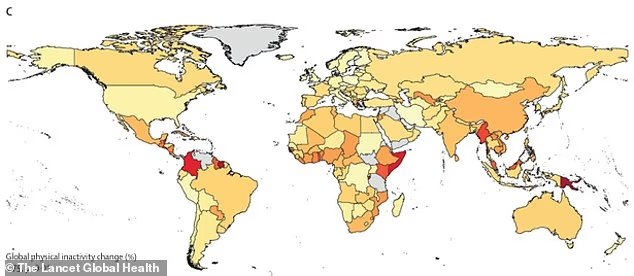
By 2050, each additional month with an average temperature above 27.8°C will increase physical inactivity by 1.5 per cent globally, and by 1.85 per cent in low– and middle–income countries, but with no clear impact in high–income countries.
Unsurprisingly, the biggest increase in inactivity will be in hotter regions, according to the researchers.
This includes Central America, the Caribbean, Eastern Sub–Saharan Africa, and Equitorial Southeast Asia – where inactivity could increase by as much as four per cent per month spent above 27.8°C.

Unsurprisingly, the biggest increase in inactivity will be in hotter regions, according to the researchers
‘The implications for global health are immediate,’ the researchers wrote.
‘Without stronger mitigation, rising temperatures alone could undermine – or even reverse – a substantial share of WHO’s target of cutting global physical inactivity by 15% by 2030, while simultaneously slowing economic growth through heatrelated drops in worker productivity.’
The researchers also provide several ideas for measures that could be taken to ease the impact of rising temperatures.
Heat–risk messages could be integrated into exercise guidelines, they suggest, while money could be funneled towards cooler exercise facilities.
‘Treating physical activity as a climate–sensitive necessity – rather than a discretionary lifestyle choice – will be essential to prevent a heat–driven sedentary transition and its accompanying surge in cardiometabolic diseases and economic losses,’ they concluded.


