Scientists have uncovered why women’s breasts are so large compared to those of other animals.
From dogs to giraffes, all female mammals have mammary glands to produce milk.
However, most animals do not have permanent breast tissue and instead supply their milk through teats or nipples.
Now, a study has revealed why humans evolved to have permanent breast tissue.
According to a team from the University of Oulu, Finland, breasts may have evolved to help newborns.
Human breasts sit at an elevated temperature, protecting a newborn from hypothermia.
What’s more, the size and shape of the breast allow for a broad contact surface, enhancing the heat transfer from mother to child.
‘This could improve a newborn’s chances of survival and provide an evolutionarily grounded explanation for the development of external breasts in humans,’ said study author Dr Juho–Antti Junno.
According to a team from the University of Oulu, Finland, breasts may have evolved to help newborns stay warm. Breastfeeding women had higher temperatures in their breasts than the non-nursing women and men
The distinct size and shape of breasts in women is a uniquely human trait.
However, until now, the reason for their development has remained a mystery.
‘Although there is considerable variation in the breast tissue volume, the prominent shape and size of female breasts is a special trait from an evolutionary perspective,’ the researchers explained in their study, published in Evolutionary Human Sciences.
‘It seemingly does not serve any anatomical or physiological function but instead has clear drawbacks as increased breast size is correlated with several health issues such as back pain.’
To get to the bottom of it, the team enlisted 27 participants, including non–breastfeeding women, breastfeeding women, and men.
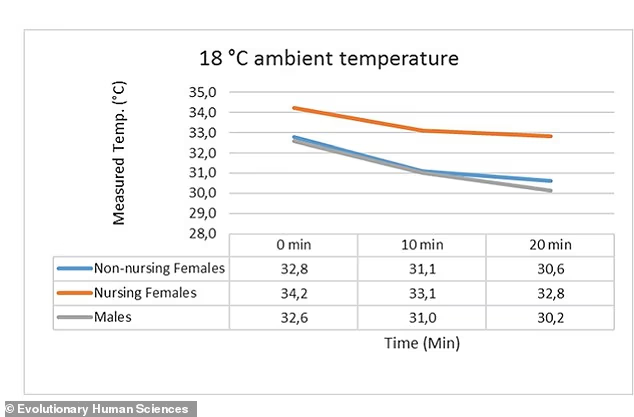
The volunteers were exposed to three temperatures (32°C, 27°C, and 18°C) for 20 minutes, while thermal imaging cameras measured the change in temperature of their breasts.
The results revealed that the breastfeeding women had higher temperatures in their breasts than the non-nursing women and men.
What’s more, breastfeeding women had a ‘distinct resilience’ against cooling environments.

According to a team from the University of Oulu, Finland, breasts may have evolved to help newborns (stock image)
The thermal cameras showed that these women lost an average of just 2.5°C of their mammary surface temperature, compared to 4.3°C and 4.7°C in men and non-nursing women, respectively.
According to the researchers, this suggests that women’s breasts evolved to be so large to keep newborns warm.
‘Shared body heat has been the most convenient and reliable heat source since before the invention of fire or protective clothing,’ the researchers explained.
‘The morphology of the female breast provides a large surface for skin-to-skin contact as the prominent shape and elasticity of the breast multiplies the contact area compared to a planar surface.’
The researchers now hope to carry out similar studies with other mammals to test their theory further.
‘Similar studies on other primates, such as breastfeeding and non-breastfeeding female chimpanzees, could shed light on the role of breastfeeding in chest temperatures in general and, consequently, on the origin of perennially enlarged breasts,’ they added.