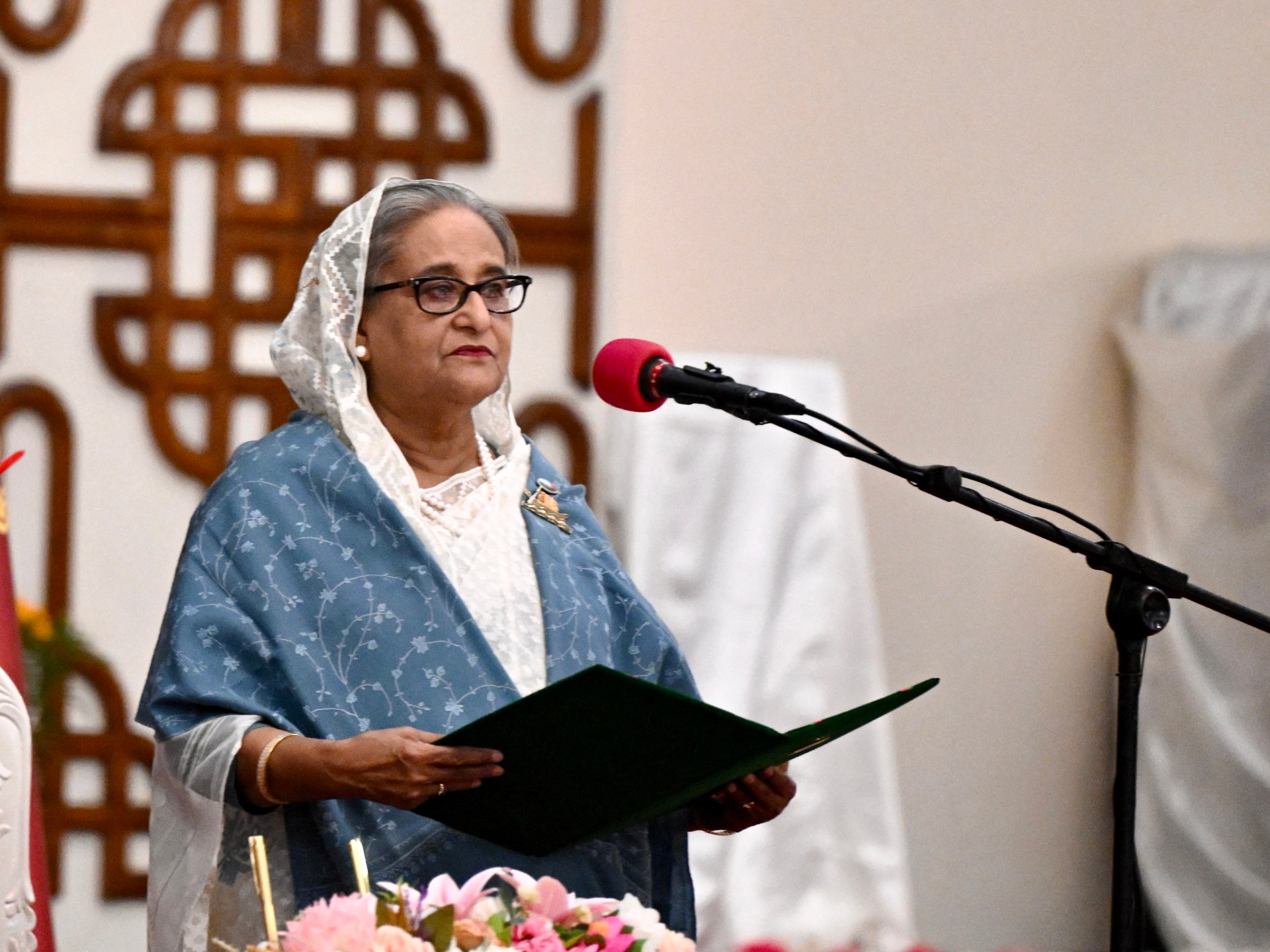
Former Bangladeshi Prime Minister Sheikh Hasina has been convicted of crimes against humanity and sentenced to death by a special tribunal in Dhaka.
Hasina, who is in exile in India, was tried in absentia on several charges related to her government’s deadly crackdown on student protests in 2024.
Prosecuting Hasina was a key promise made by the interim government, which is led by the Nobel laureate, Muhammad Yunus.
Here is more about Monday’s verdict, and what happens next:
What was the verdict?
The special International Crimes Tribunal 1 (ICT) in Dhaka has found Hasina guilty of crimes against humanity and sentenced her to death.
The independent ICT was originally set up by Hasina herself in 2010 to investigate crimes against humanity committed during the 1971 liberation war, which resulted in Bangladesh’s independence from Pakistan. However, it has been criticised in the past by human rights organisations and her opponents who have accused her of using it for politically motivated purposes while she was in power.
The tribunal delivered three categories of punishment against Sheikh Hasina across five charges: Two counts resulting in the death penalty and one count leading to imprisonment until natural death.
Hasina faced five charges:
- Orchestrating the mass killings of protesters
- Ordering or authorising lethal force from air and ground
- Murdering specific individuals
- Incinerating and disposing off bodies to hide evidence
- Coordinating the killings and persecution of demonstrators in specific areas
Hasina has been sentenced to imprisonment until natural death after being found guilty on three counts under the first charge: The incitement, ordering the killings and the inaction to prevent the atrocities and failing to take punitive actions against the perpetrators.
For charge two, Hasina was found guilty of crimes against humanity by her order to use drones, helicopters and lethal weapons. She was handed the death sentence.
Former Home Minister Asaduzzaman Khan, who was on trial alongside Hasina, has also been found guilty of the first charge and sentenced to death. Former police chief Chowdhury Abdullah Al-Mamun, was also found guilty of the first charge and has been sentenced to five years in prison.
Both Hasina and Khan face will have their property confiscated.
Hasina was also found guilty of the remaining three charges, but since she was handed the death sentence for her second charge, the court did not announce a punishment for the remaining charges.
Al-Mamun was shown leniency due to his cooperation with the trial proceedings. He provided “material evidence to the tribunal to arrive at the correct decision”, the court said.
While Hasina and Khan, who is also thought to be in India but whose whereabouts are unclear, were tried in absentia, Al-Mamun was present at the tribunal.
The court added: “The government is directed to pay considerable amount of compensation to the protesters concerned in this case, who have been killed in the July movement 2024 and also to take measures, to pay adequate compensation to the wounded protesters, in consideration of the gravity of their injury and loss.” It is unclear who would be expected to pay this compensation, however.
The verdict can be appealed to the Supreme Court.
Will Hasina and Khan be extradited to Bangladesh?
It is unclear whether Hasina and Khan will be returned to Bangladesh to face justice.
Bangladesh and India signed an extradition treaty in 2013. However, the treaty says: “Extradition may be refused if the offence of which it is requested is an offence of a political character.”
India has close ties to Hasina and has not formally responded to Dhaka’s previous demands for extradition.
“Under no circumstances is India going to extradite her,” Sreeradha Datta, a professor specialising in South Asian Studies at India’s Jindal Global University, told Al Jazeera. “We saw in the last year and a half that relationships between India and Bangladesh are not at their best and have been fragile at many occasions.”
“India and Bangladesh maintain an extradition treaty but under the provisions of the treaty, New Delhi has the right to refuse extradition if the offence is of a ‘political character.’
So far, New Delhi has adopted a ‘wait and see’ approach until next year’s election when a democratically elected government is back in power in Dhaka,” Chietigj Bajpaee, a South Asia expert at the Chatham House think tank in London told Al Jazeera.
However, Ishrat Hossain, an international relations expert and associate at the German Institute for Global and Area Studies, told Al Jazeera the verdict would help Bangladesh’s case in recovering Hasina and Khan.
“Politically and legally, the verdict strengthens Bangladesh’s hand in pressing India to extradite Sheikh Hasina, who fled there after the collapse of her government,” he said. “It also signals that the interim authorities intend to pursue accountability beyond symbolic gestures. Socially, this is an important early step toward acknowledging the suffering of survivors and the families of those killed under Hasina’s watch, even if full justice remains a distant prospect.
“Holding the perpetrators of the police-led brutality during Bangladesh’s 2024 uprising, where nearly 1,400 people were killed, has been a central priority of the interim administration.”
How has Hasina reacted to the verdict?
Hasina called the verdict “politically motivated”, the AFP news agency reported.
“The verdicts announced against me have been made by a rigged tribunal established and presided over by an unelected government with no democratic mandate. They are biased and politically motivated,” she said from India.
“I am not afraid to face my accusers in a proper tribunal where evidence can be weighed and tested fairly.”
Who is Hasina?
Hasina, 78, is the daughter of Bangladesh’s founding father, former President Sheikh Mujibur Rahman. After a 1971 war, Bangladesh declared independence and split from Pakistan.
In 1975, Rahman was assassinated in a military coup, ushering in a period of military and quasi-military rule.
Hasina led a pro-democracy uprising that ousted military ruler Hussain Muhammad Ershad in 1990. Hasina came to power in 1996 as leader of the now-banned Awami League party. The Awami League, founded in 1949, is a centre-left party with roots in Bengali nationalism and secularism. The party receives strong backing from those who supported the 1971 war.
Her first term as prime minister ended in 2001 after her party lost the general election to the Bangladesh Nationalist Party (BNP), led by Khaleda Zia. Hasina became prime minister again in 2009 and remained in the position for 15 years until August 2024 when student protests forced her out of power and she fled to India. Bangladesh does not have a set constitutional term limit for premiers.
Since Hasina was deposed, Bangladesh has been led by an interim government under Nobel Peace Prize laureate Muhammad Yunus. Elections for a new parliament are expected to take place in early 2026.
In May, the interim government revoked the Awami League’s registration and prohibited its political activities, citing national security concerns and ongoing war crimes investigations against senior members.
Why was Hasina tried over student protests?
On July 1, 2024, Bangladeshis led mostly by students and other young people took to the streets to protest against a High Court decision to reinstate a policy reserving one-third of civil service positions for descendants of those who fought in the 1971 war.
By July 19, the protests had escalated, a telecommunications blackout was imposed and the army was deployed to crack down on protesters. Student protesters were also attacked by Awami League’s student wing, the Bangladesh Chhatra League. Thousands of students fought with armed police in Dhaka, and about 1,400 people were killed, according to estimates by the United Nations.
The tribunal heard ample evidence that Hasina’s forces were ordered to fire on unarmed protesters.
During its own investigations since then, Al Jazeera also discovered secret phone call recordings in which Hasina “issued an open order” to “use lethal weapons” on students protesting against her government’s policies last year and shoot “wherever they find them”.
What is the significance of this verdict?
“Authorities in the interim government want to show that it is possible to have a clean and better judicial process under their watch,” Abbas Faiz, an independent South Asia researcher, told Al Jazeera
Faiz said while the Bangladeshis who lost loved ones during last year’s bloody uprising are likely to be pleased at the verdict, they still want to see “closure”.
“The significance of this verdict also opens the door for a national reconciliation process, which is not a bad thing,” Faiz said.
“While the possibility of enforcing the sentence is yet to be explored, the verdict has immense implications of various groups,” Hasan Mahmud, an Assistant Professor in Residence at Northwestern University in Qatar, told Al Jazeera.
“On the ground of justice, it is the first major transitional-justice moment of the post-Hasina era, it sets a precedent for accountability of powerful leaders, and it signals whether Bangladesh’s judiciary can establish autonomy after years of politicisation.”
Mahmud added that the verdict marks a pivotal moment in Bangladesh’s bid to move beyond decades of winner-takes-all politics.
“The verdict has profound symbolic implications for Bangladesh’s youth – the students, young workers, and first-time voters who took to the streets. To them, this is not just about one leader. It is about ending a cycle: of political repression, of corruption protected by state power, of dynastic politics that ignore ordinary people, of institutions captured by elites.”
Mahmud said that the youth in the country view the verdict as a step in a wider fight for structural change, not an act of retribution. They seek an impartial justice system, freedom from intimidation, truly fair elections and a country where justice is free from partisan influence.
Who was on the tribunal?
The ICT has three members and was headed by a retired district court judge, Justice Golam Murtaza Mazumdar.
In December, the Awami League criticised Mazumdar’s appointment as chairman of the tribunal in an X post, saying: “Golam Murtaza Mazumdar retired in 2019 and has not served as a judge for five years. Despite this, he has been elevated to the status of an appellate division judge as the Tribunal’s chairman.”
The other two members of the tribunal were Mohitul Haque Enam Chowdhury and Shofiul Alam Mahmood.
Even though the tribunal was established by Hasina herself, members of her party have called it a “kangaroo court”, a derogatory term for a court or tribunal that ignores recognised standards of law and justice, often delivering predetermined or biased outcomes.
How did the tribunal proceed?
In October 2024, the ICT issued an arrest warrant for Hasina and 45 others, including former ministers.
“The court has … ordered the arrest of former prime minister Sheikh Hasina and to produce her in court on November 18,” Mohammad Tajul Islam, the ICT’s chief prosecutor, told reporters in October 2024.
“Sheikh Hasina was at the helm of those who committed massacres, killings and crimes against humanity in July to August,” he added.
A state lawyer was appointed to defend Hasina and the two others on trial.
Arrest warrants for Hasina and Khan were again issued in June after the pair failed to appear before the tribunal in November 2024. They were formally charged on July 10. Al-Mamun pleaded guilty on the same day and agreed to become a state witness, agreeing to testify for the prosecution.
Testimony was heard from August 3 to October 8. Final arguments concluded between October 12 and October 23.
The tribunal examined a trove of evidence against Hasina: 14 volumes of documents spanning about 10,000 pages, including official reports, medical and postmortem records, ballistic data, flight logs and media footage; 93 documentary exhibits and 32 physical exhibits, such as ammunition, clothing, recordings and field reports; and testimony from more than 80 witnesses, including survivors, doctors, organisers and investigators with 54 testifying in court.
Security was tightened in Dhaka before Monday’s verdict, especially around the ICT and the surrounding Supreme Court area. Police and paramilitary forces – including the Rapid Action Battalion, Border Guard Bangladesh and army units – were deployed.
A “shoot-at-sight” order was issued for anyone engaged in arson, attacks involving explosives or violence before the verdict in Dhaka and other parts of Bangladesh.
Was the tribunal fair?
In October 2024, Human Rights Watch (HRW) issued a letter urging the interim government to amend the International Crimes (Tribunal) Act to ensure a fair and impartial judicial process.
An HRW statement alleged that the tribunal has “previously been fraught with violations of fair trial standards. This included failure of evidence gathering, lack of independence of judges including collusion with prosecutors, witness tampering, denying proper rights to defense, forcibly disappearing relatives of the accused, and the use of the death penalty.”
HRW urged the interim government to suspend and work to abolish the death penalty in line with international human rights standards, amend laws to safeguard due process rights of the accused and establish a well-resourced witness and victim protection unit capable of safeguarding individuals and their families before, during and after testimony.
The fact that two of the defendants were not present during the trial is another cause for concern, analysts said.
“In absentia trials are often a source of contention, and in this case, the speed with which the hearings were conducted and the apparent lack of resources for the defence also raise questions of fairness … but they should not be used to downplay or deflect from Sheikh Hasina’s actions,” Thomas Kean, an analyst focused on Myanmar and Bangladesh at the International Crisis Group said, AFP reported.
What happens next?
“This decision marks a significant inflection point in Bangladeshi politics, one that could trigger heightened volatility in the run-up to the February 2026 national election,” Hossain told Al Jazeera.
Hossain said that while the Awami League is now banned from participating in elections, the party retains a large, deeply embedded activist base that is likely to mobilise, potentially through disruptive and violent protests.
“Such confrontations risk re-creating the same patterns of repression and lethal force used by the law enforcers that the interim government now seeks to adjudicate.”
Crucially, however, about 15 million Bangladeshis living abroad, many of whom came out to protest in solidarity with the students in 2024 – often risking imprisonment in the countries they live in – have now been given the means to vote by post for the first time. Many analysts think their votes could sway elections because they now account for about 10 percent of the nation’s electorate.
Hossain said instability is likely in the short term but it is unclear what will happen in the long term.
“The short-term outlook is, therefore, turbulent. The longer-term implications – whether this ushers in a sustained shift toward accountability or entrenches another cycle of politicised justice – remain uncertain and will hinge on how both state institutions and political parties navigate the coming months.”
Moudud Ahmmed Sujan contributed to this report.