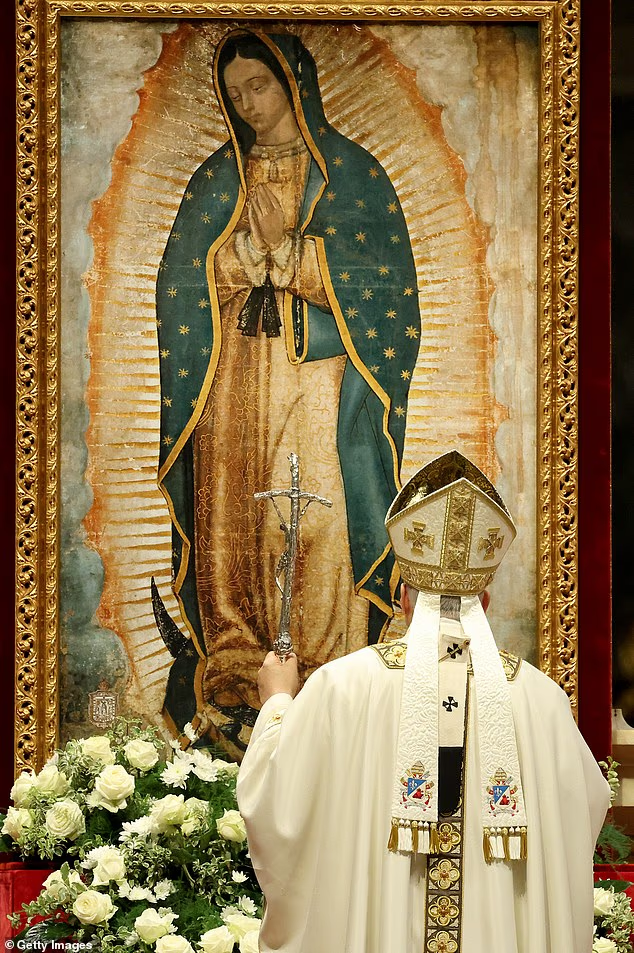
A mysterious detail hidden inside one of the world’s most famous religious images may defy conventional explanation, proving it might just be a miracle.
Scientists analyzing the Tilma of Guadalupe, a cactus-fiber cloak that Christians believe bears a miraculous image of the Virgin Mary, claimed they discovered at least 13 tiny human figures embedded within the eye.
The reflections are so small they can only be seen through digital enlargement, yet researchers said they resemble witnesses present when the artifact was first revealed in the 16th century.
After digitally processing high-resolution images, investigators also reported that sections of the face, hands, robe and mantle appear to have been applied in a single step, with no sketches, corrections or visible brush strokes.
‘The image of Our Lady of Guadalupe has been the subject of numerous technical studies since 1751,’ researchers wrote, adding that despite extensive investigation, ‘none of the results offered any sound scientific explanation, which up to this very day defies science and all human reasoning.’
The image appears on the cloak, or tilma, of Juan Diego, a 16th-century Indigenous convert who reported seeing the Virgin Mary in 1531 near Mexico City.
According to tradition, the image suddenly appeared on the cloak when Juan Diego presented it to Juan de Zumárraga, stunning witnesses and becoming one of the most revered religious artifacts in the Americas.
Further analysis of the microscopic image suggested the reflections contain multiple figures, including witnesses who were allegedly present when the tilma was first displayed.
Scientists have analyzed the Tilma of Guadalupe, a cactus-fiber cloak that Christians believe bears a miraculous image of the Virgin Mary, for decades, uncovering hidden details in her eye
The claims have been published in a recent report titled ‘Miraculous Image of Our Lady of Guadalupe,’ published by St Michael the Archangel Catholic Church in Texas, which summarizes various historical examinations of the tilma conducted over the past several centuries.
However, the details have also resurfaced online where people are hailing the Tilma of Guadalupe as ‘the second greatest relic in history,’ likely after Jesus’ burial cloth.
One user shared on X: ‘I’ve read this three times and my rational mind keeps running out of explanations. Science keeps confirming what faith already knew. But I still have my faith in science.’
Some have dismissed the claims, with another user saying: ‘I’m pretty sure artists in the 16th century knew how images were distorted when reflected onto curved surfaces.’
In 1936, Nobel Prize–winning chemist Richard Kuhn was asked to analyze a small fiber sample taken from the cloak.
After examining the material, Kuhn reported that the pigments did not match any known colorants derived from plants, animals or minerals.
According to accounts of the analysis, the chemical composition of the coloring agents could not be identified using the pigment classifications available at the time.
The image was examined again using more modern technology in 1979, when biophysicist Philip Serna Callahan and art specialist Jody B Smith conducted an infrared photography study of the image, capturing high-resolution scans designed to reveal details invisible to the human eye.

The analysis identified at least 13 tiny human figures embedded within the pupil
Their analysis focused on how the image interacts with light and how the colors are distributed across the cloth.
The researchers reported that large portions of the image appeared unusually uniform, with color areas extending across the fabric without the layering patterns normally seen in traditional paintings.
The infrared images also showed that the pigments appeared to interact differently with light than conventional paints, producing subtle shifts in brightness depending on the angle of observation.
The team concluded that the technique used to create the image could not be easily explained using standard painting methods known from the 16th century, leaving the process by which the colors were applied unresolved.
Made from coarse fibers of the maguey cactus, a material that normally decays within a few decades, the fabric has survived for nearly five centuries without significant deterioration.
The cloak measures roughly five feet by three feet and consists of two pieces of cloth sewn together by a simple seam that runs through the center of the image.

The reflections are so small they can only be seen through digital enlargement, yet researchers said they resemble witnesses present when the artifact was first revealed in the 16th century. Further analysis suggested the reflections contain multiple figures, including witnesses who were allegedly present when the tilma was first displayed in 1531
Yet despite centuries of exposure to candle smoke, humidity, dust and repeated handling by pilgrims, the fabric has remained intact.
Studies of the cloth have noted that the tilma appears unusually resistant to insects and dust, and the colors of the image have retained their brightness despite long periods without a protective covering.
In the 18th century, two copies of the image were painted on similar cactus-fiber cloth using the best techniques of the time.
Both replicas deteriorated within decades, while the original remained unchanged, and even attempts to modify the image failed.
At one point, artists added decorative elements such as a crown and angels, but those additions faded away while the original figure remained untouched.
Scientists have also struggled to determine how the image itself was created. Analyses of the cloth have found no visible brush strokes, sketches or paint residues.
Some investigators reported that the colors appear to hover slightly above the surface of the fibers rather than soaking into the cloth.
‘When examined closely, the colors disappear and only the fabric is visible,’ researchers noted.
Skeptics, however, remain cautious, as many scientists argue the findings could be the result of visual interpretation or image processing artifacts rather than intentional details embedded in the painting.
Regardless, the tilma continues to attract intense scrutiny from both believers and researchers.