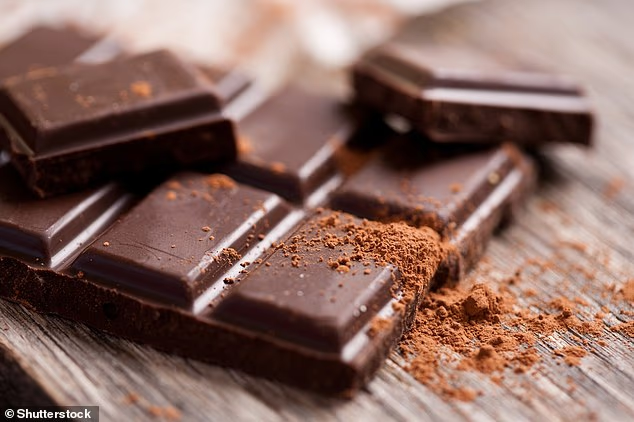
There’s good news for people with a sweet tooth, as a new study has revealed that eating dark chocolate could help you live longer.
Cocoa – the primary ingredient in dark chocolate – contains theobromine, a key compound naturally produced by plants.
New research has revealed that this compound reduces your biological age – a measure of how much damage people’s cells have accumulated over time.
While the experts are not exactly sure how theobromine has this anti-ageing effect, chomping down on your advent calendar this Christmas may not do the trick.
Theobromine – which gives unsweetened chocolate its bitter taste – is only in significant amounts in chocolate with high cocoa content.
Even dark chocolate can have a high fat and sugar content, which means it should be eaten in moderation as part of a balanced diet.
‘We’re not saying that people should eat more dark chocolate,’ said study author Jordana Bell, a professor of epigenomics at King’s College London.
‘But this research can help us understand how everyday foods may hold clues to healthier, longer lives.’
A chemical found in dark chocolate called theobromine could slow the rate of biological ageing, report researchers at King’s College London (file photo)
The study looked at health data of individuals from two cohorts – 509 from TwinsUK and 1,160 from Germany’s KORA.
These 1,669 individuals had an average age of 60 and were generally healthy, not selected for particular diseases.
To assess biological age, the team focused on chemical changes in DNA and the length of telomeres, the protective caps on the ends of chromosomes.
Like an aglet on a shoelace, telomeres stop the genetic material from unravelling and becoming damaged. Shorter telomeres are associated with ageing and age-related diseases.
According to the findings, those with higher levels of theobromine circulating in their blood had a biological age that was lower than their actual (‘chronical’) age.
After testing whether other metabolites in cocoa and coffee showed a similar link, they found the effect seemed to be specific to theobromine.
This important alkaloid, known as being poisonous to dogs, has been linked to health benefits in humans, such as a lower risk of heart disease.
It is already thought to lower blood pressure, promote fat metabolism, boost blood flow, enhance cognitive function and combat age-related cognitive decline.

Across two European cohorts, which included 509 individuals from TwinsUK and 1,160 from KORA, the research found that those who had higher levels of theobromine circulating in their blood had a biological age that was lower than their actual age

Theobromine is the primary alkaloid found in cocoa and therefore chocolate. Caffeine is also in cocoa, although in lower amounts than in coffee
The team report: ‘Theobromine, a commonly consumed dietary alkaloid derived from cocoa, has been linked to extended lifespan in model organisms and to health benefits in humans.
‘Here we report a significant association between circulating levels of theobromine with slower epigenetic ageing in two independent population-based cohorts.’
The team are not sure yet whether the effect is unique to theobromine alone, or whether theobromine may interact with other compounds in dark chocolate, such as polyphenols, which are known to have beneficial effects on human health.
Plant compounds in our diet such as this may affect how our bodies age by changing the way our genes are switched on or off.
Some of these compounds can interact with ‘cellular machinery’ that controls gene activity and helps shape health and longevity.
The findings, published today in Aging, follows follows many other papers exploring the benefits of eating cocoa, the primary ingredient in chocolate.
A 2023 study at Mass General Brigham Hospital in Boston found cocoa may reduce cognitive decline in people at high risk of dementia.
In 2021, scientists at Columbia University found consumption of cocoa was linked to improved performance in list-learning tasks due to flavanols, compounds abundant in cocoa as well as berries, apples, tea, and leafy veg.
And in 2019, Portuguese researchers said eating a few squares of dark chocolate every day lowers blood pressure in just one month.
However, there’s less evidence suggesting the health benefits of milk chocolate, which contains scant amounts of cocoa.
Commercially available chocolates on the market are increasingly packed with milk, sugar and fats at the expense of cocoa mass.
Some don’t contain enough cocoa to be permitted to be marketed as chocolate, which is why they instead have the label ‘chocolate flavoured’.
Generally, consumers are advised to enjoy chocolate as part of a balanced diet and active lifestyle, but opt for dark chocolate over milk chocolate to get the health benefits of theobromine and other compounds.
‘Exact proportions [of theobromine] vary across foods and also depend on food processing methods,’ Professor Bell told the Daily Mail.
‘Dark chocolate is high in cocoa solids, milk chocolate has lower levels and white chocolate has none.’
A brief history of chocolate
Chocolate is generally thought to have been domesticated first in Mesoamerica, by the Olmec people who flourished between 1200-400 BC.
However, research has shown that the greatest genetic diversity of the cocoa tree (Theobroma cacao) is in the upper Amazonian region in northwest South America, indicating that this is its origin.
Theobromine and DNA residues found from archaeological research in southwest Ecuador date from approximately 5,300 years ago.
It was not for another 6,800 or so years until Europe got its first taste of the magic beans.
Spanish conquistador Cortés introduced chocolate to the Spanish court after his 1519 travels to Mesoamerica and there sweeteners like honey and sugar began to be added.
In 1585, Spain received its first known shipment of cacao.
A Dutch chemist, Coenraad van Houten, opened the modern era of chocolate making in 1828 when he patented his innovative process of using a hydraulic press to remove most of the cocoa butter from processed cacao to give cocoa.
He added alkaline salts to allow the cocoa to mix more readily with water: the so-called ‘Dutch process’.
The baton then passed to the Brits – namely Bristol-based chocolate maker Joseph Fry, founder of the Fry company (responsible for delights such as the Creme Egg, the Crunchie, Peppermint Cream and Fry’s Turkish Delight).
Joseph Fry’s contribution was to remix the cocoa butter and liquor and to add sugar and to set the resulting mixture in molds – the first chocolate bars in 1847. The Swiss then got into the game with chocolatier Daniel Peter adding milk powder to create milk chocolate.

Joseph Fry, founder of the Fry company, is credited as the inventor of the chocolate bar. Pictured, advertisement for Fry’s chocolate in a traveller book from 1863
Chocolate is thought to have been associated with Valentine’s Day since 1868, when Richard Cadbury produced, but did not patent, a heart shaped box containing chocolates.
There are different schools of thought on the nomenclature around chocolate.
We use ‘cacao’ to describe the unrefined bean and the tree on which it grows. Cacao trees produce pods which contain around 20-60 seeds, known as cocoa beans.
Cacao is minimally processed and comes in the form of nibs, powder and paste.
Cocoa is produced by opening the cacao pods, fermenting the beans for between two days and a week, drying the beans to reduce moisture content from 55 per cent to 7.5 per cent, roasting the beans (an individualized process depending on the desired output) and removal of the bean’s shell to leave the cacao nib.
The cacao nib can then be ground into a paste called cocoa mass, which is roughly half and half cocoa solids and cocoa butter.
Source: Christian Aid