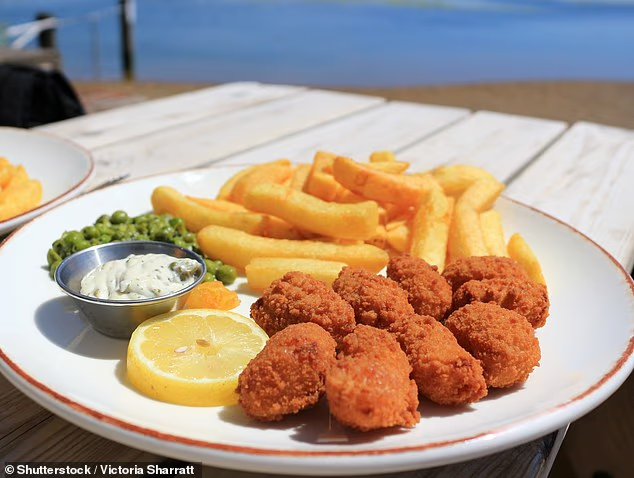
Woke scientists are calling for Brits to take scampi and chips off the menu, amid fears that the seaside staple carries a ‘hidden climate cost’.
Scampi is a traditional chip shop treat made from the breaded and fried tails of Norway lobsters, also known as langoustines.
These slim, brightly coloured lobsters live in the mud at the bottom of the ocean and thrive in the North Sea off the coast of Scotland.
However, scientists now warn that fishing for scampi threatens to release vast stores of carbon dioxide and decimate ocean ecosystems.
The most common method for catching Norway lobsters is to drag heavy nets across the sea floor in a process known as bottom trawling.
Conservationists have long warned that this practice causes enormous damage to marine life, but scientists have now identified another ‘hidden’ climate cost.
In a new study, scientists from the University of Exeter found that bottom trawling can release carbon that was trapped in the mud thousands of years ago.
With these hidden costs in mind, co–author Professor Callum Roberts told the Daily Mail that people should ‘definitely’ avoid British scampi caught through bottom trawling.
Scientists have warned Brits that their scampi and chips could have a hidden environmental cost, as experts warn that fishing for this classic treat damages marine ecosystems and releases trapped carbon. Pictured: Scampi bycatch from bottom trawling (stock image)
The sediment–rich muds at the bottom of the ocean are not just a home for marine life, but also a fantastic natural store of carbon.
As sediment from dead plants and animals is laid down over thousands of years, it traps that carbon deep beneath the ocean and prevents it from entering the atmosphere.
However, not every part of the ocean is an equally effective carbon trap, and some areas are far more vulnerable to disturbance than others.
Professor Roberts and his co–author Zoë Roseby investigated an area known as the Fladen Ground, a major Norway lobster fishing site east of Scotland.
The Fladen Ground stores an estimated 11.65 million tonnes of organic carbon, which helps keep the planet’s climate stable.
However, the researchers also discovered that this site deposits carbon very slowly and is especially vulnerable to the effects of trawling.
Dr Roesby says: ‘Most of the carbon stored there was deposited at the end of the last ice age and is not being replenished in our lifetime.
‘This means that modern trawl events can disturb sediments and carbon deposited several thousand years ago.’

Scientists have found that scampi fishing in the Fladen Ground (illustrated) threatens to release carbon that was trapped up to 2,300 years ago
In their paper, published in the journal Marine Geology, the researchers show that bottom trawling for your scampi releases carbon laid down up to 2,300 years ago.
‘Many people don’t realise that Norway Lobsters live in mud, or that catching them involves towing nets directly across the seabed,’ says Dr Roesby.
‘That makes the environmental cost of scampi largely invisible to consumers.’
However, the hidden carbon cost is only part of the reason that scientists are urging consumers not to buy bottom trawled scampi.
Since Norway lobsters are small and live in the mud, fishing vessels use nets that drag right through the sediment and have very fine holes.
This means that bottom trawling indiscriminately scoops up any animals or plants that happen to be in its path.
Studies estimate that for every one kilogram of Norway lobster that is caught, another kilogram of other wildlife is killed and discarded.
In Scotland alone, 16,000 tonnes of Norway lobster were landed from the North Sea in 2022, leading to enormous amounts of bycatch.

Scampi, also known as Norway lobster, are caught using a technique called bottom trawling. This involves dragging weighted nets (pictured) across the bottom of the ocean

Dragging nets through the mud of the Fladen Ground (outlined) disturbs sediment that was laid down during the end of the last Ice Age
That includes sharks, flatfish, other shellfish and crustaceans, and even juveniles of other species like cod.
Phil Taylor of the ocean conservation charity Open Seas explains that this is especially problematic since bottom trawling often takes place close to shore or even up sea lochs.
These areas are the nursery and spawning grounds for other marine species, with trawlers knocking out a key stage in their life cycles.
Mr Taylor told the Daily Mail: ‘Unfortunately, management of the fisheries catching scampi is poor.
‘The bottom trawls used flatten and damage habitats throughout huge areas of the North Sea. The trawls also lift carbon locked up in the seafloor, some of which then gets released to the atmosphere.’
He adds: ‘Given the risks, some consumers may choose to avoid scampi altogether, but ultimately, it’s the regulation of our fisheries that needs to change so that the marine habitats that underpin our fisheries are properly protected.’
SeaFish, the public body supporting the seafood industry, contests these claims.
A spokesperson for the organisation said: ‘There has been unfair criticism that the Nephrops [the scientific name for Norway lobster] fishery causes widespread damage to seabed habitats and some of the vulnerable marine life that lives there.

Besides releasing carbon, every kilogram of Norway lobster caught by bottom trawling leads to another kilogram of bycatch – unwanted extra fish that is often discarded
‘Nephrops are usually caught from well–defined areas of soft mud and sandy habitats, which are naturally disturbed by burrowing animals.’
Likewise, alternatives to bottom trawling are available, such as creel fishing, which uses lobster pots to trap live animals and has a much smaller impact on marine environments.
Additionally, studies have shown that these methods can generate more revenue for fishing fleets due to the larger and higher–quality catch.
In fact, Norway lobsters themselves are actually an extremely environmentally friendly seafood.
Professor Roberts explains: ‘From the narrow perspective of the scampi alone, you can fish sustainably. These prawns live fast, reproduce early and die young, so they can easily withstand fishing pressure.’
However, as most scampi is still caught by bottom trawling, Professor Roberts says there is currently no way to sustainably eat scampi.
Professor Roberts adds: ‘Trawling for scampi is incredibly destructive of seabed habitats and mobilises lots of seabed carbon in the process.
‘Trawling over the course of hundreds of years has completely transformed the seabed, turning it from a place dominated by rich and complex habitats inhabited by huge fish, like cod, halibut and skates, into a wasteland of shifting sands and mud today.’