An ‘exceptionally rare’ shipwreck, a gnome garden and ‘Dragon’s Teeth’ Second World War defences are among the weird and wonderful historic structures that have gained heritage protection over the previous year.
The National Heritage List for England ranks entries based on their importance, with Grade I reserved for sites considered to be of ‘exceptional interest’, while Grade II covers those of ‘special interest’.
Other newly protected sites range from a Neolithic burial mound dating to 3400BC in the Yorkshire Dales to a ‘time capsule’ Victorian ironmongers that specialised in making ice skates.
They are joined by Victorian guide posts to help drivers in Cheshire, a tin tabernacle church in Essex and the concrete 1980s London workshop of architect Sir David Chipperfield.
Other listings will divide opinion, including a 1960s university block in Manchester dubbed a ‘modernist icon’ by fans – and an outdated eyesore by some critics.
Heritage Minister Baroness Twycross said: ‘Britain’s heritage is as varied as it is brilliant, with each of these buildings playing a part in shaping our national story over the centuries.’
Below are 17 of the most unusual and surprising entries.
Dragon’s Teeth WWII anti–tank defences
Thorneycroft Wood, Guildford (scheduled monument)
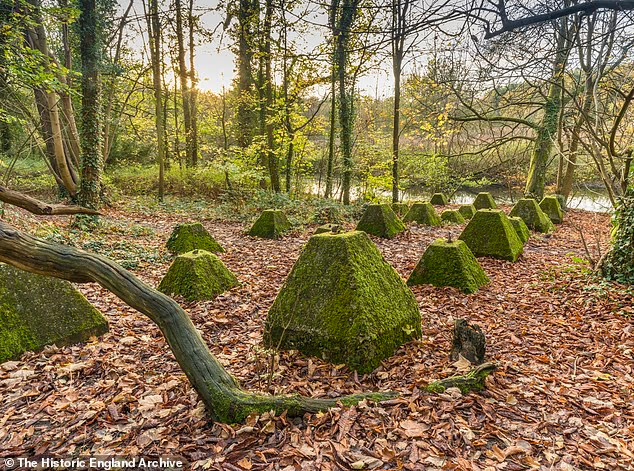
Anti–tank defences known as Dragon’s Teeth were built at Thorneycroft Wood near Guildford in 1941–42

Consisting of concrete blocks in the shape of pyramids, they are among the best–preserved examples of the defences set up to counter a feared Nazi invasion
These remarkable anti–tank obstacles known as Dragon’s Teeth were built at Thorneycroft Wood in Surrey in 1941–42.
Consisting of concrete blocks in the shape of pyramids, they are among the best–preserved examples of the defences set up to counter a feared Nazi invasion.
This period saw the construction of a network of coastal defences and inland strongholds called ‘nodal points’ that were expected to resist attack for up to seven days.
Nearby Guildford was designated a ‘Category A’ nodal point, and the Dragon’s Teeth in Thorneycroft Wood guarded the eastern approach to the town.
Built by the Royal Engineers and manned by the 4th Guildford Battalion Surrey Home Guard, the defences are designed to take advantage of the natural landscape, topography and surrounding woodland.
Dragon’s teeth like this are not unique to location and are found UK–wide, with others at Fairbourne Beach in Wales and on GHQ Line near Waverley Abbey, Surrey.
‘Time capsule’ Victorian ironmongers
Adams Heritage Centre, 17 Main Street, Littleport, Cambridgeshire (Grade I)

Built in 1893 and originally an ironmongers, this shop in Littleport served the local community for over 100 years and remains a rare survival of its kind

Now known as Adams Heritage Centre, it has achieved a Grade II listing, meaning it is of special interest
Adams Heritage Centre in Littleport has been listed at Grade II for its exceptional preservation of Victorian commercial architecture.
Built in 1893 and originally an ironmongers, the building served the local community for over 100 years and remains a rare survival of its kind.
The shopfront still has many original features including large display windows, ornate wrought–iron folding gates, etched glass with painted lettering and a recessed entrance.
Inside, tall wooden shelving (relocated from a 19th–century chemist’s shop in Ely), and a steel–framed structure – which was very advanced for its time – give a glimpse into the working life of a traditional shop.
It gained a national reputation for fitting and maintaining Norwegian ice skates, widely used by fen skaters, the traditional form of ice skating in fens of East Anglia.
Under owner John Henry Adams, the shop became a hub for the sport, even importing skates from Oslo and distributing them across the UK.
Rare 19th–century wreck complete with original fittings
St Albans Head, Dorset (scheduled monument)

This exceptionally rare shipwreck lost in 1903 known as the Pin Wreck in Dorset is a scheduled monument – a nationally important archaeological site

Mooring lighters were specialised working vessels that laid and recovered heavy moorings and anchors that allowed ships to secure safely in harbours and anchorages
This ‘exceptionally rare’ wreck of a 19th–century steam mooring lighter is strewn with hundreds of copper bolts that once supported its hull.
The ‘Pin Wreck’ is located 89ft underwater off St Albans Head and is believed to be a Yard Craft 8, lost in 1903.
Mooring lighters were specialised working vessels that laid and recovered heavy moorings and anchors that allowed ships to secure safely in harbours and anchorages.
They could handle the enormous chains and equipment needed to maintain port operations.
Only 47 mooring vessels operated across 20 naval dockyards during the late Victorian period and just four were steam–powered mooring lighters.
This wreck represents the only known surviving example. Historic England recommended the site for protection following archaeological surveys by Bournemouth University.
Dock equipment linked to first transatlantic phone calls
Enderby’s Wharf, Greenwich (scheduled monument)

This cable hauler and gantry at Enderby’s Wharf stand as reminders of Greenwich’s place in the development of worldwide undersea communications
A steel cable gantry (built between 1897 and 1907) and cable hauler (from 1954) at Enderby’s Wharf stand as reminders of Greenwich’s place in the development of worldwide undersea communications which laid the foundations for today’s subsea optical cables that transmit internet traffic worldwide.
These structures were once part of the busy undersea works that helped connect England to the rest of the world.
The cable hauler was installed specifically to assist with loading the first successful transatlantic telephone cable, which became operational in 1956 – a major milestone in global communication history, allowing simultaneous phone calls between Britain and North America.
Previously, these calls had only been possible via a radio telephone service
From the mid–19th century, Greenwich played a key role in developing, producing and loading the heavy armoured cables that carried telegraph and telephone signals across oceans, with the technological leap required to manufacture these cables known as the ‘moon shot’ of the 19th century.
Rare 1843 working smock mill – a survivor of Kent’s rural past
St Peter’s Footpath in Dane Valley, Margate, Kent (Upgraded from Grade II to Grade II*)

Coming up to 200 years old, Draper’s Windmill in Margate, Kent has been upgraded from Grade II to Grade II*

Built around 1843, probably by the millwright John Holman of Canterbury to grind grain into flour, it has survived in remarkable condition. Pictured is a man enjoying the view from a window
Timber–framed Draper’s Windmill in Margate, Kent has been upgraded from Grade II to Grade II* – a particularly important building of more than special interest.
It was built around 1843, probably by the millwright John Holman of Canterbury to grind grain into flour, and has survived in remarkable condition.
It had been Grade II listed since 1973, but its significance as a 19th–century smock mill with rare surviving internal machinery has now been formally recognised.
The Grade II* listing reflects the increasing rarity of operational historic mills across England and celebrates this important part of Kentish heritage.
Today, the handsome black smock windmill is open by appointment or when volunteers are on site.
Sir David Chipperfield’s 1980s Camden workshop
Cobham Mews Studios, 1 and 1a Cobham Mews, London (Grade II)

Architect Sir David Chipperfield’s striking Camden workshop has now been designated Grade II

The design draws inspiration from small–scale industrial buildings as well as Victorian artist’s studios, using rooflights and glass bricks to bring in natural light
Sir David Chipperfield’s first UK building has been designated Grade II, following a listing application in January.
Cobham Mews Studios, designed by David Chipperfield Architects and built between 1987 and 1989, was the practice’s first complete building after a series of luxury shop interiors, including for Japanese fashion designer Issey Miyake.
Seeing the potential of a back–land plot, then in use as a scrapyard, Chipperfield worked with Derwent Valley Property Developments to create a pair of studio offices tucked behind the residential terraces of central Camden. The building remained the practice’s home for over 20 years.
The design draws inspiration from small–scale industrial buildings as well as Victorian artist’s studios, using rooflights and glass bricks to bring in natural light whilst protecting the privacy of surrounding houses.
The exterior nods to Modern Movement pioneers of the 1920s and 30s which were an early influence on Chipperfield. Inside, crisp detail, double–height spaces and mezzanine floors create spatial drama.
Best known for The Hepworth Wakefield gallery (2003–2011) and Turner Contemporary gallery, Margate (2006–2011), Chipperfield is famous worldwide.
Storm tower dubbed ‘the Pepperpot’
Compass Point, Bude, Cornwall (Grade II List Amendment)

Victorian Bude Storm Tower has been saved from the risk of falling into the sea for a second time in its history through a major conservation project
Inspired by the ancient Tower of the Winds in Athens and known as ‘the Pepperpot’ due to its distinctive shape, this tower has been saved from the threat of coastal erosion and has had its list entry amended to reflect its new location.
Victorian Bude Storm Tower has been saved from the risk of falling into the sea for a second time in its history through a major conservation project partly funded by The National Lottery Heritage Fund and local people.
Built in 1835 and designed by renowned architect George Wightwick, it was moved inland from its original clifftop location in 1881 due to cliff collapse.
Nicknamed ‘the Pepperpot’ due to its shape, it was listed at Grade II in 1985. The octagonal tower was recently relocated again 120 metres north–east due to the imminent threat of cliff erosion caused by climate change.
Commissioned by Sir Thomas Dyke Acland, it originally served as a coastguard lookout and refuge.
Bude Storm Tower has had its list entry updated with new information about how it was built and its new location.
Edwardian Arts and Crafts gem
Sharlands House, Sharlands Lane, Braunton, Devon (Grade II)

Sharlands House was designed by notable architect and craftsman Godfrey A E (Bertie) Schwabe for artist Thomas A Falcon RBA

Alongside original works by Falcon, such as two decorative panels with geometric designs in the drawing room, the intended aesthetic of the house has been maintained to the present
Completed in 1912, Sharlands House was designed by notable architect and craftsman Godfrey A E (Bertie) Schwabe for artist Thomas A Falcon RBA.
The building in Braunton, Devon is a bold design in a Georgian revival style. The elegant interior features well–crafted panelling, a marble–tiled hall and fine detailing including beaten copperwork.
Alongside original works by Falcon, such as two decorative panels with geometric designs in the drawing room, the intended aesthetic of the house has been maintained over a century later.
Mr Schwabe, who established his career working with internationally renowned architect Edgar Wood from 1893 to 1910, designed the house as a commission for his sister and brother–in–law. This family connection is reflected in the attention to detail throughout the building.
Sharlands House is representative of an era when artistic, cultural and scientific communities flourished in the English countryside.
Neolithic burial site that sheds light on ancient farmers
Dudderhouse Hill Neolithic Long Cairn, Long Scar, Yorkshire Dales (scheduled monument)

Dudderhouse Hill is located near Ingleborough in the Yorkshire Dales and provides important evidence of early prehistoric communities in northern England

This partly turf–covered mound of stone dates to around 3400–2400 BC and measures 23 metres long and 12 metres wide
The burial site at Dudderhouse Hill is located near Ingleborough in the Yorkshire Dales and provides important evidence of early prehistoric communities in northern England.
This partly turf–covered mound of stone, dating to around 3400–2400 BC and measuring 23 metres long and 12 metres wide, is one of the oldest visible monuments in the landscape and offers a rare insight into prehistoric ritual and burial practices.
Until the 1990s, experts believed long cairns were absent from the Yorkshire Dales, assuming that Neolithic communities in the area used natural cave systems for burial instead. However, fieldwork over the past two decades has identified a small number of these ancient monuments across the region.
First identified in 2008, the Dudderhouse Hill Long Cairn displays evidence of structural arrangements, including large stone slabs and edge–set stones suggesting internal compartments.
Remarkably, the Cairn’s orientation appears carefully planned with its axis aligned towards Pen–y–ghent, a prominent peak, whilst mirroring the Ingleborough to Simons Fell ridge to the north–west.
Victorian ‘tin tabernacle’ church
St Peter’s Church, Littlebury Green, Essex (Grade II)

St Peter’s Church is a rare example of a ‘tin tabernacle’ – a type of prefabricated church built by the Victorians

While many tin tabernacles were temporary structures later dismantled, replaced or moved, St Peter’s is unusual in surviving on its original site and retaining the majority of its original fabric
St Peter’s Church is a well–preserved Victorian ‘tin tabernacle’ – a once–common but now increasingly rare type of prefabricated church.
Built in 1885 as a chapel of ease, (situated for the convenience of people who lived a distance from the main parish church), the building was supplied in kit form by C.Kent of London, with corrugated–iron cladding from Frederick Braby & Co’s ‘Sun Brand’; materials that made fast, affordable church building possible for growing 19th–century communities.
While many tin tabernacles were temporary structures later dismantled, replaced or moved, St Peter’s is highly unusual in surviving on its original site and retaining the majority of its original fabric.
Its wooden cupola with bell, pointed Gothic openings and Y–tracery windows give the modest structure surprising architectural presence.
The pine–lined interior also survives almost completely intact, with original pews, altar fittings, decorative transfers in the windows and a biblical text encircling the chancel arch.
‘Enchanting’ inter–war gnome garden
Garden at Tudor Croft, Stokesley Road, Tees Valley (Grade II)

A gnome peeks through the undergrowth at Tudor Croft’s garden in Guisborough, North Yorkshire

Created from 1934 for industrialist Ronald Crossley, the site is a rare survival of an inter–war suburban garden in a relaxed Arts and Crafts style
This ‘enchanting’ inter–war garden has terracotta gnomes, pixies and elves and the far–reaching landscape of the North York Moors beyond
Tudor Croft’s garden, created from 1934 for industrialist Ronald Crossley, is a rare survival of an inter–war suburban garden in a relaxed Arts and Crafts style. Designed to complement the family home, it remains largely intact, with the house overlooking the garden and the North Yorkshire Moors.
The highlight is the Gnome Garden, entirely populated by magical beings. Hand–crafted terracotta ornaments by potter and sculptor Walter Scott, including elves, gnomes playing instruments, pixies, birds and animals are scattered throughout the garden, all produced at the Commondale brickworks.
Their cheeky features have an affinity with the fairytale illustrations of Cecily Mary Barker or Margaret Tarrant which had become popular in the 1920s.
There is also a secret garden with a small stone–flagged bridge over a pond with a terracotta fisherman at the opposite end. It also features a rare, roofed fernery and intricate rockwork, likely by the acclaimed Backhouse Nursery of York, a curving rose pergola of Crossley bricks and a water garden.
Unlike the rigid geometries of earlier Arts and Crafts gardens, Tudor Croft’s design is one of personal expression.
Coal duty boundary post harking back to the Great Fire
South side of Epping Road, Essex (Grade II)

This distinctive Victorian cast–iron marker, erected in the 1860s, is one of the few remaining roadside posts from a ring of approximately 280 that once encircled London
A tangible reminder of London’s industrial past and taxation system to help London rebuild after the Great Fire of 1666
This distinctive Victorian cast–iron marker, erected in the 1860s, is one of the few remaining roadside posts from a ring of approximately 280 that once encircled London at a 20–25 mile radius from the City.
They marked the boundary where duty was payable on coal imported into the capital under the London Coal and Wine Duties Continuance Act of 1861.
Cast by Henry Grissell of the Regents Canal Ironworks, the white–painted square column, features a pyramidal top and the City of London crest. It bears the inscription ’24 VICT’, referring to the 1861 Act, along with the maker’s mark at ground level.
The marker provides a physical connection to the tax on coal that helped fund London’s development following the Great Fire of 1666. The duty system originated with the First Rebuilding Act of 1667 and evolved over centuries as coal transportation shifted from sea to road, canal and rail routes.
The 1861 Act aligned the duty boundary with the Metropolitan Police District, requiring new markers between 1859 and 1864. The tax continued until 1891, when the Corporation of London relinquished its collection rights.
Rare Arts and Crafts–inspired suburban garden
Garden of Great Ruffins, Wickham Bishop, Essex (Grade II)

The Edwardian garden is at Great Ruffins, a Grade II* listed building, in Wickham Bishop, Essex

The garden was created in 1903 by pioneering architect and designer Arthur Heygate Mackmurdo
The garden at Great Ruffins was created in 1903 by pioneering architect and designer Arthur Heygate Mackmurdo.
It is the only surviving garden known to be of his design and is a rare example of an Arts and Crafts suburban landscape.
Mr Mackmurdo designed the garden as an expression of his ideals of social harmony and a life lived in balance with nature.
Set across sloping grounds, it transitions from formal terraced areas near the house to informal woodland walks and countryside views beyond.
Many original features have survived, including clipped yew hedges, a cedar avenue, garden rooms, a sunken rockery, and a bowling green.
Together, they form a near–complete picture of early 20th–century garden design inspired by Arts and Crafts values.
Manchester lecture theatre block
Renold Building, UMIST Campus, Manchester (Grade II)

With its daring form and sculptural Modernist style, the Renold Building in Manchester announced a new era of academic architecture

It remains divisive today, with some considering it an example of the ugly post–war architecture that many blame for blighting Britain’s cities
Designed by W.A. Gibbon of the Manchester–based firm Cruickshank and Seward, the Renold Building became the first purpose–built lecture theatre block in an English higher education institution.
With its daring form and sculptural Modernist style, the Renold Building announced a new era of academic architecture.
You might not know it from looking at the exterior, but the building’s concept was as practical as it was visionary.
Instead of scattering lecture halls across campus, it consolidated them into a single structure with three larger lecture theatres in the podium and six lecture theatres stacked vertically in the tower, creating space for 3,000 students under one roof.
But it remains divisive today, with some considering it an example of the ugly post–war architecture that many blame for blighting Britain’s cities.
‘A cathedral for a new age’
Liverpool Metropolitan Cathedral of Christ the King, Liverpool (Upgraded from Grade II* to Grade I)

Designed by Sir Frederick Gibberd and built between 1962 and 1967, Liverpool’s Metropolitan Cathedral marked a turning point in British cathedral architecture

The soaring lantern, filled with coloured glass by John Piper and Patrick Reyntiens, floods the space with light and symbolises the connection between earth and heaven
Liverpool’s Metropolitan Cathedral has been upgraded to Grade I, placing it among the most important buildings in England.
Designed by Sir Frederick Gibberd and built between 1962 and 1967, this radical design marked a turning point in British cathedral architecture.
Gibberd’s circular plan broke with tradition, placing worshippers around a central altar and emphasising communal participation – ideas that echoed the changes of the Second Vatican Council.
The soaring lantern, filled with coloured glass by John Piper and Patrick Reyntiens, floods the space with light and symbolises the connection between earth and heaven.
The cathedral is also home to some of the finest examples of post–war liturgical art, including works by William Mitchell, Elizabeth Frink and Margaret Traherne.
Three unusual cast–iron guideposts
Ashley, Cheshire (Grade II)

Three cast–iron guideposts in Ashley, Cheshire, offer a glimpse of early road transport in England
Three unusual cast–iron guideposts charting Cheshire’s roads, craftsmanship and motoring history also make the list
The cast–iron guideposts in Ashley, Cheshire, offer a glimpse of early road transport in England.
Dating from the late 19th to early 20th centuries, each guidepost, standing at a triangle of minor roads in the parish, displays a slightly different design.
They illustrate the evolution of fingerpost styles in response to motor travel legislation from the 1888 County Councils Act to Ministry of Transport guidance in the 1920s and 1930s.
Crafted by W H Smith & Co (Whitchurch) Ltd, the posts feature scalloped or squared finger ends and distinctive finials, including the firm’s signature chess pawn motif.
They have become increasingly rare after the 1960s as modern road signs replaced them.
Bournville radio sailing and model boat club boathouse
Bourneville, Birmingham (Grade II)

Bournville Radio Sailing and Model Boat Club’s boathouse and boating lake were built by the Cadbury family

With only 11 pre–war model boating clubhouses remaining in England, Bournville’s is an exceptionally rare building
Bournville Radio Sailing and Model Boat Club’s boathouse and boating lake are an important part of Birmingham’s social history.
Built in 1933, the boathouse and its distinctive teardrop–shaped lake are an example of the philanthropy of the Cadbury family of chocolatiers, known for their concern for employee welfare.
Cadbury hired 64 men who were long–term unemployed and not eligible for state benefit to build the club and boating lake.
Workers spent four days a week on construction and the fifth day attending carpentry or gardening classes, to help increase their chances of future employment.
With only 11 pre–war model boating clubhouses remaining in England, Bournville’s is an exceptionally rare building.
The listing at Grade II recognises both the careful craftsmanship of the timber–framed boathouse with its tall doors and pantile roof, purpose–built to accommodate fully rigged model yachts, and its cohesive design scheme – linking both the building and lake and the Cadbury family’s philanthropy.
School recognised for its neoclassical design and remarkable interior
King Edward VI Handsworth School for Girls, Rose Hill Road, Birmingham, (Grade II*)

The grand and colourful King Edward VI Handsworth School for Girls in Birmingham was built in 1911

The school retains its original plan and a remarkable number of original fixtures and fittings
King Edward VI Handsworth School for Girls in Birmingham was built in 1911. Designed by locally significant architect P B Chatwin, the school is an impressive example of neoclassical design.
The school retains its original plan and a remarkable number of original fixtures and fittings. This level of survival is unusual for a building of this type and age that remains in active use.
The building’s long façade features two full–height gabled entrance bays flanking a central hall, carved stone and a distinctive domed cupola.
The interior centres on a full–height hall with detailed plasterwork and ornamental leadwork.
Throughout the building, architectural features including arches, decorated corridors and stairwells demonstrate craftsmanship of a very high standard.
Symbols of King Edward VI appear repeatedly – in the hall plasterwork, staircase newel posts, glazing leadwork, and the wrought iron gates – speaking to the pride in the school’s identity and the careful attention to detail in its design.
Rare example of Victorian private Catholic worship
Broxwood Court Garden Chapel, Bonds Green Road, Chapel, Bonds Green Road, Pembridge, Lower Broxwood, Herefordshire (Grade II)

Located in Herefordshire, this modest brick–built chapel represents a rare surviving example of a 19th–century private Catholic place of worship

The chapel was constructed by the Snead–Cox family as an expression of gratitude following Richard Snead–Cox’s recovery from an accident
The modest brick–built chapel represents a rare surviving example of a 19th–century private Catholic place of worship.
Built in the Gothic style popular for Catholic architecture of the period, it features a decoratively tiled roof and stained–glass windows.
The chapel was constructed by the Snead–Cox family as an expression of gratitude following Richard Snead–Cox’s recovery from an accident, making it a physical embodiment of the family’s deep Catholic faith. Small, private Catholic chapels from this period are extremely rare, with few comparable examples known to exist.
Recent additions to the chapel include memorial glass commemorating three Snead–Cox brothers who were lost during the First World War, adding poignant layers to its significance as a place of private family worship.
It has group value with other nearby sites connected with the Snead–Cox family that demonstrate their Catholic faith; these include the Biblically named walks in the Registered Park and Garden, St Joseph’s hut, and the larger Chapel of the Holy Family.