Researchers have unmasked the deadly bacteria responsible for causing sea stars to melt away, killing billions over the past decade and upending marine ecological habitats.
Sea Star Wasting Disease, or SSWD, is considered the largest marine epidemic ever documented in the wild and killed billions of sea stars from Alaska to Mexico, according to the Tula Foundation, which is among the organizations investigating this deadly disease. SSWD has wiped out 90% of sunflower sea stars along the west coast of North America.
RECORD-BREAKING MEGA CORAL VISIBLE FROM SPACE IS POSSIBLY 300 YEARS OLD
The symptoms of the washing disease start with lesions on the outside of a sea star and eventually turns deadly as its tissue “melts.” The whole process takes about two weeks, causing sea stars to become completely disfigured, often losing their arms in the process.
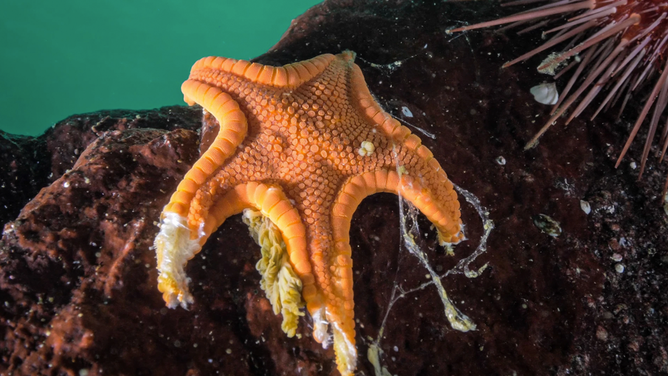
This cookie sea star found near Calvert Island, British Columbia, shows how SSWD “melts” the animal’s flesh.
(Tula Foundation)
The cause of this disease has remained elusive for the past decade, until now.
An international team of researchers from the Hakai Institute, the University of British Columbia (UBC) and the University of Washington pinpointed a strain of bacterium, Vibrio pectenicida, as the culprit behind the death of billions of sea stars.
Vibrio is a genus of bacteria deadly to coral and shellfish. Vibrio cholerae is the pathogen that causes cholera in humans.
It took years of honing in on different pathogens before the team finally found a match.
“When we looked at the coelomic fluid between exposed and healthy sea stars, there was basically one thing different: Vibrio,” said senior study author Alyssa Gehman, a marine disease ecologist with Hakai Institute and UBC. “We all had chills. We thought, That’s it. We have it. That’s what causes wasting.”
RESEARCHERS USE SEAWEED TO CUT CONCRETE’S CARBON FOOTPRINT
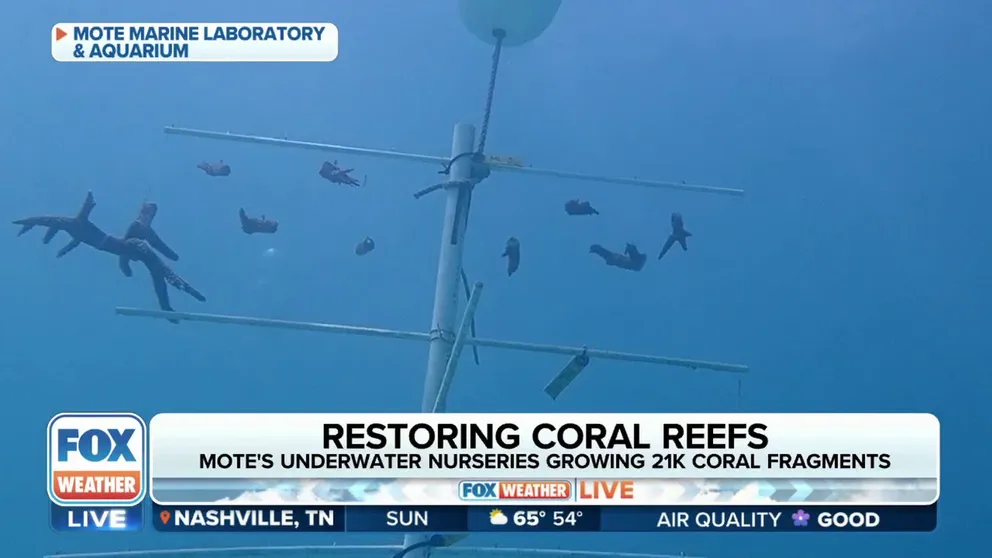
Dr. Jason Spadaro, Program Manager of Mote Coral Reef Restoration and Research Program, joined FOX Weather on Sunday and explained how researchers are not only trying to preserve what’s left of our coral reefs, they’re trying to restore function to those critical ecosystems that support marine life.
Their findings were published this week in the journal Nature Ecology & Evolution, and came after four years of research in partnership with The Nature Conservancy, the Tula Foundation, the U.S. Geological Survey’s Western Fisheries Research Center and the Washington Department of Fish and Wildlife.
Study author Melanie Prentice, an evolutionary ecologist at the Hakai Institute and UBC, said the massive loss of sunflower sea stars has caused widespread changes across coastal ecosystems.
“When we lose billions of sea stars, that really shifts the ecological dynamics,” Prentice said in a statement. “In the absence of sunflower stars, sea urchin populations increase, which means the loss of kelp forests, and that has broad implications for all the other marine species and humans that rely on them. So losing a sea star goes far beyond the loss of that single species.”
The research team said identifying the cause of the wasting disease is the first crucial step toward recovery.
Gehman said scientists can now look at additional factors of the disease, including ocean temperature. Vibrio is known to multiply in warm water.