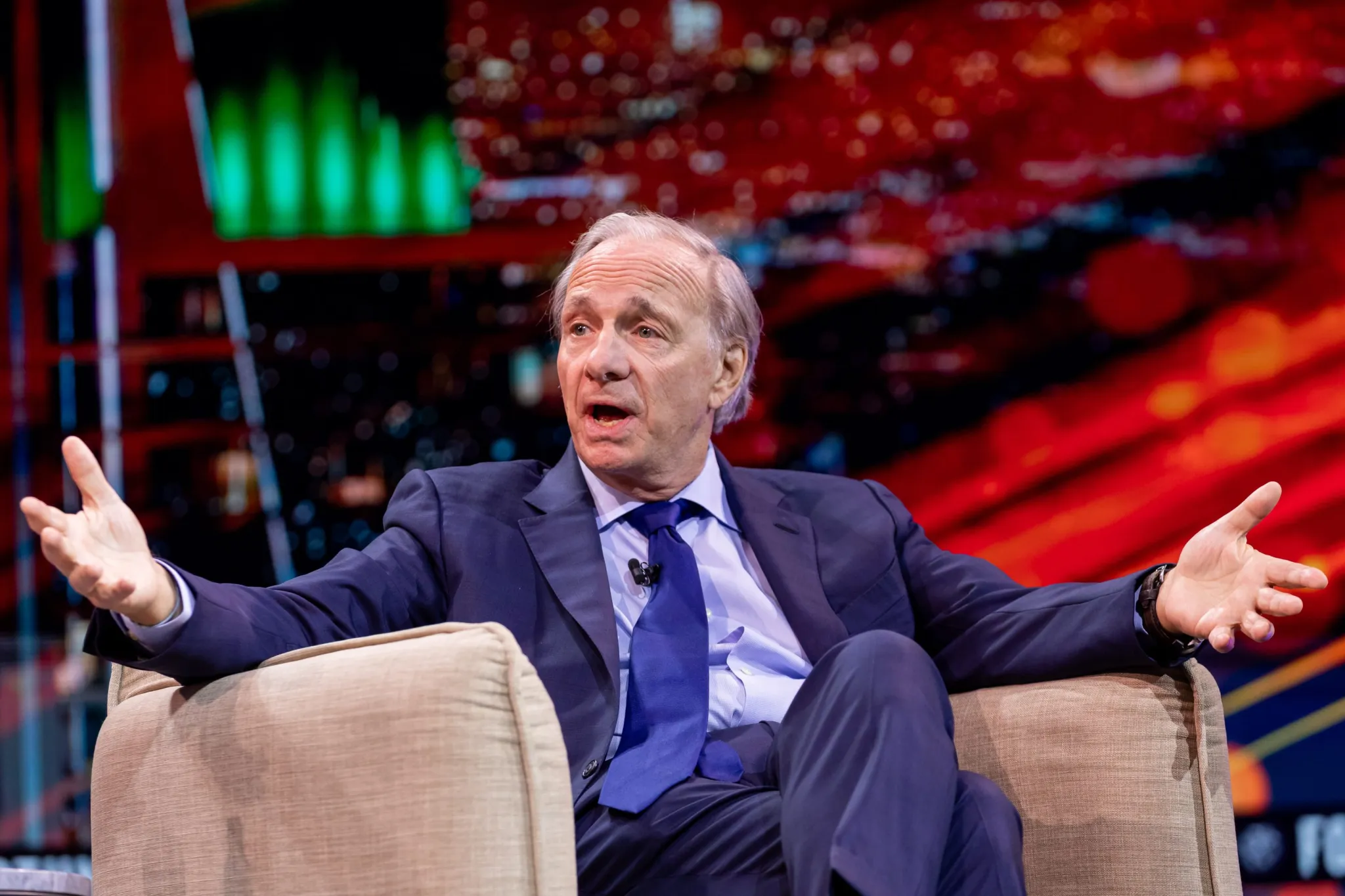
Good morning. How will AI impact Ray Dalio’s prognosis for the economy? The Bridgewater founder published a piece in Fortune this weekend, in which he argues that we are in stage 5 of what he calls the “Big Cycle.” (The global macro investor has studied the six stages of how major empires rise and fall, with stage 5 being the period prior to collapse.)
Dalio writes that “it is indisputably clear that what is happening now is more analogous to pre-1945 times than the post-1945 times that we have gotten used to, which misleads most people’s expectations and causes them to be shocked about what’s happening.”
Among the hallmarks of stage 5:
“Large and rapidly rising government debts and geopolitical conflicts that lead to concerns about the value of and security of money, especially of the reserve currency, which drives a movement out of fiat currencies and into gold.” (Gold prices are up 70% over the past year.)
“Large income, wealth, and values gaps within countries that lead to the rise of populism of the right and populism of the left and irreconcilable differences that can’t be resolved with compromises and rule of law.” (The income gap has increased and, well, look around.)
“The movement from a world order with a dominant power and relative peace to a world order that reflects a great powers conflict.” (Iran could be the final blow to the WTO-based world order.)
Other forces could disrupt or accelerate the Big Cycle: AI is creating a drastic shift of wealth, with the potential to destroy jobs unlike anything we’ve experienced before. Artificial general intelligence could materially change the structure of money and nature of growth while creating faster and more volatile cycles. And one other factor comes to mind, following a fascinating discussion at the Explorers Club on Friday with NYU glaciologist David Holland about the “doomsday” Thwaites glacier in Antarctica: The accelerating pace of climate change, if not addressed, could make that coveted stage 1 seem even further away.
Contact CEO Daily via Diane Brady at [email protected]
Top leadership news
Palantir CEO says Defense Department isn’t using AI for citizen surveillance
Palantir CEO Alex Karp told Fortune that the Defense Department isn’t using—and won’t use, to his knowledge—AI for domestic surveillance. However, Karp expressed support for the use of AI tools in military partnerships abroad and argued that other nations’ militaries will do the same.
Trump’s AI Czar says country should find exit in Iran
Venture capitalist and Trump AI czar David Sacks told the All-In podcast that “we should probably find the off-ramp” in the U.S.-Israel war with Iran. Sacks claimed that Iran’s military has already been devastated, but certain groups within the Republican Party want to see even further military escalation.
Meta is flattening its corporate structure
Meta is doubling its employee-to-manager ratio to 50-1 per the Wall Street Journal, joining a wave of other companies who are looking to make decision-making more efficient and cut costs. André Spicer, executive dean of Bayes Business School in London and a professor of organizational behavior, says the move will “end in tragedy in the bottom line.”
The markets
S&P 500 futures are up 0.4%, following a 0.6% drop before the weekend. Japan’s Nikkei 225 fell 0.1%, South Korea’s KOSPI is up 1.1%, and Hong Kong’s Hang Seng Index is up 1.5%. BYD, CATL and Xiaomi, all Chinese manufacturers working with green products, rose by over 5% in Hong Kong trading. India’s NIFTY 50 is flat; the STOXX Europe 600 is also flat in early trading. WTI Crude passed $100/barrel, Bitcoin is hovering just above $73,000.
Around the watercooler
The $265 billion private credit meltdown: How Wall Street’s hottest investment craze turned into a panic by Shawn Tully
How Nasdaq CEO Adena Friedman found her ideal job: ‘I realized I liked risk-taking more than risk management’ by Sheryl Estrada
After 93 years and a 25-hour filibuster, Washington finally has an income tax, and billionaires are already packing their bags by Catherina Gioino
Americans are demanding refunds from the $180 billion in tariffs they paid for, and they’re suing companies like Costco to make it happen by Sasha Rogelberg
‘Raise a lobster’: How OpenClaw is the latest craze transforming China’s AI sector by Nicholas Gordon
Today’s edition of CEO Daily was compiled and edited by Joey Abrams, Nicholas Gordon and Lee Clifford.